
ERCOT's RTC+B Launch and Its Implications for Energy Buyers and Storage Investors
 Aime Summary
Strategic Energy Contracting in a New Grid Paradigm
According to ERCOT, ERCOT's RTC+B replaces the outdated Operating Reserve Demand Curve (ORDC) with Ancillary Service Demand Curves (ASDCs), enabling more precise pricing of scarcity in ancillary services. This change allows batteries to be modeled as a single device with a defined state of charge (SoC), rather than as separate charging and discharging assets. For energy buyers, this means greater flexibility in managing demand fluctuations, particularly as renewable penetration grows. A case study from Enverus illustrates the benefits: during a "solar cliff" event, RTC+B enabled early re-dispatch of Combustion Turbines to avoid ancillary service shortfalls, preventing price spikes.
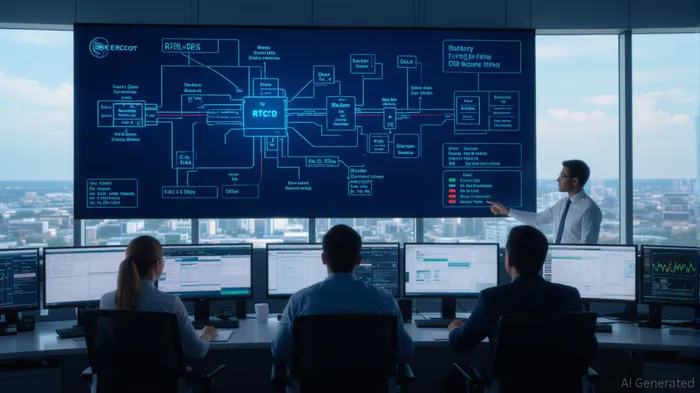 Energy buyers must now adapt to a market where real-time pricing volatility is tempered by smarter scarcity signals. This requires contracts that account for dynamic dispatch and the reduced reliance on traditional arbitrage between day-ahead and real-time markets. For instance, the "Swap the Reg" scenario demonstrated a 2.7% reduction in total system costs by reallocating batteries to provide regulation up services during peak demand. Such outcomes highlight the need for energy buyers to incorporate real-time co-optimization into their procurement strategies, leveraging tools like Ascend's SmartBidder platform to optimize bids based on SoC constraints and ancillary service pricing curves.
Opportunities and Risks for Storage Investors
For storage investors, RTC+B unlocks new revenue streams by allowing batteries to participate in both energy and ancillary services markets simultaneously. However, the integration of batteries into real-time co-optimization also introduces operational complexity. The elimination of the ORDC adder-previously a premium for standby capacity-means revenue is now tied strictly to active service provision. This shift necessitates advanced automation and analytics to manage SoC and avoid penalties for deviations from dispatch set points.
Case studies underscore the dual-edged nature of these changes. In a "Mid-Day Soak and Shift" scenario, batteries stored excess solar energy during low locational marginal price (LMP) hours and discharged during high LMP periods, reducing curtailment and cutting system costs by 5.5%. While such outcomes enhance grid reliability, they also signal a potential compression of traditional arbitrage margins. Storage investors must now balance the flexibility of real-time participation with robust risk management, including hybrid project dynamics and Day-Ahead/Real-Time Spreads analysis.
Projected Economic Benefits and Market Adaptation
ERCOT projects annual wholesale market savings of $2.5–$6.4 billion through RTC+B, driven by optimized resource utilization and reduced operational costs. These savings are critical for energy buyers seeking to hedge against rising demand and renewable intermittency. For storage investors, the long-term outlook remains positive despite near-term challenges. The Independent Market Monitor notes that the program's efficiency gains will stabilize battery pricing and reduce total system costs.
However, success hinges on market participants' ability to adapt. Energy buyers must prioritize contracts that align with real-time co-optimization, while storage investors should invest in automation and analytics to navigate SoC constraints. The transition to RTC+B is not without risks, but its potential to reshape Texas's energy market is undeniable.
Conclusion
ERCOT's RTC+B represents a pivotal step toward a more efficient and resilient grid. For energy buyers and storage investors, the key lies in strategic adaptation: embracing dynamic contracting frameworks, leveraging advanced analytics, and rethinking revenue models. As the market evolves, those who align their strategies with the realities of real-time co-optimization will be best positioned to capitalize on the opportunities-and mitigate the risks-of this new paradigm.

La combinación de la sabiduría tradicional en el comercio con las perspectivas más avanzadas sobre criptomonedas.
Latest Articles
Stay ahead of the market.
Get curated U.S. market news, insights and key dates delivered to your inbox.






Comments
No comments yet