
ERCOT's RTC+B: A Game-Changer for Grid Stability and Renewable Energy Buyers
 Aime Summary
Grid Stability and Market Efficiency: A New Paradigm
ERCOT's RTC+B replaces the legacy ORDC with ASDCs, enabling product-specific pricing for reserves like regulation up and spinning reserves. This shift allows batteries to operate as unified Energy Storage Resources (ESRs) rather than separate charging and discharging units, improving their ability to optimize revenue and support grid stability. By modeling batteries as single devices with state-of-charge (SoC) tracking, the system can dynamically allocate resources to address transmission congestion and reduce manual interventions.
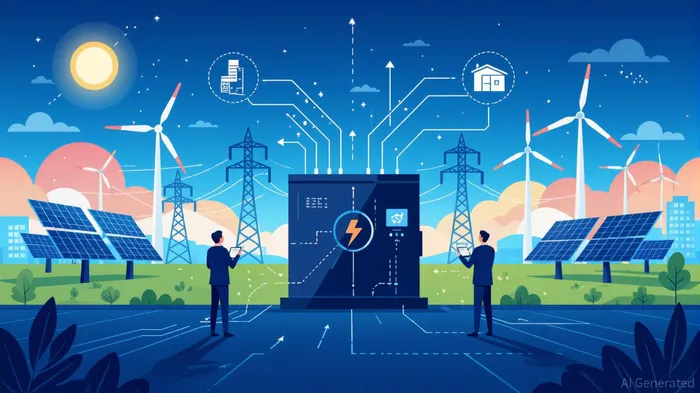 The Independent Market Monitor (IMM) estimates that RTC+B will deliver annual savings of $2.5–$6.4 billion, driven by smarter scarcity pricing and efficient resource utilization. For example, Enverus case studies demonstrate that the framework reduces system costs by 2.7% in "Swap the Reg" scenarios and 5.5% in "Mid-Day Soak and Shift" scenarios, where surplus solar energy is stored to avoid curtailment. These efficiencies are critical as Texas faces a projected 43 GW demand surge by 2030 due to AI growth and electrification.
Investment Opportunities in Energy Storage
The RTC+B program unlocks new revenue streams for energy storage operators. By co-optimizing energy and AS in real time, batteries can now bid for both energy arbitrage and ancillary services simultaneously, maximizing asset utilization. This is particularly valuable for managing the intermittency of renewables: during sudden drops in solar or wind output, batteries can discharge stored energy to prevent price spikes and maintain grid reliability.
However, the market's saturation has driven average battery profitability down from $149 per kilowatt in 2023 to $17 per kilowatt in 2025. To remain competitive, operators must adopt advanced analytics and automation tools to navigate the program's increased complexity. For instance, platforms like Ascend Analytics' SmartBidder enable dynamic bidding strategies aligned with Security-Constrained Economic Dispatch (SCED) runs, optimizing risk-adjusted returns.
Investors should also consider hybrid projects that combine solar/wind with storage. The RTC+B framework allows these assets to leverage day-ahead and real-time market opportunities, enhancing their economic viability. Regulatory tailwinds, including the Inflation Reduction Act's tax credits for storage, further bolster the case for deployment.
Clean Energy Contracting in the RTC+B Era
The program's emphasis on real-time co-optimization reduces the volatility between day-ahead and real-time markets, making long-term clean energy contracts more predictable. Buyers can now secure power purchase agreements (PPAs) with lower risk, as batteries and ASDCs provide buffer capacity during periods of renewable underperformance.
For example, the "Solar Cliff" case study illustrates how RTC+B enables proactive responses to sudden drops in solar output, preventing ancillary service shortfalls and stabilizing prices. This reliability is a boon for corporate buyers and municipalities seeking to meet decarbonization targets without compromising grid resilience.
Moreover, the program's ASDCs create a more transparent pricing mechanism for reserves, incentivizing developers to pair storage with renewable projects to meet both energy and AS needs. This synergy is expected to drive down the levelized cost of storage, with Enverus projecting a 30% reduction in battery LCOE by 2030.
Challenges and Strategic Considerations
While the RTC+B framework offers substantial benefits, it introduces operational and financial complexity. Operators must now manage exposure parameters in real time, requiring sophisticated tools to avoid penalties for deviations from set points. Additionally, proposed legislation like SB 388, which mandates non-battery dispatchable sources for new generation, could reshape investment trends.
Investors should prioritize projects with robust data infrastructure and partnerships with analytics providers. The modular nature of battery systems also allows for scalable deployment, making them ideal for distributed energy resource (DER) aggregators targeting commercial and industrial (C&I) markets.
Conclusion
ERCOT's RTC+B is a watershed moment for the Texas energy market, redefining how grid stability, renewable integration, and storage economics intersect. For investors, the program's emphasis on real-time co-optimization and ancillary service innovation opens doors to high-impact opportunities in energy storage and clean energy contracting. While challenges like market saturation and operational complexity persist, the projected $6.4 billion in annual savings and the growing demand for flexible resources position the ERCOT market as a cornerstone of the U.S. energy transition.

La combinación de la sabiduría tradicional en el comercio con las perspectivas más avanzadas sobre criptomonedas.
Latest Articles
Stay ahead of the market.
Get curated U.S. market news, insights and key dates delivered to your inbox.


AInvest
PRO
AInvest
PRO



Comments
No comments yet