
ERCOT's RTC+B: A Game-Changer for Energy Storage and Grid Reliability
 Aime Summary
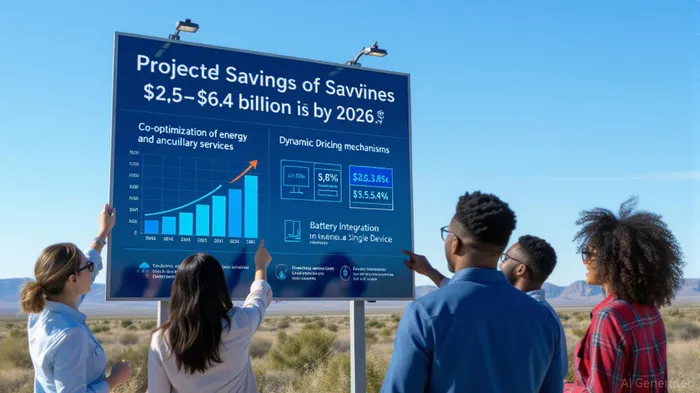
The $2.5–$6.4 Billion Savings: A Structural Shift in Market Efficiency
ERCOT's Independent Market Monitor (IMM) attributes the projected savings to three key innovations under RTC+B:
1. Simultaneous co-optimization of energy and ancillary services, which eliminates inefficiencies from sequential market clearing. According to Resurety, this co-optimization eliminates inefficiencies from sequential market clearing.
2. Dynamic pricing mechanisms that replace static reserve curves with demand-responsive models, reducing overpayment for grid services.
3. Battery integration as a single device, enabling precise dispatch based on state-of-charge and real-time grid needs. According to Resurety, battery integration as a single device enables precise dispatch based on state-of-charge and real-time grid needs.
According to a report by Resurety, these changes are expected to reduce total system costs by 17–21%, with savings materializing as early as 2026. For example, real-world simulations under the new framework demonstrated a 2.7% reduction in system costs during peak demand events by optimizing battery dispatch. These efficiencies are not merely theoretical; they represent a structural shift in how Texas manages its grid, with direct benefits for consumers and market participants alike.
Battery Storage as a Grid-Centric Asset: Real-Time Pricing and Flexibility
 The RTC+B program marks the first time batteries are modeled as flexible resources in ERCOT's market, capable of both injecting and withdrawing electricity in real time. According to Resurety, this shift marks the first time batteries are modeled as flexible resources in ERCOT's market. This shift has two critical implications:
- Enhanced grid reliability: According to Enverus, by co-optimizing energy and ancillary services, batteries can respond to grid imbalances more swiftly, reducing the risk of outages during extreme weather or generation shortfalls.
- Revenue diversification: According to Enverus, prior to RTC+B, 42% of battery revenue in ERCOT came from ancillary services, while 40% came from real-time energy markets. The new framework allows batteries to bid into real-time markets for both energy and ancillary services, potentially increasing their utilization and profitability.
However, this transition also introduces challenges. As noted by Enverus, the integration of batteries may reduce scarcity-driven price premiums in ancillary services, which historically provided high-margin revenue streams. Investors must now prioritize assets that can adapt to real-time signals and leverage hybrid configurations (e.g., solar + storage) to maximize value.
Evolving Revenue Models: From Ancillary Services to Strategic Bidding
The RTC+B framework is reshaping how storage operators generate revenue. Key trends include:
- Shift to real-time energy markets: According to Enverus, with batteries now modeled as flexible resources, operators are expected to derive a larger share of revenue from real-time energy sales, which are more sensitive to grid conditions.
- Ancillary service price compression: According to Enverus, the increased availability of batteries has already driven a 90% decline in ancillary service revenues since 2023, signaling a long-term shift toward lower, more stable compensation.
- Node-specific strategies: According to Enverus, the new market design requires operators to adopt granular, location-based strategies to capitalize on price differentials between day-ahead and real-time markets.
For investors, this means moving beyond traditional fixed-income models for storage. Instead, success will depend on agile asset management, advanced forecasting tools, and the ability to navigate complex market rules-such as the Constraint Competitiveness Test (CCT), which now includes battery withdrawal capabilities in market power assessments.
Investment Strategies for the RTC+B Era
The RTC+B program creates a compelling case for strategic investment in energy storage and grid infrastructure. Key opportunities include:
1. Hybrid projects: According to Enverus, combining renewable generation (e.g., solar, wind) with storage allows operators to leverage both energy and ancillary service markets, mitigating revenue volatility.
2. Node-specific development: According to Enverus, assets located in congested or high-demand areas can capitalize on localized price premiums under the new co-optimized framework.
3. Technology innovation: According to Enverus, developers that integrate advanced battery management systems (BMS) and AI-driven dispatch tools will gain a competitive edge in real-time markets.
Moreover, the projected $2.5–$6.4 billion in annual savings is likely to attract regulatory and private-sector capital to support grid modernization. As Enverus highlights, the RTC+B framework's emphasis on efficiency and reliability aligns with broader trends in decarbonization and decentralized energy systems.
Conclusion: Positioning for a New Market Paradigm
ERCOT's RTC+B program is more than a technical upgrade-it is a paradigm shift that redefines the role of energy storage in the grid. For investors, the path forward lies in embracing flexibility, innovation, and strategic alignment with the new market rules. By capitalizing on the projected savings, adapting to evolving revenue models, and prioritizing hybrid and node-specific assets, investors can position themselves at the forefront of Texas's energy transition.
As the grid evolves, so too must investment strategies. The RTC+B era demands agility, but it also offers unprecedented opportunities for those who understand the interplay between market design, technology, and grid reliability.

Blending traditional trading wisdom with cutting-edge cryptocurrency insights.
Latest Articles
Stay ahead of the market.
Get curated U.S. market news, insights and key dates delivered to your inbox.






Comments
No comments yet