
ERCOT's RTC+B and the Future of Energy Storage Valuation
 Aime Summary
A New Paradigm for Grid Flexibility
The RTC+B framework replaces ERCOT's legacy Operating Reserve Demand Curve (ORDC) with Ancillary Services Demand Curves (ASDCs), enabling granular pricing for reserves and co-optimizing energy and ancillary services in real time. By modeling batteries as unified assets with a state-of-charge (SoC) rather than separate charging and discharging devices, the program unlocks their full operational flexibility. This shift allows batteries to respond dynamically to grid conditions, capturing value from both energy arbitrage and ancillary services markets simultaneously.
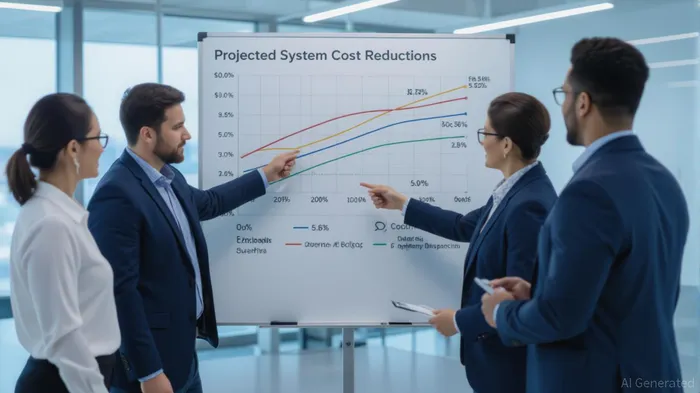
The implications are profound. According to a report by Enverus, the program is projected to reduce total system costs by 2.7% in scenarios where batteries supply regulation services, freeing gas turbines to focus on energy production according to the report. Similarly, the "Solar Cliff" case study demonstrated how RTC+B mitigates price spikes during sudden solar generation drops by reallocating resources in real time, while the "Mid-Day Soak and Shift" scenario showed a 5.5% cost reduction by avoiding solar curtailment through optimized battery dispatch as the study shows. These examples underscore how the framework enhances grid resilience while creating new revenue streams for storage operators.
Strategic Positioning for Battery Storage Investors
For investors, the RTC+B framework introduces a dual imperative: leveraging real-time market signals and navigating evolving scarcity dynamics. The program's revised system-wide offer caps-$2,000/MWh in real time and $5,000/MWh in day-ahead-create a more predictable pricing environment, but they also require operators to refine their bidding strategies. As Jayasuriya of Sendero Consulting notes, the ability to co-optimize energy and ancillary services reduces operational risk for storage projects, making them more attractive to capital according to industry analysis.
Hybrid projects, which combine solar, wind, and storage, stand to benefit disproportionately. By shifting energy from low locational marginal price (LMP) hours to high LMP hours, these assets can reduce total system costs while improving asset utilization. For instance, the "Mid-Day Soak and Shift" case study revealed that surplus solar energy could be stored instead of curtailed, generating additional value from both energy and regulation markets as the study shows. Investors should prioritize projects with geographic proximity to renewable-rich zones, where the interplay between generation variability and storage flexibility is most pronounced.
However, the transition to RTC+B also demands caution. While the program's efficiency gains may lower the premium for ancillary services, the overall system savings-projected at over $1 billion annually-offset this by enhancing long-term profitability according to ERCOT's release. Investors must also contend with the Constraint Competitiveness Test (CCT), a new rule that evaluates market power during re-dispatch events. Projects with multiple battery assets, in particular, will need to navigate these rules carefully to avoid regulatory scrutiny as industry experts note.
Energy Buyers and the Path to Cost Efficiency
For energy buyers, the RTC+B framework offers a dual advantage: lower procurement costs and enhanced grid reliability. The program's ability to replace inefficient supplemental reserve markets with ASDCs ensures that ancillary services are priced according to their true scarcity value. This is particularly critical during periods of high demand or renewable variability, when batteries can step in to stabilize the grid without relying on costly gas-fired peakers according to market analysis.
Moreover, the projected $2.5–$6.4 billion in annual wholesale market savings-driven by smarter scarcity pricing and reduced curtailment-positions Texas as a model for other deregulated markets as the report states. Energy buyers, including industrial consumers and commercial entities, can capitalize on these savings by locking in long-term contracts with storage operators that demonstrate superior dispatch flexibility under the new framework.
Conclusion: A Tipping Point for Storage Valuation
ERCOT's RTC+B is more than a technical upgrade; it is a tectonic shift in how energy storage is valued and deployed. By treating batteries as unified assets and co-optimizing markets in real time, the program has created a fertile ground for innovation and investment. For storage operators, the challenge lies in mastering the nuances of ASDCs and real-time bidding. For energy buyers, the opportunity is to harness this flexibility to reduce costs and decarbonize their portfolios.
As the Texas grid moves into 2026, the RTC+B framework will serve as a litmus test for the future of energy markets. Those who position themselves to exploit its full potential-whether through hybrid projects, strategic bidding, or long-term partnerships-will find themselves at the forefront of a new era in grid management.

Blending traditional trading wisdom with cutting-edge cryptocurrency insights.
Latest Articles
Stay ahead of the market.
Get curated U.S. market news, insights and key dates delivered to your inbox.






Comments
No comments yet