
ERCOT's RTC+B and the Future of Energy Storage in Texas
 Aime Summary
The launch of ERCOT's Real-Time Co-Optimization Plus Batteries (RTC+B) on December 5, 2025, marks a seismic shift in Texas's energy landscape. This market redesign, which integrates battery storage into real-time co-optimization of energy and ancillary services, is not merely a technical upgrade-it is a catalyst for redefining the economics of energy storage and unlocking new financial instruments for investors. By modeling batteries as unified assets with state-of-charge dynamics, ERCOT has created a framework that enhances grid flexibility, reduces volatility, and opens pathways for innovative revenue streams. For investors, the implications are profound: the RTC+B era is reshaping how battery storage assets are valued, operated, and monetized.
Enhancing Asset Value Through Co-Optimization
At the core of RTC+B is the co-optimization of energy and ancillary services (AS) in real time. This replaces the outdated Operating Reserve Demand Curve (ORDC) with Ancillary Service Demand Curves, which assign granular prices to specific AS based on scarcity. For battery operators, this means their assets are no longer constrained by rigid day-ahead commitments but can dynamically adjust to real-time conditions. A battery that previously had portions of its capacity locked into day-ahead AS obligations can now offer its full capacity in real-time dispatch, maximizing utilization.
The economic benefits are staggering. According to a report by Resurety, the RTC+B framework is projected to deliver annual wholesale market savings of $2.5–6.4 billion by 2025. These savings stem from reduced curtailment of renewable energy, improved asset utilization, and smarter scarcity pricing. For example, in a simulated case study, the co-optimization of battery storage during peak demand reduced total system costs by 2.7% by reallocating regulation up capacity. Such efficiency gains directly enhance the profitability of battery storage projects, particularly those with longer durations (four hours or more) that can capitalize on both energy arbitrage and AS markets.
Reshaping Revenue Streams: From Ancillary Services to Energy Arbitrage
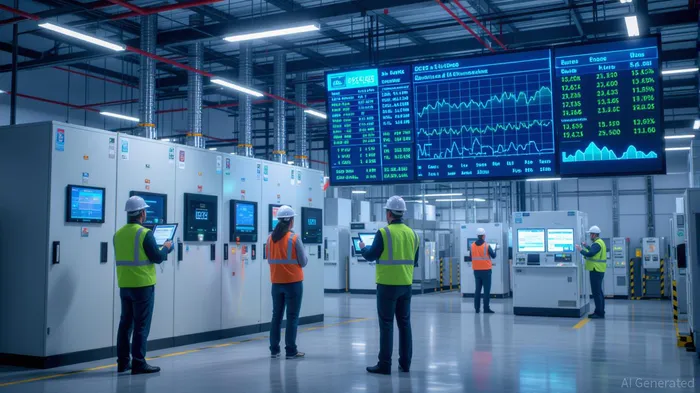 The transition to RTC+B has also recalibrated revenue streams for energy storage. Historically, ancillary services (AS) were a primary income source for battery operators in ERCOT. However, data from Tyba.ai reveals that AS revenues in H1 2025 dropped to $17/kWh, a 90% decline from 2023 levels. This shift has forced operators to pivot toward energy arbitrage and real-time market strategies. Top-performing assets in H1 2025 captured 112% of their Day-Ahead (DA) TB2 revenue through real-time energy trading, compared to a median of 56%.
The decline in AS revenues is partly due to the new ASDC framework, which prices AS more accurately but reduces the premium previously available under ORDC. However, this volatility reduction is a double-edged sword. While it lowers the risk of sudden revenue drops, it also necessitates advanced analytics and automation to navigate the granular bidding environment. Operators must now submit up to ten bid pairs per interval for energy and five for AS, a complexity that demands real-time optimization tools.
New Opportunities: Clean Energy Derivatives and Financial Instruments
The RTC+B framework has also spurred the emergence of novel financial instruments tied to energy storage. One such innovation is the integration of battery storage into energy arbitrage contracts, where operators lock in spreads between day-ahead and real-time prices. With the co-optimization of energy and AS, these spreads have widened in certain hubs, creating a stronger economic rationale for BESS projects. For instance, Pexapark's Q3 2025 Market Update noted a 19% year-over-year increase in energy arbitrage values in three of four ERCOT hubs, driven by high solar penetration and growing load demand.
Another emerging derivative is the use of battery storage in structured offtake agreements. Modo Energy's research highlights that projects with favorable locations and four-hour durations can meet investor return thresholds even in a low-AS-revenue environment. These agreements often combine energy arbitrage with AS participation, layering multiple revenue streams to hedge against market fluctuations. For example, a battery operator might sell AS capacity during peak hours while simultaneously arbitraging energy during off-peak periods, creating a diversified income profile.
Case Studies: Lessons from 2025 Deployments
The Q3 2025 surge in battery deployments-2 GW of new capacity-underscores the market's confidence in the RTC+B framework. One notable case study involves a 200-MW/800-MWh battery in West Texas that leveraged co-optimization to reduce curtailment of nearby solar farms by 15%. By storing excess solar during midday and discharging during peak hours, the asset generated $1.2 million in monthly revenue from energy arbitrage alone.
Another example is a 150-MW/600-MWh battery in South Texas that combined AS participation with real-time energy trading. Despite the decline in AS revenues, the asset's ability to pivot between markets allowed it to capture 119% of its DA TB2 revenue in H1 2025. These cases illustrate how strategic participation in the RTC+B framework can transform battery storage from a marginal asset into a core component of grid resilience and profitability.
The Road Ahead: Strategic Recommendations for Investors
For investors, the RTC+B era demands a shift in mindset. First, prioritize projects with advanced analytics capabilities. The complexity of real-time bidding and state-of-charge management requires tools that can process granular data and optimize dispatch in milliseconds. Second, focus on longer-duration batteries (four hours or more), which are better suited to exploit widened energy arbitrage spreads and AS opportunities. Third, explore structured offtake agreements that layer multiple revenue streams, reducing exposure to market volatility.
The transition to RTC+B is not without risks. The initial phase of the market is expected to bring higher volatility and thinner liquidity as participants adjust to the new rules. However, the long-term outlook is favorable. With projected annual savings of $2.5–6.4 billion and a growing emphasis on renewable integration, battery storage is poised to become a cornerstone of Texas's energy future. For investors willing to navigate the complexity, the rewards are substantial.

Blending traditional trading wisdom with cutting-edge cryptocurrency insights.
Latest Articles
Stay ahead of the market.
Get curated U.S. market news, insights and key dates delivered to your inbox.






Comments
No comments yet