
ERCOT's RTC+B and the Future of Energy Storage Investing
 Aime Summary
The Valuation Revolution: From Ancillary Services to Holistic Flexibility
ERCOT's RTC+B replaces the traditional Operating Reserve Demand Curve (ORDC) with Ancillary Service Demand Curves (ASDCs), directly reflecting the scarcity value of specific services like frequency regulation and voltage support. This change allows batteries to bid into real-time markets for ancillary services while managing their state of charge, a capability that enhances their operational flexibility and visibility. For investors, this means storage assets are no longer confined to narrow revenue streams but can now leverage their dual role as both energy arbitrageurs and grid stabilizers.
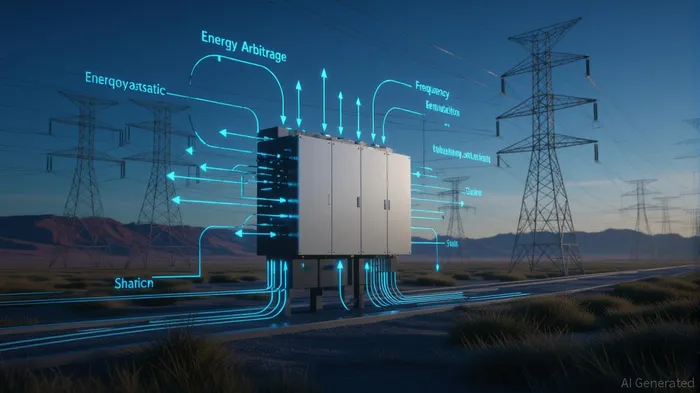 However, this flexibility comes with a caveat. According to Enverus, while the program is projected to save over $1 billion annually in wholesale market costs, these savings could compress margins for battery operators reliant on high-margin ancillary service contracts. According to Resurety, investors must therefore balance the promise of diversified revenue with the risk of margin erosion in a more competitive environment.
Risk Management in a Co-Optimized World
The RTC+B design introduces new layers of complexity for risk assessment. By modeling batteries as single devices with a state of charge, the market now demands more granular data submissions, including real-time tracking of energy inflows and outflows. This transparency, while beneficial for grid reliability, requires operators to adopt advanced analytics and hedging strategies to mitigate exposure to price volatility and operational constraints.
For example, during peak demand periods-such as summer heatwaves-batteries may face pressure to prioritize ancillary services over energy arbitrage, reducing their ability to capture arbitrage profits. As noted by Ascend Analytics, operators are advised to hedge against such scenarios by locking in risk premiums through forward contracts or dynamic pricing mechanisms. Additionally, the shift from scarcity-based pricing to demand curve-driven pricing means that revenue predictability will depend on the alignment of battery dispatch with real-time grid needs, a factor that requires sophisticated modeling and scenario planning.
Revenue Diversification: Beyond Ancillary Services
The integration of batteries into real-time co-optimization also reshapes revenue models. By enabling simultaneous participation in energy and ancillary services markets, RTC+B allows operators to submit a combined Energy Bid-Offer Curve (EBOC), effectively turning batteries into multi-use assets. This capability is particularly valuable in a market where renewable energy penetration is rising, as batteries can arbitrage low-cost solar and wind generation while providing critical grid support during periods of congestion or stress.
Yet, the long-term sustainability of these revenue streams hinges on market saturation. According to a recent analysis by Resurety, this trend could lead to a bifurcation in the storage market: high-margin, grid-critical services for a subset of operators and lower-margin, commodity-like arbitrage for the rest. Investors must therefore prioritize assets with unique capabilities-such as fast-response frequency regulation or hybrid systems paired with renewables-to differentiate their portfolios.
Strategic Recommendations for Investors
To thrive in the RTC+B era, investors should adopt the following strategies:
1. Diversify Revenue Streams: Prioritize assets that can access multiple markets (energy, ancillary services, and capacity) while leveraging hybrid configurations (e.g., solar + storage) to enhance flexibility.
2. Invest in Data Infrastructure: Given the increased complexity of market submissions, operators must deploy advanced analytics tools to optimize state-of-charge management and bid strategies.
3. Hedge Against Volatility: Use forward contracts, options, and dynamic pricing mechanisms to stabilize revenue during periods of high demand or grid stress.
4. Monitor Market Saturation: Track the growth of ancillary service providers to anticipate margin compression and adjust asset acquisition or divestment strategies accordingly.
Conclusion
ERCOT's RTC+B is more than a technical upgrade-it is a catalyst for redefining the economics of energy storage. By enabling batteries to operate as unified, multi-functional assets, the program enhances grid efficiency and reliability while creating new opportunities for investors. However, success in this evolving landscape requires a nuanced understanding of valuation dynamics, risk management, and revenue diversification. For those who adapt swiftly, the RTC+B era offers a chance to position storage assets as cornerstones of the modern grid.

Blending traditional trading wisdom with cutting-edge cryptocurrency insights.
Latest Articles
Stay ahead of the market.
Get curated U.S. market news, insights and key dates delivered to your inbox.






Comments
No comments yet