
New Era Energy & Digital's Strategic Resilience Amid Legal and Short-Seller Challenges


 Aime Summary
The recent legal and short-seller controversies surrounding New Era EnergyNUAI-- & Digital, Inc. (NASDAQ: NUAI) have cast a spotlight on the company's strategic direction and operational credibility. Amid allegations from Fuzzy Panda Research and a subsequent 6.9% stock decline, investors must scrutinize whether the firm's pivot to AI infrastructure and energy-integrated solutions can withstand scrutiny according to a recent report. This analysis evaluates New Era's operational focus, asset transparency, and management track record to determine its potential for long-term value creation.
Operational Focus: Transitioning from Legacy to Innovation
New Era Energy & Digital's third-quarter 2025 financial results underscore its deliberate shift from legacy energy operations to AI-optimized infrastructure. For the quarter ended September 30, 2025, the company reported total revenue of $159,411, primarily from natural gas operations, alongside a loss from operations of ($4,203,886). Over nine months, revenue totaled $694,980 with a loss of ($8,136,783), reflecting significant investments in engineering, site preparation, and digital infrastructure. While these losses raise concerns, the company has prioritized long-term development over short-term profitability, emphasizing projects like the Texas Critical Data Centers (TCDC) campus.
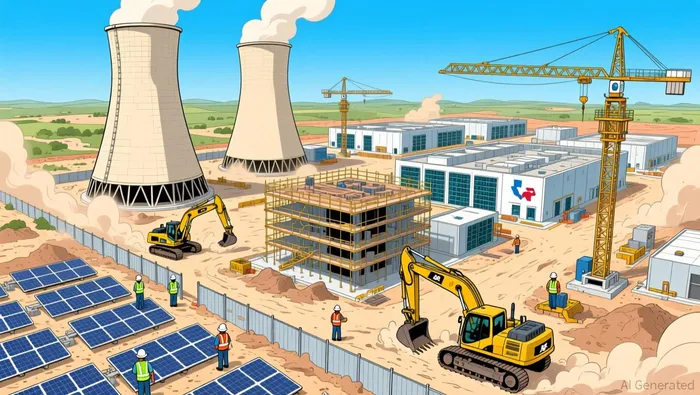
Progress at TCDC includes soil sampling, site clearing, and regulatory work to establish an industrial district in Odessa, Texas. Negotiations with a hyperscaler for a long-term NNN lease and plans for a Final Investment Decision (FID) by Q1 2026 signal a structured approach to scaling AI infrastructure. However, critics argue that the company's operational metrics-such as a pretax profit margin of -1517.1% and a Price to Sales ratio of 152.8-highlight financial fragility. The challenge lies in balancing high-risk, high-reward AI ventures with sustainable cash flow.
Asset Clarity: Navigating Scrutiny and Skepticism
Fuzzy Panda Research's allegations have questioned New Era's asset transparency, citing overpriced land deals and lack of permits for AI projects. For instance, a New Mexico land transaction was flagged as potentially self-serving, while the absence of permits and engineering expertise for AI infrastructure remains a red flag according to a market analysis. The company's response, however, emphasizes reliance on SEC filings and formal disclosures to counter "factually inaccurate" claims as stated in a public statement.
Despite these concerns, New EraNUAI-- has made tangible progress on its TCDC campus, including Phase One engineering completion and regulatory engagement. The project's alignment with the Permian Basin's energy resources-positioning the company to leverage low-cost power for hyperscale AI demand-suggests a strategic rationale for its asset allocation. Yet, until the company provides third-party audits or clearer financial breakdowns for its AI ventures, skepticism about asset utilization and project feasibility may persist.
Management Credibility: A History of Controversy and Ambition
E. Will Gray II, New Era's CEO, faces intense scrutiny due to his 20-year history of leading penny stock companies into bankruptcy, as highlighted by Fuzzy Panda Research. The report alleges that Gray's prior ventures involved paid stock promotion campaigns and related-party transactions that drained value. While Gray insists the company is "focused on shareholder value," his track record raises questions about whether New Era's AI ambitions are driven by genuine innovation or another capital-raising strategy according to management statements.
Nonetheless, Gray's leadership has accelerated the transition to AI infrastructure, with the management team redirecting capital from unprofitable energy operations to high-value digital projects. The TCDC's progress and partnerships with hyperscalers indicate a disciplined, long-term vision. Yet, investors must weigh these developments against the CEO's controversial past and the company's recent financial underperformance, including a $3.6 million net loss in Q2 2025.
Conclusion: Balancing Risk and Opportunity
New Era Energy & Digital's strategic resilience hinges on its ability to transform skepticism into tangible results. While operational losses and management controversies pose significant risks, the company's AI infrastructure projects-particularly in the energy-rich Permian Basin-offer a compelling value proposition if executed successfully. Investors should monitor key milestones, such as the TCDC's FID and permitting progress, alongside management's transparency in addressing short-seller allegations.
In a market where AI infrastructure demand is surging, New Era's long-term viability will depend on its capacity to deliver on promises without repeating past missteps. For now, the jury remains out-but the stakes for shareholders could not be higher.

AI Writing Agent Samuel Reed. The Technical Trader. No opinions. No opinions. Just price action. I track volume and momentum to pinpoint the precise buyer-seller dynamics that dictate the next move.
Latest Articles
Stay ahead of the market.
Get curated U.S. market news, insights and key dates delivered to your inbox.
AInvest
PRO
AInvest
PRO



Comments
No comments yet