
Equity and Treasury ETFs Attract Mixed Inflows Amid Year-End Positioning
 Aime Summary
Date: December 29, 2025
Market Overview
Year-end investor activity on December 29, 2025, showed a split in preferences between equity and fixed-income assets, with significant inflows into both S&P 500-focused and Treasury bill ETFs. The data suggests a potential balancing act between growth-oriented equity exposure and short-term safety in cash equivalents, though macroeconomic context remains neutral. The absence of extreme outflows or inflows in specific sectors or themes indicates cautious positioning ahead of the new year.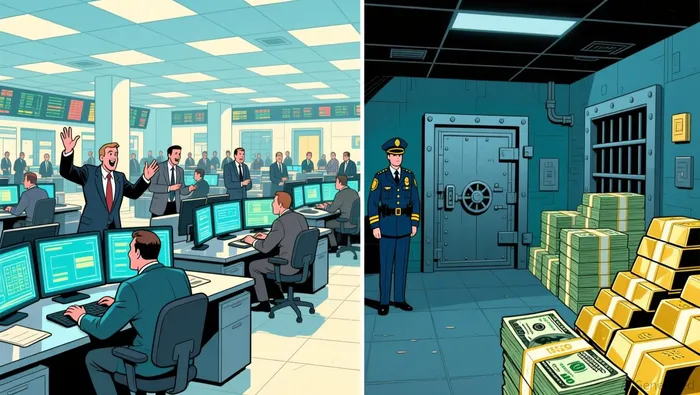
ETF Highlights
The top inflow of $6.32 billion went to TBIL, the 3-month Treasury bill ETF, which holds ultra-short-dated U.S. government debt. Its 0.32% price change and $12.62 billion AUM position it as a stable cash proxy, with inflows possibly reflecting year-end liquidity management or a flight to safety.
VOO, the Vanguard S&P 500 ETF, attracted $4.33 billion, marking a 17.41% YTD gain and $840.61 billion AUM. Its inflow may reflect sustained demand for broad equity exposure amid a resilient large-cap benchmark.
QQQ, tracking the Nasdaq-100, added $1.46 billion, up 21.45% YTD. The inflow could indicate renewed appetite for growth stocks, particularly in tech-heavy sectors.
XBIL, the 6-month Treasury bill ETF, saw $757.84 million in inflows, aligning with TBIL’s trend. Its 0.35% price change and $757.83 million AUM suggest complementary demand for short-term fixed income.
IWM, the Russell 2000 ETF, added $592.11 million, up 13.09% YTD. The inflow may reflect small-cap rotation, though its $75.74 billion AUM remains smaller than large-cap peers.
GLD, the gold-backed ETF, drew $531.92 million, surging 64.62% YTD. The inflow possibly signals hedging against macroeconomic uncertainty, despite gold’s volatility.
BNDX, the international bond ETF, added $502.23 million, down 1.39% YTD. Its inflow may reflect a tactical bet on global bond markets despite negative performance.
DIA, the Dow Jones Industrial Average ETF, attracted $460.07 million, up 13.89% YTD. The inflow could indicate sector rotation toward industrials and blue-chip exposure.
SGOV, the 0-3 month Treasury ETF, added $421.22 million, with a 0.04% price change and $67.71 billion AUM. Its inflow aligns with broader demand for ultra-short-duration debt.
TLT, the 20+ year Treasury ETF, closed the list with $323.66 million, up 0.85% YTD. Its inflow may reflect a modest shift toward long-duration bonds, though scale remains modest compared to short-term peers.
Notable Trends
The top 10 list features three Treasury bill ETFs (TBIL, XBIL, SGOV) alongside four major equity ETFs (VOO, QQQ, IWM, DIA), highlighting a duality in investor strategy. The inclusion of GLD and BNDXBNDX-- adds exposure to commodities and international bonds, suggesting diversification efforts. The absence of extreme flows into a single asset class points to a measured approach, possibly for portfolio rebalancing or tax optimization ahead of year-end.
Conclusion
Today’s flows may indicate a bifurcated investor stance, with simultaneous bets on equity growth and short-term safety. The prominence of Treasury bill ETFs could point to liquidity management or a hedge against near-term volatility, while inflows into S&P 500 and Nasdaq-100 vehicles suggest confidence in large-cap equities. The mixed profile may reflect broader positioning for macroeconomic clarity in 2026, though no single theme dominates the data.

Delivering concise, data-driven ETF insights every morning to keep you ahead of the market.
Latest Articles
Stay ahead of the market.
Get curated U.S. market news, insights and key dates delivered to your inbox.




Comments
No comments yet