
U.S. Equities at a Crossroads: S&P 500's All-Time High Amid Mixed Market Signals
 Aime Summary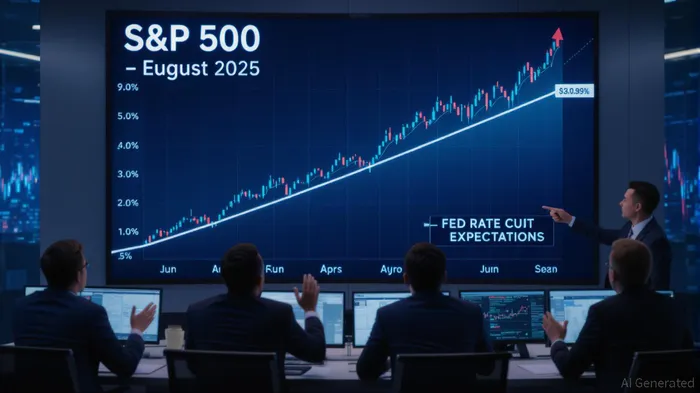
The U.S. stock market has reached a pivotal moment. The S&P 500's recent all-time high—capping a 30% rebound from its April 8, 2025, low—has been hailed as a triumph of resilience and innovation. Yet beneath the surface, the rally is underpinned by a fragile mix of optimism and uncertainty. Investors are grappling with conflicting signals: record highs in tech-driven indices, flat futures markets, and a Federal Reserve poised to act but constrained by inflationary risks. The question now is whether this momentum can endure—or if the market is teetering on the edge of a correction.
The Drivers of the Rally: AI, Deregulation, and Rate Cut Hopes
The S&P 500's surge to 6,468.54 in early August 2025 has been fueled by three primary forces. First, the artificial intelligence boom has transformed the tech sector into a growth engine. Companies like NvidiaNVDA--, which has seen its stock price surge on robust demand for AI chips, and AmazonAMZN--, leveraging AI to streamline logistics and customer engagement, have become poster children for the new economy.
Second, a Republican-led push for deregulation in the AI sector has reduced compliance costs and accelerated innovation. This policy shift has disproportionately benefited Big Tech, which now accounts for over 40% of the S&P 500's total market capitalization.
Third, the market's fixation on a potential Federal Reserve rate cut in September has created a tailwind for equities. Despite a hotter-than-expected July Producer Price Index (PPI) report—showing a 0.9% monthly increase—investors remain convinced that the Fed will prioritize growth over inflation. Fed funds futures currently price in a 93% probability of a 25-basis-point cut, though the odds of a 50-basis-point cut have evaporated.
Mixed Signals: Flat Futures, Volatility, and Sectoral Divergence
While the S&P 500 and Nasdaq Composite have reached record highs, the broader market tells a different story. U.S. futures markets have remained stubbornly flat, with S&P 500 futures trading near breakeven in the days leading up to August 8. This suggests that institutional investors are adopting a wait-and-see approach, hedging against potential volatility from geopolitical risks (e.g., renewed tariffs) and macroeconomic surprises.
Sectoral divergence further complicates the picture. The S&P 500 Technology Select Sector Index has surged 25% year-to-date, while the Energy Select Sector Index has lagged, down nearly 1% for the year. This imbalance reflects a market that is increasingly dependent on a narrow set of high-growth stocks.
Meanwhile, gold's record high of $3,534.10 and the 10-year Treasury yield's climb to 4.29% signal a tug-of-war between risk-on and risk-off sentiment. Gold's rise, driven by fears of U.S. tariffs on gold bullion imports, underscores lingering doubts about the durability of the equity rally.
Assessing Sustainability: Can the Bull Market Continue?
The S&P 500's ability to sustain its rally hinges on three critical factors:
Federal Reserve Policy: A September rate cut would provide a short-term boost to equities by lowering borrowing costs and reducing pressure on corporate balance sheets. However, if inflation reaccelerates—particularly in services or energy—the Fed may be forced to delay further cuts, triggering a sell-off.
Trade Policy Clarity: The Trump administration's 100% tariffs on semiconductor imports and gold bullion have introduced uncertainty. While these measures aim to protect domestic industries, they risk spooking global markets. A resolution—whether through renegotiation or a temporary pause—would stabilize sentiment.
Sectoral Diversification: The current rally is heavily concentrated in tech and AI. For the bull market to endure, other sectors—such as industrials, healthcare, and small-cap stocks—must participate. The Russell 2000's recent resilience is a positive sign, but broader participation is needed.
Investment Implications: Positioning for a Balanced Approach
For investors, the key is to balance exposure to high-growth sectors with defensive positions. Here's how to navigate the crossroads:
- Tech and AI Exposure: Maintain overweight positions in AI-driven stocks like Nvidia and MicrosoftMSFT--, but monitor valuations. The sector's multiples are stretched, and a slowdown in AI adoption could trigger a correction.
- Hedging with Gold and Treasuries: Allocate a portion of portfolios to gold and long-duration Treasuries to offset equity risk. The 10-year yield's recent rise suggests that Treasuries may underperform, but they remain a hedge against a Fed pivot.
- Sector Rotation: Rebalance into underperforming sectors like energy and industrials if macroeconomic data improves. Wells Fargo's downgrade of the energy sector to “neutral” highlights the need for caution, but a rebound in oil prices could present buying opportunities.
- Small-Cap Opportunities: The Russell 2000's 2.4% weekly gain indicates that small-cap stocks are regaining traction. These companies often benefit from a Fed easing cycle and could outperform in a low-inflation environment.
Conclusion: A Market at a Crossroads
The S&P 500's all-time high is a testament to the market's ability to adapt and innovate. However, the rally's sustainability depends on resolving the tension between optimism and uncertainty. Investors must remain vigilant, balancing bets on AI and rate cuts with hedges against inflationary surprises and trade policy risks. As the Fed's September decision looms and global tensions simmer, the crossroads of 2025 will test the mettle of even the most seasoned investors.

Delivering real-time insights and analysis on emerging financial trends and market movements.
Latest Articles
Stay ahead of the market.
Get curated U.S. market news, insights and key dates delivered to your inbox.
AInvest
PRO
AInvest
PRO



Comments
No comments yet