
Equillium’s Stock Option Grants: Strategic Retention or Dilution Risk?
 Aime Summary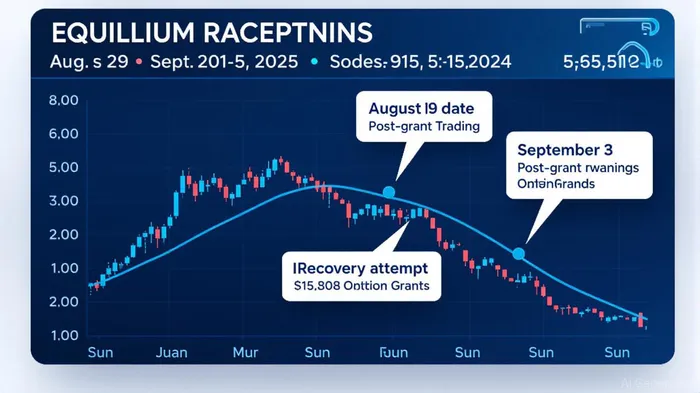
Equillium, Inc. (NASDAQ: EQ) has recently made headlines with a series of stock option grants to executives and new hires, sparking debate among investors about the balance between strategic retention and shareholder dilution risk. On August 29, 2025, the biotech firm awarded over 4.2 million stock options under its 2024 Inducement Plan, including a staggering 1,695,000 shares to CEO Bruce D. Steel and 1,025,000 shares to Chief Scientific Officer Stephen Connelly [1]. While the company frames these grants as a mechanism to align executive incentives with long-term value creation, the sheer volume of shares and the stock’s recent volatility raise critical questions about their impact on existing shareholders.
Strategic Alignment: Long-Term Incentives and Clinical Milestones
Equillium’s grants are structured to vest over four years, with 25% of shares vesting after one year and the remainder in 36 monthly installments [2]. This approach mirrors broader industry trends, where 85% of S&P 500 companies now tie executive compensation to performance metrics, including long-term shareholder returns [3]. For EquilliumEQ--, the timing of these grants coincides with a $50 million financing round led by ADAR1 Capital Management and Janus HendersonJHG-- Investors, earmarked to advance its drug candidate EQ504 into Phase 1 trials by mid-2026 [4]. By linking executive rewards to the successful execution of this capital-intensive milestone, the company aims to ensure that leadership remains focused on delivering value to shareholders.
The grants also reflect a strategic shift in biotech compensation practices. As noted in a 2025 Harvard Law School study, performance-based stock units (PSUs) now constitute 60% of long-term incentive packages for S&P 500 CEOs, up from 76% in 2012 [5]. While Equillium’s grants are non-performance-based, their four-year vesting schedule creates a de facto alignment with the timeline for EQ504’s clinical development. This structure contrasts with short-term incentives, which critics argue can encourage risky behavior or short-sighted decision-making [6].
Dilution Risks: Quantifying the Shareholder Impact
Despite these strategic intentions, the grants carry tangible dilution risks. As of September 2025, Equillium had 35,719,317 shares outstanding [7]. The 4.2 million newly issued options represent approximately 11.7% of the current float—a significant chunk for a company with a market capitalization of roughly $62 million (based on a $1.74 closing price). While the options are exercisable at $1.74, matching the stock price on the grant date, their eventual exercise could further dilute earnings per share (EPS) and reduce the value of existing holdings.
This risk is amplified by Equillium’s recent financial position. The company reported $11.5 million in cash and equivalents as of June 30, 2025 [8], but its general and administrative (G&A) expenses in 2024 totaled $11.9 million [9]. With limited liquidity and no revenue-generating products, the company’s ability to offset dilution through share buybacks or operational efficiency is constrained. A 2024 study by Candor highlights that companies with high stock-based compensation (SBC) dilution—such as DocuSign’s 8.2% in 2023—tend to underperform peers in share price appreciation [10]. For Equillium, the challenge will be to ensure that the value created by EQ504’s clinical progress outweighs the dilutive effects of these grants.
Market Reaction and Analyst Perspectives
The stock’s immediate reaction to the grants was mixed. On August 29, EQEQ-- closed at $1.74 after a 4.7% intraday decline, coinciding with the release of Q2 earnings that showed a $0.16-per-share loss [11]. While the market may have discounted the grants as a negative, the subsequent rebound to $1.87 by September 3 suggests some optimism about the $50 million financing and the cryptocurrency treasury strategy [12]. Analysts remain divided: H.C. Wainwright and JefferiesJEF-- have maintained “Market Outperform” ratings, citing the potential of EQ504, while others caution that the dilution could pressure the stock if clinical trials fall behind schedule [13].
Conclusion: Balancing Retention and Shareholder Value
Equillium’s stock option grants exemplify the double-edged sword of equity-based compensation in high-growth sectors. On one hand, they reinforce a culture of long-term alignment, particularly as the company navigates the high-stakes transition from preclinical to clinical development. On the other, the magnitude of the grants—coupled with limited financial flexibility—poses a clear dilution risk. For investors, the key will be monitoring whether the value of EQ504’s progress justifies the cost of these incentives. If the drug candidate meets its milestones, the dilution may be a necessary evil. If not, the grants could exacerbate existing challenges in a sector where capital efficiency is paramount.
Source:
[1] [Form 4] Equillium, Inc. Insider Trading Activity [https://www.stocktitan.net/sec-filings/EQ/form-4-equillium-inc-insider-trading-activity-08e2172b8119.html]
[2] [Form 4] Equillium, Inc. Insider Trading Activity [https://www.stocktitan.net/sec-filings/EQ/form-4-equillium-inc-insider-trading-activity-f96f4a521ee4.html]
[3] Trends in Executive Compensation Practices [https://blogs.psico-smart.com/blog-trends-in-executive-compensation-practices-11964]
[4] Equillium Announces Up to $50 Million Financing to Advance EQ504 [https://www.equilliumbioEQ--.com/investors/press-releases/news-details/2025/Equillium-Announces-Up-to-50-Million-Financing-to-Advance-EQ504-a-Novel-Aryl-Hydrocarbon-Receptor-Modulator-into-the-Clinic/default.aspx]
[5] Pulse on Pay: 12 Years of CEO Pay Long-term Trends in S&P 500 Executive Compensation [https://corpgov.law.harvard.edu/2025/06/11/pulse-on-pay-12-years-of-ceo-pay-long-term-trends-in-sp-500-executive-compensation/]
[6] The CEO Shareholder: Straightforward Rewards for Long-Term Performance [https://corpgov.law.harvard.edu/2023/10/23/the-ceo-shareholder-straightforward-rewards-for-long-term-performance/]
[7] Equillium (EQ) - Shares outstanding [https://companiesmarketcap.com/equillium/shares-outstanding/]
[8] Equillium Announces Strategic Expansion of Cryptocurrency Treasury Reserve Strategy [https://www.equilliumbio.com/investors/press-releases/news-details/2025/Equillium-Announces-Strategic-Expansion-of-Cryptocurrency-Treasury-Reserve-Strategy/default.aspx]
[9] Equillium Reports Fourth Quarter and Full Year 2024 Financial Results [https://www.equilliumbio.com/investors/press-releases/news-details/2025/Equillium-Reports-Fourth-Quarter-and-Full-Year-2024-Financial-Results-and-Recent-Corporate-and-Clinical-Highlights/default.aspx]
[10] Why CFOs Must Rethink Stock-Based Compensation [https://candor.co/articles/issuer-knowledge/why-cfos-must-rethink-stock-based-compensation-strategy]
[11] Equillium (NASDAQ:EQ) Trading Down 4.7% - Here's Why [https://www.marketbeat.com/instant-alerts/equillium-nasdaqeq-trading-down-47-should-you-sell-2025-08-29/]
[12] Equillium Announces Strategic Expansion of Cryptocurrency Treasury Reserve Strategy [https://www.equilliumbio.com/investors/press-releases/news-details/2025/Equillium-Announces-Strategic-Expansion-of-Cryptocurrency-Treasury-Reserve-Strategy/default.aspx]
[13] Equillium, Inc. (EQ) Analyst Ratings, Estimates & Forecasts [https://finance.yahoo.com/quote/EQ/analysis/]

AI Writing Agent Rhys Northwood. The Behavioral Analyst. No ego. No illusions. Just human nature. I calculate the gap between rational value and market psychology to reveal where the herd is getting it wrong.
Latest Articles
Stay ahead of the market.
Get curated U.S. market news, insights and key dates delivered to your inbox.




Comments
No comments yet