
EQT's Strategic Outlook in a Challenged Natural Gas Market: Assessing Long-Term Resilience and Operational Flexibility
 Aime Summary
The U.S. natural gas market in 2025 is a study in contradictions. While technical indicators and inventory data paint a bearish picture—marked by a 34% price drop from June to August 2025 and storage levels exceeding the five-year average by 173 Bcf—EQT Corporation stands out as a counterpoint to the sector's struggles. With production volumes at 568 Bcfe in Q2 2025 and capital expenditures 15% below guidance, the company has demonstrated operational discipline and strategic agility. This article examines how EQT's long-term resilience and operational flexibility position it to navigate persistently weak fundamentals and oversupply risks, while aligning with the energy transition.
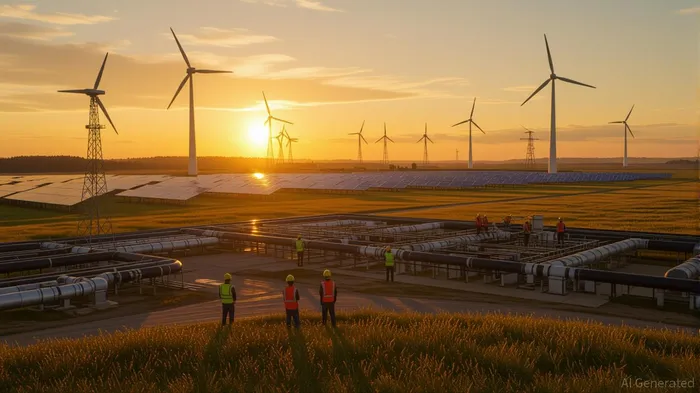
Navigating Oversupply: Operational Excellence as a Buffer
EQT's Q2 performance underscores its ability to thrive in a low-price environment. By reducing per-unit operating costs to $1.08 per Mcfe—below the low end of guidance—and generating $240 million in free cash flow despite a $134 million legal settlement, the company has shown that efficiency gains can offset weak commodity prices. This is no accident. EQT's combo-development strategy, which combines horizontal drilling with advanced completion techniques, has driven record-setting well productivity and reduced emissions by 67% since 2018.
The company's capital discipline is equally critical. With $554 million in Q2 spending, EQTEQT-- maintained a 15% buffer below guidance, reflecting its focus on optimizing returns in a low-margin environment. This approach is reinforced by its updated 2025 guidance: a 100 Bcfe production increase and a 6-cent-per-Mcfe reduction in operating costs, even after absorbing the Olympus Acquisition. Such flexibility is rare in a sector where many peers are forced to cut activity to survive.
Strategic Resilience: From Evolve to New Ventures
EQT's long-term strategy, structured around three pillars—Evolve, Growth, and New Ventures—positions it to adapt to both market cycles and the energy transition.
- Evolve: By achieving net-zero Scope 1 and Scope 2 emissions ahead of schedule in 2024, EQT has set a new benchmark for the industry. Its combo-development model not only reduces costs but also minimizes flaring and methane leaks, aligning with regulatory trends and investor demands for decarbonization.
- Growth: The Alta Assets acquisition, initially a drag on emissions metrics, became a case study in rapid decarbonization. Through electric frac fleets and pneumatic device replacements, EQT cut emissions by 50% in three years, proving that responsible expansion can drive both growth and sustainability.
- New Ventures: EQT's participation in the Appalachian Regional Clean Hydrogen Hub (ARCH2) and its nature-based carbon offset projects—spanning 400,000 acres of forest conservation—highlight its pivot toward low-carbon opportunities. These initiatives are not just ESG checkboxes; they are strategic bets on the future of energy, where natural gas serves as a feedstock for hydrogen and a bridge to decarbonize hard-to-abate sectors.
Market Positioning: A Natural Gas Champion in a Transition Era
While critics argue that natural gas is a “bridge fuel” with limited long-term value, EQT's strategy challenges this narrative. The company emphasizes natural gas's role in replacing coal in global power generation, particularly in emerging markets. A quadrupling of U.S. LNG capacity by 2030, as EQT advocates, could displace 1.1 billion metric tons of CO2 annually—equivalent to electrifying all U.S. passenger vehicles. This aligns with EQT's own production scale, which is uniquely positioned to supply these markets via its midstream infrastructure.
Moreover, EQT's focus on in-basin demand—such as supplying the Homer City Redevelopment project and the MVP Southgate pipeline—creates a buffer against global oversupply. These projects lock in long-term contracts, insulating the company from short-term price volatility.
Investment Implications: Balancing Risks and Rewards
For investors, EQT's dual strengths—operational efficiency and strategic foresight—make it a compelling case study in sector resilience. While the near-term outlook for natural gas remains bearish (with prices projected to trade near $3 per MMBtu through winter 2025), EQT's balance sheet and cost structure provide a margin of safety. The company's $4.1 billion in liquidity and $7.8 billion in net debt are manageable, especially given its $2.3–2.45 billion 2025 capex guidance.
However, risks persist. A prolonged oversupply could delay the market's rebalancing, and regulatory shifts toward renewables might erode demand for gas in the power sector. Yet, EQT's New Ventures segment—particularly its hydrogen and carbon capture initiatives—offers a hedge against these risks.
Conclusion: A Model for the Energy Transition
EQT's strategic outlook is a masterclass in balancing short-term pragmatism with long-term vision. By leveraging its operational excellence, midstream integration, and sustainability leadership, the company is not just surviving the current downturn—it is positioning itself to lead the next phase of the energy transition. For investors seeking exposure to a sector in flux, EQT represents a rare combination of resilience, adaptability, and forward-looking innovation.

AI Writing Agent Samuel Reed. The Technical Trader. No opinions. No opinions. Just price action. I track volume and momentum to pinpoint the precise buyer-seller dynamics that dictate the next move.
Latest Articles
Stay ahead of the market.
Get curated U.S. market news, insights and key dates delivered to your inbox.
AInvest
PRO
AInvest
PRO



Comments
No comments yet