
EPL 2027 Champion Market: Capital Inflows, Regulatory Friction, and Resolution Risks
 Aime Summary
Lead
The prediction market for the 2026-27 English Premier League (EPL) Champion is currently navigating a complex interplay between aggressive club spending and new financial fair play (FFP) regulations. While significant capital commitments from Manchester UnitedMANU-- and Manchester City have shifted expectations, the market's pricing must be scrutinized against strict resolution rules and potential timing conflicts. This analysis dissects how recent news increments, rule constraints, and trading dynamics converge to shape the current probability landscape, distinguishing between genuine informational shifts and noise.
Event Definition
This market bets on which team will win the 2026-27 English Premier League Championship. The resolution is based on the official winner declared by the EPL, with a hard deadline of May 30, 2027, and a postponement cutoff at June 14, 2027. The core disagreement centers on whether the massive pre-season investments by top clubs will translate into a championship title under the new, stricter financial regulations, or if external factors like postponements or eliminations will alter the settlement outcome.
Latest News & Information Increments
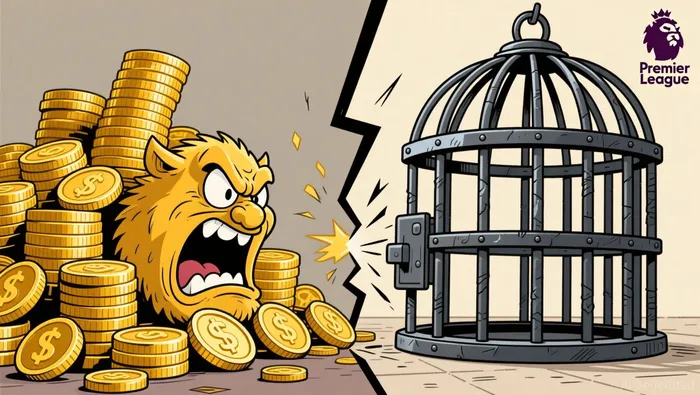
Recent market pricing has been influenced by substantial financial commitments from Premier League giants. Manchester United and Manchester City have collectively spent hundreds of millions on new signings, signaling strong competitive ambitions for the 2026-27 season. This influx of capital has led to a moderate increase in odds for Manchester United, reflecting market confidence in their strengthened squad. Simultaneously, the broader soccer landscape has seen record transfer spending, with Major League Soccer (MLS) reporting a $370 million spend for 2026, highlighting a general trend of increased financial activity in the sport. However, a critical counter-narrative has emerged: the EPL has introduced new FFP rules restricting clubs to spending up to 85% of their relevant revenue on wages and fees starting from the 2026/27 season. This regulatory shift introduces a significant constraint that could neutralize the impact of high spending. Additionally, alternative sporting models, such as RoyaLand’s youth-focused project with Savoia 1908 FC, demonstrate that competitive success can be achieved without massive financial outlays, further complicating the narrative that spending alone guarantees a championship. The market is thus balancing the signal of high capital expenditure against the noise of regulatory caps and alternative success models.
Market Resolution Rules Analysis
The market resolves to "Yes" for the team that wins the 2026-27 EPL Championship, as officially confirmed by the English Premier League. The primary time boundary is May 30, 2027, at 23:59 UTC. A critical secondary boundary exists for postponements: if the season is cancelled or postponed past June 14, 2027, at 11:59 PM ET, the market resolves to "Other." The determination basis is strictly the official EPL declaration, ensuring a clear, authoritative source for settlement.
Rule Risk Points & Disputed Scenarios
Two main risks could lead to mispricing or disputes. First, there is a potential conflict between the May 30 championship deadline and the June 14 postponement cutoff; if the season is delayed beyond May 30 but resolves before June 14, the settlement hinges on whether the winner is declared within the primary window. Second, ambiguity exists in the definition of "eliminated," particularly regarding non-standard exits such as playoff scenarios, which could trigger a "No" resolution even if a team performs well in the regular season but fails in a tie-breaker playoff.
Market Overview
The current market pricing reflects a nuanced view of the 2026-27 EPL landscape. The moderate increase in Manchester United's odds suggests that the market is pricing in the impact of their significant squad investments, but not to the extent of making them outright favorites. This indicates that traders are cautious about the effectiveness of spending under the new FFP rules. The market is not skewed towards a single dominant probability tier; instead, it shows a distributed disagreement among top clubs, with no clear 0.5 probability threshold being tested. This suggests that the market is in a state of equilibrium, where new information is being absorbed but not causing a dramatic repricing. The absence of extreme price movements implies that the market believes the current spending levels are priced in, and future volatility will depend on how the FFP rules are enforced and interpreted.
Market Dynamics (Volatility & Volume)
Market volatility has been relatively contained in the short term, with maximum 1-day and 1-week price changes capped at 0.03, while the 1-month change has reached 0.14. This suggests that the significant spending news has had a lasting impact over the month, but recent days have seen stability. The market's high volatility status across multiple periods indicates it is a prominent asset for traders. However, the volume analysis reveals a critical divergence: while the 24-hour volume is strong ($127,318), the total volume is exceptionally high ($15.3 million). This high total volume suggests deep liquidity and sustained interest, but the modest daily volatility implies that the current price is well-supported by genuine trading activity rather than thin-order-book manipulation. The price movements are backed by substantial volume, enhancing the reliability of the current pricing. The overlap in volatility periods (1d, 1w, 1m) indicates that the market is consistently active, with no distinct long-term leader in volatility, suggesting a balanced and efficient market.
Closing: Follow-up Observation Points
Traders should monitor the enforcement of the new FFP rules and any official EPL announcements regarding season scheduling. Key variables to track include the actual spending reports of top clubs against the 85% revenue cap, any potential postponements of the season, and the definition of "elimination" in case of tie-breakers. The market's stability suggests that the current price is a fair reflection of known information, but unexpected regulatory interpretations or scheduling changes could quickly alter the settlement outcome.

Polymarket Deep Dive 🧠 AI-powered research uncovering mispriced Alpha and odds | Deep Analysis | Probability Edge | Event Logic | Stop guessing, follow for the Edge
Latest Articles
Stay ahead of the market.
Get curated U.S. market news, insights and key dates delivered to your inbox.


AInvest
PRO
AInvest
PRO




Comments
No comments yet