
EOG Resources' Q3 2025 Earnings Call: Contradictions in Gas Strategy, Capital Allocation, Encino Integration, Gas Demand, and Delaware Basin Productivity
 Aime Summary
Date of Call: None provided
Financials Results
- EPS: $2.71 adjusted earnings per share; adjusted cash flow from operations per share $5.57; free cash flow $1.4B; net income $1.5B
Guidance:
- FY2025 free cash flow guidance raised to $4.5B (up $200M vs prior midpoint).
- Q4 volumes above guidance midpoints; capex, cash operating costs and DD&A below midpoints supporting strong FCF.
- No specific 2026 guidance yet; management suggests using Q4 run-rate as a starting point and expects no-to-low oil growth in 2026 while remaining constructive on gas.
- Plan to remain active in buybacks; minimum 70% FCF to shareholders (historically ~90% returned).
Business Commentary:
 * Strong Financial Performance and Shareholder Returns: - EOG Resources reported
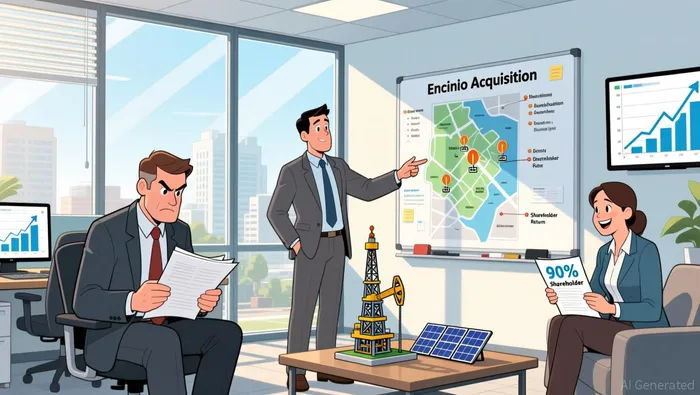
 $1.4 billion of free cash flow and $1.5 billion in net income for Q3 2025. - The company returned nearly 90% of its estimated 2025 free cash flow to shareholders through regular dividends and share repurchases. - This performance was driven by disciplined capital spending, cost reductions, and strategic acquisitions like the acquisition of Encino.- Diversified Portfolio and Operational Excellence:
- EOG's portfolio consists of high-return assets in the Delaware Basin, Eagle Ford, Utica, and emerging plays like Dorado and the Powder River.
- The company lowered breakeven costs through data and technology-driven operational improvements, including investments in strategic infrastructure projects such as the Janus gas processing plant.
- Operational execution and strategic investments in foundational assets provided a strong base for financial performance.
- Encino Acquisition and Synergies:
- The acquisition of Encino strengthened EOG's portfolio and provided a third high-return foundational asset.
- Initial synergy targets include cost reductions, with a primary driver being a reduction in well costs.
Integration efforts are focused on applying EOG's operational best practices and proprietary software applications to unlock synergies and improve field performance.
Macroeconomic Outlook and Strategic Investments:
- EOG is cautiously optimistic about near-term oil supply due to spare capacity return, but bullish on medium- to long-term supply-demand balances.
- On the natural gas side, growth is anticipated due to increased LNG feed gas demand and U.S. electricity demand.
- The company is strategically investing in building a premier gas business, such as increasing LNG commitments and expanding unconventional development internationally.
Sentiment Analysis:
Overall Tone: Positive
- Management called it an "exceptional quarter," citing $2.71 adjusted EPS, $1.4B free cash flow and $1B returned to shareholders; noted successful Encino close, $150M synergy target and strengthened balance sheet with $3.5B cash and $5.5B liquidity, emphasizing continued buybacks and disciplined capital allocation.
Q&A:
- Question from Neil Mehta (Goldman Sachs): Macro: can you put numbers behind your oil and gas outlook? Micro: comment on Delaware productivity concerns and Permian maturity risks?
Response: Near-term cautious on oil because spare capacity is returning but constructive medium/long term as spare capacity declines; natural gas structurally bullish (LNG + power demand; management cites ~4–6% CAGR for North American gas demand); Delaware wells are performing to plan—cost reductions (longer laterals, -15% well cost over 2 years) and tech/infrastructure unlock new landing zones with paybacks <1 year and >100% well-level returns.
- Question from Steve Richardson (Evercore ISI): Any color on 2026 (use of Q4 run-rate), activity across the portfolio, and Utica oil gathering/market access/differentials timeline?
Response: Q4 run-rate is a reasonable starting point for 2026 planning; management expects no-to-low oil growth next year, will continue gas and international investments at similar pace, and sees ample market for Utica volumes while differentials should improve over time with scale and infrastructure.
- Question from Josh Silverstein (UBS): What drove the drop in overall cost guidance this quarter and post-Encino how will FCF be allocated (debt paydown vs. cash build vs. returns)?
Response: Costs beat across LOE (lower workover/compression), GP (lower gathering/processing), G&A and DD&A driven by operational performance and Encino integration; capital allocation remains returns-focused—70% FCF is a minimum, balance sheet strong, and management expects to remain opportunistic with buybacks (historical returns ~90%).
- Question from Doug Legate (Wolfe Research): Are you optimizing at basin level or running to sustain portfolio FCF; and is Alaska part of your exploration/BD plans?
Response: EOG runs a multi-basin, returns-focused program—manage each basin individually to maximize full-cycle returns and then allocate capital company-wide; exploration remains selective and returns-driven (bolt-ons preferred); management declined to comment on any Alaska position.
- Question from Leo Mariani (Raymond James): Given bullish gas outlook for 2026, would you step up Dorado activity? And any early read on Bahrain wells drilled in 3Q?
Response: Dorado activity will be paced to preserve high full-cycle returns (step-up possible as rigs/fracs reach full-time cadence and if LNG/winter demand support it); Bahrain is early stage—legacy wells contributed reported gas volumes, new wells drilled and to be completed this quarter, but results are still preliminary.
- Question from Scott Hanold (RBC Capital Markets): At current valuation would you push buybacks toward 100% FCF and what drove better base production in the Utica?
Response: Management has flexibility to exceed the 70% minimum and could opportunistically return near 100% of FCF; Utica production beat driven by rapid Encino integration, deployment of EOG proprietary apps, artificial lift optimizers and other operational/efficiency synergies.
- Question from David Deckelbaum (TD Cowen): Are lower operating costs and fewer workovers specific to Utica integration or broad-based; and what's your appetite for inorganic growth given spare capacity trends?
Response: Cost and workover improvements are broad-based, enabled by data/analytics, hi‑fidelity sensors and predictive maintenance to reduce failures; inorganic activity is disciplined—management seeks high-return bolt-ons and value-adding opportunities rather than indiscriminate acreage accumulation.
- Question from Betty Jung (Barclays): How material is AI to operations/exploration and should capabilities be built in-house? Follow-up: why drill the dry-gas Peckins wells and what would trigger that option?
Response: AI is materially transformative across exploration, drilling, production and safety; EOG builds proprietary in‑house applications tied to field operations for advantage; Peckins wells (acquired) showed very strong ~30 MMcf/d 30-day IPs—encouraging for gas optionality, but company sees primary gas growth via Dorado where costs and market access are most attractive.
Contradiction Point 1
Gas Market Strategy and Long-Term Contracts
It involves EOG's strategy regarding gas marketing and long-term contracts, which impacts revenue and risk management in the energy market.
Can you share your macro views on oil and gas, specifically the near-term caution and medium-to-long-term optimism? - Neil Mehta (Goldman Sachs)
2025Q3: We are not opposed to long-term contracts, but signing takeaways for differential pricing is also valuable. - Ezra Yacob(CEO)
How does EOG approach the gas market and marketing strategy? Will EOG enter long-term contracts? - Stephen I. Richardson (Evercore ISI Institutional Equities, Research Division)
2025Q2: We look for good agreements with market alignment and premium pricing. We are not opposed to long-term contracts. - Ezra Yacob(CEO)
Contradiction Point 2
Macro Outlook and Capital Investment Strategy
It reflects a shift in EOG's strategic approach to macroeconomic conditions and capital expenditure, which impacts shareholder expectations and investment decisions.
Could you outline 2026 activity and considerations for the portfolio, considering macroeconomic factors? - Steve Richardson(Evercore ISI)
2025Q3: We will continue to invest in gas with increased LNG commitments and international activity. The ability to invest at the right pace in each asset remains crucial. - Ezra Yacob(CEO)
Can you explain the decision to reduce CapEx and whether further reductions are planned if macro conditions change? - Arun Jayaram(J.P. Morgan)
2025Q1: Our decision doesn't reflect deterioration in reinvestment economics. It's about capital discipline to protect shareholder returns and free cash flow. The focus is on generating returns and free cash flow, not growth in a potentially oversupplied market. - Ezra Yacob(CEO)
Contradiction Point 3
Encino Acquisition and Sustaining Capital Requirements
It involves EOG's approach to integrating Encino and its impact on sustaining capital requirements, affecting financial planning and operational strategies.
Can you discuss 2026 activity levels and strategic considerations for your portfolio, considering macroeconomic factors? - Steve Richardson (Evercore ISI)
2025Q3: We are evaluating the Encino assets and will make thoughtful decisions on how we optimize them as the market evolves. - Ezra Yacob(CEO)
What are the capital requirements to maintain Utica production levels, and would a 5-rig, 3-crew completion schedule drive Utica growth? - Arun Jayaram (JPMorgan Chase & Co, Research Division)
2025Q2: With regard to pro forma sustaining capital, for the rest of this year, we are layering on top of our activity levels, the ongoing Encino plan. - Ezra Yacob(CEO)
Contradiction Point 4
Natural Gas Demand and Investment Strategy
It highlights a change in EOG's perspective on natural gas demand and investment strategy, which has implications for EOG's operational plans and market positioning.
Given the positive gas outlook for 2026, do you plan to increase Dorado activity? - Leo Mariani(Raymond James)
2025Q3: EOG is bullish on gas and expects increased LNG commitments. Dorado activity will continue to be governed by high returns and maintaining low costs. There is flexibility in the plan, depending on LNG demand and market conditions. - Ezra Yacob(CEO)
How do you approach capital allocation changes in a weak oil market, particularly for gas? - Scott Hanold(RBC Capital Markets)
2025Q1: EOG remains optimistic about natural gas demand. The focus is on maintaining low-cost structures without chasing inventory levels or commodity prices. Investing in Dorado is on track with gas demand outlook. - Ezra Yacob(CEO)
Contradiction Point 5
Delaware Basin Well Productivity and Returns
It involves the performance of wells in the Delaware Basin, which is crucial for understanding the company's production strategy and financial outlook.
Are concerns about weaker well productivity in the Delaware Basin and Permian Basin maturity valid? - Neil Mehta(Goldman Sachs)
2025Q3: The Delaware Basin wells perform as intended, with a focus on balancing returns and resource recovery. Efficiency gains, infrastructure development, and lower costs have unlocked additional landing zones meeting stringent economic hurdle rates. The economics of new targets are strong, with payback periods under a year and direct well returns exceeding 100% at current prices. - Jeff Leitzell(COO)
How has productivity in the Delaware program changed year-over-year? - Nitin Kumar(Mizuho Securities)
2024Q4: Productivity in Delaware varies each year due to well mix. We're seeing more oil-weighted productivity in the first quarter. Recent improvements in shallow targets have improved cost and productivity. Each target delivers comparable returns at bottom-cycle pricing, allowing optimal development and resource capture. - Jeffrey Leitzell(COO)

Discover what executives don't want to reveal in conference calls
Latest Articles
Stay ahead of the market.
Get curated U.S. market news, insights and key dates delivered to your inbox.
AInvest
PRO
AInvest
PRO



Comments
No comments yet