
EOG Resources' Q3 2025: Contradictions Emerge on CapEx Strategy, Free Cash Flow, Gas Market Outlook, and Eagle Ford Play Strategy
 Aime Summary
Date of Call: None provided
Financials Results
- EPS: $2.71 adjusted EPS (Q3 2025)
Guidance:
- FY2025 free cash flow forecast $4.5B (up $200M vs prior midpoint)
- Q3 FCF $1.4B; YTD FCF $3.7B; returned $1.0B to shareholders in Q3
- 2025 target: 65 net well completions; Utica rig count reduced from 5 to 4 for remainder of 2025
- Maintain minimum commitment to return ≥70% of free cash flow to shareholders (recent years ≈90%); $4B remaining buyback authorization
- Too early to provide 2026 capex specifics; management suggests Q4 run-rate as a reasonable starting point for 2026 planning
Business Commentary:
* Strong Financial Performance and Returns to Shareholders: - EOG Resources reported$1.4 billion in free cash flow and $1.5 billion in net income for Q3 2025. - The company returned $1 billion to shareholders through regular dividends and share repurchases. - This performance was driven by strong operational execution, exceeding guidance on production volumes, and effective cost management.- Successful Acquisition and Strategic Milestones:
- The acquisition of Encino was successfully completed, enhancing EOG's portfolio and accelerating free cash flow generation potential.
- EOG achieved
$1.4 billionin free cash flow for the quarter, exceeding guidance. These strategic moves were part of EOG's plan to diversify its production base and enhance long-term value creation.
Capital Allocation and Cost Efficiency:
- EOG's capital expenditures and cash operating costs were below guidance targets, supporting strong free cash flow performance.
- The company reduced well costs by over
15%in the Delaware Basin over the last two years and achieved a20%increase in lateral length. Operational improvements, strategic infrastructure investments, and data-driven insights contributed to these efficiency gains.
Outlook on Commodity Fundamentals:
- EOG anticipates a constructive support for oil prices beyond the next few quarters, driven by spare capacity reductions and demand growth.
- The company's positive outlook on natural gas is supported by record LNG demand and increased electricity consumption.
- EOG sees long-term supply-demand imbalances favoring its high-return North American liquids and natural gas portfolio.
Sentiment Analysis:
Overall Tone: Positive
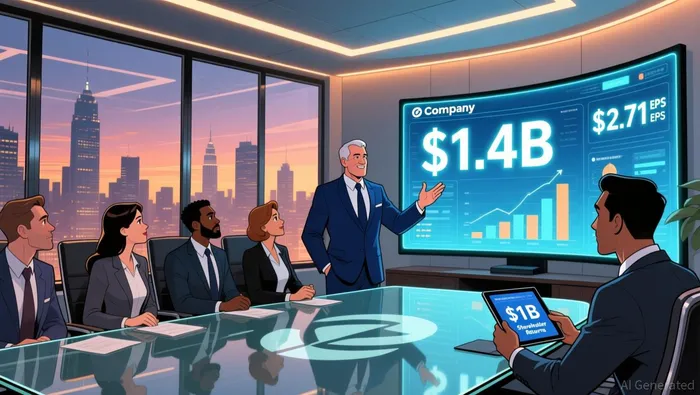
- Management highlighted an "exceptional quarter": adjusted EPS $2.71, Q3 free cash flow $1.4B and YTD $3.7B, successful Encino acquisition strengthening the portfolio, and $1B returned to shareholders in the quarter — all cited as evidence of operational and financial strength.
Q&A:
- Question from Neil Mehta (Goldman Sachs): Could you unpack your macro view with numbers (cautious near-term, constructive medium/long term) for oil and gas?
Response: Near-term oil: cautious/oversupplied due to returning spare capacity; medium/long-term bullish as spare capacity declines, reduced investment and geopolitics support prices; natural gas structurally bullish driven by LNG and power demand (forecast ~4–6% demand CAGR).
- Question from Neil Mehta (Goldman Sachs): Concerning Delaware productivity data and perceived Permian maturity, how should we think about that risk?
Response: Delaware wells are meeting design expectations; longer laterals, ~15% lower well costs and new landing zones have improved economics (payback <1 year; >100% well-level returns).
- Question from Stephen Richardson (Evercore ISI): Any color on 2026 activity if one used Q4 CapEx annualized as a proxy and how you view portfolio activity next year?
Response: Q4 run-rate is a reasonable starting point; expect no-to-low oil growth in 2026, continued investment in gas (Dorado) and international at similar pace; 2026 specifics still early and dynamic.
- Question from Stephen Richardson (Evercore ISI): Thoughts on Utica oil gathering and market access differentials and timing for improvement?
Response: Market molecules are ample; the issue is differentials—Encino widened corporate differentials slightly; with scale and maturity EOG expects to improve Utica differentials over time.
- Question from Joshua Silverstein (UBS): Drivers of the ~$0.25 reduction in overall cost guidance this quarter — was Encino a factor and how should costs look into next year?
Response: Cost beats were broad-based: LOE ~ $0.10 below midpoint (lower workover/compression and Trinidad), GP&T ~ $0.20 below (Eagle Ford/Powder lower fees and Utica forecast variance), plus G&A and DD&A modestly under.
- Question from Joshua Silverstein (UBS): Post-Encino, how will free cash flow be allocated next year — debt paydown, cash build, or shareholder returns (70%+)?
Response: 70% is a minimum; historically ~90% returned; balance sheet strong at target leverage, preference is opportunistic buybacks rather than building cash; debt level is acceptable, not prioritizing cash accumulation.
- Question from Douglas George Blyth Leggate (Wolfe Research): Do you run the business to optimize basin-level production or to sustain portfolio free cash flow? And is Alaska part of your BD plans?
Response: Operate multi-basin to maximize returns per asset and company-level free cash flow; investment paced by returns, infrastructure and learnings; exploration remains strategic—no comment on Alaska.
- Question from Leo Mariani (ROTH): Do you view 2026 as the year to materially step up Dorado activity given bullish gas outlook?
Response: Bullish on gas; Dorado pace will be governed by maintaining strong full-cycle returns; 2026 could approach full-time rigs/frac spreads but timing depends on winter, LNG demand and cost step-changes.
- Question from Leo Mariani (ROTH): Any early read on Bahrain wells — are they meeting or beating expectations?
Response: Early days; legacy producing wells added to production (reported gas volumes); first new wells drilled with completions this quarter — team gaining geology/ops understanding and optimistic about opportunity.
- Question from Scott Hanold (RBC Capital Markets): At current valuations would you push buybacks toward ~100% of free cash flow this year?
Response: Balance sheet supports returning well above the 70% minimum and approaching prior levels (~92%); management finds current valuations very compelling and buybacks attractive.
- Question from Scott Hanold (RBC Capital Markets): What drove the better Utica base production performance — artificial lift, reservoir, or Encino integration?
Response: Integration benefits drove uplift: drilling/completions efficiency, high‑intensity completions, and rollout of proprietary production optimizers/artificial lift to ~80% of applicable Encino wells delivered incremental production and synergies.
- Question from David Deckelbaum (TD Cowen): Were lower workover expenses specific to Utica integration or broad-based across the portfolio?
Response: Broad-based improvement: analytics, targeted interventions, HiFi sensors and predictive maintenance reduced failures and workovers across assets, lowering LOE company-wide.
- Question from David Deckelbaum (TD Cowen): Given spare capacity trends, will you hoard inventory via M&A or pursue organic expansion over next 12–24 months?
Response: Focus on returns-focused inorganic opportunities (small bolt-ons) and high-quality organic exploration; not pursuing inventory hoarding—acquisitions must compete on full-cycle returns (Encino an example of a compelling bolt-on).
- Question from Wei Jiang (Barclays): Materiality of AI integration and advantage of building capabilities in-house?
Response: Significant value from in-house proprietary apps tightly coupled to field ops: ML/AI used for drilling optimization, production optimization, predictive maintenance, process automation and safety; generative/deep learning being applied to geologic and operational data.
- Question from Wei Jiang (Barclays): On the dry-gas Utica Pekin wells, what would trigger scaling that option versus focusing on volatile oil window?
Response: Pekin wells showed strong ~30mmcfd 30‑day IPs (acquired drilled wells); Utica focus remains volatile oil window for now, while Dorado is primary engine for gas growth given its low cost and Gulf Coast access.
Contradiction Point 1
Capital Expenditure (CapEx) Strategy
It involves differing perspectives on the company's CapEx strategy, which directly impacts financial planning and investor expectations for future growth and investment.
Is the strategy focused on optimizing production or sustaining portfolio cash flow? Is EOG considering Alaska for business development? - Douglas George Blyth Leggate(Wolfe Research)
20251107-2025 Q3: We continue to believe it is more important to focus on sustaining cash flow than it is to optimize production. - Ezra Yacob(CEO)
What are the sustaining capital and activity requirements to maintain 275 MBoe/day production from the Utica? Can a 5-rig, 3-completion-crew cadence drive growth? - Arun Jayaram(JPMorgan Chase & Co, Research Division)
2025Q2: It doesn't change our view necessarily about our budget or our capital allocation strategy for the remainder of the year. We're going to stay really consistent on that, and that's a testament to the Williston Basin. - Ezra Yacob(CEO)
Contradiction Point 2
Gas Market Outlook and Strategy
It involves differing views on the gas market outlook and strategic approach, which could impact operational decisions and financial performance.
Will Dorado's activity increase in 2026 due to the bullish gas outlook? - Leo Mariani(ROTH)
20251107-2025 Q3: Our focus on Dorado will be governed by maintaining high full-cycle returns. Investment will ramp up as necessary with infrastructure investments, such as platforms and pipelines, to support cost efficiency. - Ezra Yacob(CEO)
What are your plans for the gas market and marketing strategy? Will you pursue long-term contracts for Utica gas volumes? - Stephen I. Richardson(Evercore ISI Institutional Equities, Research Division)
2025Q2: We see an opportunity to lock in additional cash flow by taking advantage of the premium natural gas prices available in our diverse markets. - Ezra Yacob(CEO)
Contradiction Point 3
EOG's Free Cash Flow Guidance and Investments
It involves changes in financial forecasts and investments, which are critical for understanding EOG's financial strategy and investor expectations.
What is your macro view on oil and gas, particularly near-term caution and medium-term optimism? - Neil Mehta (Goldman Sachs)
20251107-2025 Q3: The 2025 plan starts with capital discipline. We have a flat activity in the Delaware Basin and a slightly moderated activity in the Eagle Ford. - Ezra Yacob(CEO)
Given the free cash flow guide at $70 WTI and $4.25 Henry Hub was lower than expected, can you discuss the emerging plays and infrastructure investments that could impact future free cash flow? - Neil Mehta (Goldman Sachs)
2024Q4: We're stepping up completions in the Utica and Dorado, and we're raising our full-year capex guidance to $9.3 billion. - Ezra Yacob(CEO)
Contradiction Point 4
EOG's Strategy in the Eagle Ford Play
It highlights differences in EOG's strategic approach to the Eagle Ford play, which could impact production and financial performance.
Are you prioritizing production optimization or portfolio cash flow sustainability? Is EOG considering Alaska for business development? - Douglas George Blyth Leggate (Wolfe Research)
20251107-2025 Q3: We're moving a rig from Eagle Ford to Delaware, it's elevating the capital program in Delaware from $957 million to $1.75 billion. - Ezra Yacob(CEO)
What are the reasons for reducing Eagle Ford activity, and is there a specific plan for Utica? - Leo Mariani (ROTH)
2024Q4: Eagle Ford activity moderated due to prior inflation in the Delaware Basin. - Keith Trasko(CPO)
Contradiction Point 5
EOG's Approach to Infrastructure Investments
It involves changes in EOG's approach to infrastructure investments, which are crucial for optimizing production and costs.
Why did cost guidance decline significantly this quarter, and how should we view future costs? - Joshua Silverstein (UBS)
20251107-2025 Q3: The cost reduction is due to better-than-expected operating expenses like lower LOE and GP&T. Improvements in Utica mainly due to Encino integration. - Jeffrey Leitzell(COO)
Given the free cash flow guidance at $70 WTI and $4.25 Henry Hub was lower than expected, can you discuss the investments in emerging plays and infrastructure that could impact future free cash flow? - Neil Mehta (Goldman Sachs)
2024Q4: We're also investing in strategic infrastructure like the Verde pipeline and the Janus processing plant. - Ezra Yacob(CEO)

Discover what executives don't want to reveal in conference calls
Latest Articles
Stay ahead of the market.
Get curated U.S. market news, insights and key dates delivered to your inbox.
AInvest
PRO
AInvest
PRO



Comments
No comments yet