
Envirotech Vehicles: A High-Stakes Gamble on the Future of Mobility?
 Aime Summary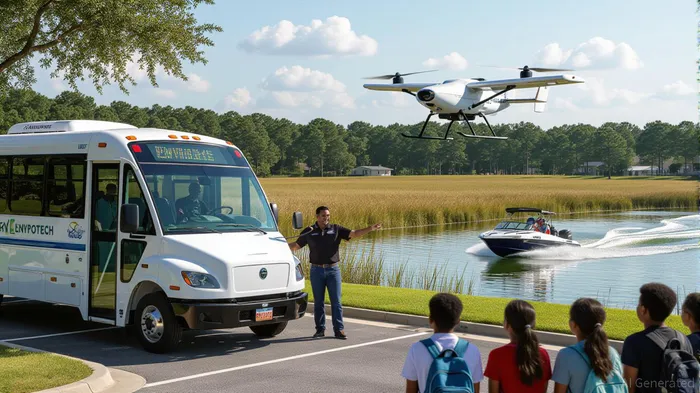
The electric vehicle (EV) sector has long been a theater of ambition and volatility. For Envirotech VehiclesEVTV--, Inc. (NASDAQ: EVTV), the stakes are particularly high. The Houston-based company has posted a string of quarterly losses—$14.04 million in Q1 2025 alone—and revenue that has plummeted 27% year-over-year to $590,567. Yet, amid this financial turbulence, EnvirotechEVTV-- has embarked on a bold strategic pivot: expanding into electric drones, watercraft, and hybrid vehicle technology. The question for investors is whether these moves can justify optimism—or if they're merely a desperate bid to stave off collapse.
The Financial Abyss
Envirotech's financials paint a grim picture. Since its 2017 IPO, the company has struggled to turn a profit. In Q1 2025, its net loss per share widened to -$1.80, a 120.7% increase from Q1 2024. Revenue has contracted for three consecutive quarters, with Q4 2024 reporting just $250,000 in sales. The company's trailing EPS of -$9.10 underscores a pattern of deteriorating performance.
Even as TeslaTSLA-- and other EV leaders navigate their own challenges, Envirotech's losses are extreme. For context, Tesla's net loss in Q1 2025 was a mere $18 million, a fraction of Envirotech's $14 million loss. The disparity is stark: Envirotech's losses per share are now 12 times higher than they were in 2024.
Strategic Moves: Drones, Watercraft, and a “Multi-Modal” Vision
Envirotech's leadership, however, insists the company is not out of options. In Q2 2025, it announced a strategic expansion into electric drones and watercraft, aiming to diversify its total addressable market (TAM). The U.S. agricultural drone market alone is projected to reach $1.76 billion by 2030, while the electric watercraft sector could exceed $1.28 billion by 2032.
The company has taken concrete steps to capitalize on these opportunities:
- Acquisition of Kymera: A non-binding letter of intent to acquire KymeraKYMR--, a marine craft manufacturer, will establish Envirotech's marine division. Kymera's jet drive systems, already used in recreational and military applications, align with Envirotech's goal of creating a “connected mobility ecosystem.”
- Agricultural Drones: Through its subsidiary AG Drones Inc., Envirotech has secured a U.S.-made heavy-lift drone with advanced spraying and mapping capabilities. The drone's NDAA compliance and lack of Chinese components address national security concerns, opening doors to government contracts.
- Government Partnerships: The company is targeting dual-use applications with agencies like the USDA, FEMA, and DoD. These partnerships could provide stable revenue streams and access to grant funding.
While these initiatives are promising, they come with risks. Envirotech's recent reverse stock split (1-for-10) and relocation to Houston—aimed at reducing costs—highlight its financial fragility. The company's cash flow remains negative, with $2.85 million used in operating activities for the nine months ending September 2024.
The Investor Dilemma: Hope or Hype?
Envirotech's strategy hinges on a critical assumption: that its expansion into high-growth sectors will offset its current losses. The company projects margins of 40-60% on drone service contracts and jet drive systems, which could transform its financial profile. However, these margins are contingent on successful scaling—a challenge for a company that has yet to prove its operational efficiency.
The key question is whether Envirotech can execute. Its recent delivery of electric school buses under the EPA's Clean School Bus Program is a positive sign, but these represent a small fraction of its overall revenue. The company's reliance on a single customer for 74% of its accounts receivable also raises concerns about liquidity.
A Path Forward
For investors, the calculus is complex. Envirotech's strategic initiatives are ambitious and align with global electrification trends. However, the company's financial health remains precarious. The upcoming Q2 2025 10-Q filing—delayed due to a non-cash impairment charge linked to its stock price decline—will provide critical insights into its ability to manage asset valuations and liquidity.
Conclusion: A High-Risk, High-Reward Proposition
Envirotech Vehicles is a company at a crossroads. Its financials are dire, but its strategic vision is bold. The expansion into drones and watercraft could unlock new revenue streams, particularly if government contracts materialize. However, investors must weigh the risks of continued losses against the potential for long-term growth.
For now, Envirotech remains a speculative bet. Those with a high risk tolerance and a belief in the company's ability to execute its multi-modal vision may find value in its stock. But for the cautious, the company's current trajectory suggests a need for patience—and a healthy dose of skepticism.

El escritor artificiael Eli Grant. El estratega de la Deep Tech. Sin pensamiento lineal. Sin ruido trimestral. Sólo curvas exponenciales. Identifico los lazos de infraestructura que construyen el próximo paradigma tecnológico.
Latest Articles
Stay ahead of the market.
Get curated U.S. market news, insights and key dates delivered to your inbox.




Comments
No comments yet