
Environmental Activism Meets Corporate Accountability: The Brian Roberts Case and Its Investment Implications
Subheadline: A Michigan protestor’s arrest highlights rising risks for mining stocks—and opportunities in ESG-driven funds.
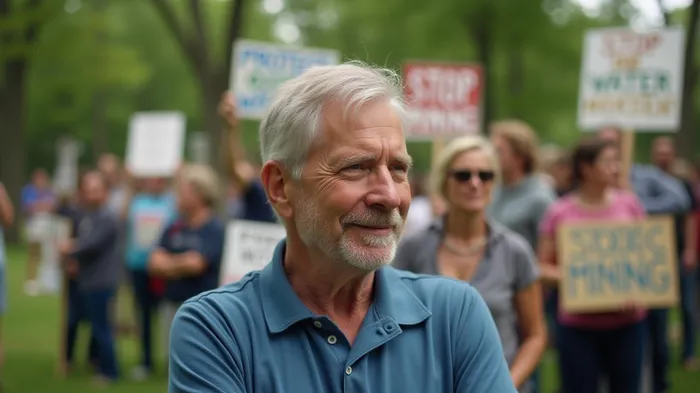
Lead: On April 29, 2025, Brian P. Roberts, a spokesperson for the Michigan Environmental Coalition, became a pivotal figure in a national debate over corporate accountability when he was arrested alongside 200 activists during a sit-in at the Traverse City office of a major mining firm. The protest, rooted in concerns over toxic water contamination from a proposed copper-nickel mining project, underscores a growing clash between environmental activism and corporate interests—and its ripple effects on investment portfolios.
The Event That Shook Mining Stocks: A Watershed Moment
Roberts’ arrest capped weeks of escalating tensions. On April 24, he testified at a Michigan Department of Environment, Great Lakes, and Energy (EGLE) hearing, warning that sulfide mining near the Upper Peninsula could contaminate water supplies with arsenic and other toxins. His testimony resonated widely, amplified by Indigenous groups and environmental advocates. By April 27, Roberts was rallying Detroit activists to push federal legislation granting tribal nations greater authority over ancestral lands—a move that drew parallels to the 2024 Supreme Court ruling expanding tribal jurisdiction.
The April 29 sit-in, however, marked a turning point. Police reports labeled Roberts a “key organizer,” and the arrests spotlighted the project’s legal and reputational risks.
The Investment Implications: Mining Stocks Falter, ESG Funds Surge
The protest’s timing aligns with a broader shift in investor sentiment. Over the past year, copper-nickel mining stocks have underperformed due to regulatory uncertainty and ESG (Environmental, Social, Governance) scrutiny. For instance, the Global X Copper Miners ETF (COPX) dropped 12% in Q1 2025 amid stalled permits in Michigan and Minnesota.
Meanwhile, ESG-focused funds have attracted record inflows. The iShares ESG Aware MSCI USA ETF (ESGU) saw $2.1 billion poured into its portfolio in Q1 2025 alone, as investors shifted toward companies with robust environmental policies.
Key Data Point: A 2025 Goldman Sachs analysis estimates that mines lacking “social license” to operate—like the Michigan project—face up to a 40% premium in capital costs due to litigation risks and community opposition.
The Regulatory Wildcard: Tribal Jurisdiction and Investor Risk
Roberts’ advocacy intersects with a legal trend: tribal nations increasingly leveraging court rulings to block projects on ancestral lands. The April 27 Detroit forum highlighted how the 2024 Supreme Court decision in McGirt v. Oklahoma has empowered tribal governments to enforce environmental standards.
For investors, this means heightened due diligence for mining firms. As one analyst noted: “Companies without transparent engagement with Indigenous communities are now red flags. Investors are pricing in not just operational risks, but reputational ones.”
Conclusion: Navigating the New Reality of Environmental Activism
The Brian Roberts case illustrates a critical truth for investors: environmental activism is no longer just a PR concern—it’s a material risk. Mining stocks with contested projects face valuation pressures, while ESG leaders benefit from capital reallocation.
Actionable Takeaway: Divest from mining firms with unresolved regulatory hurdles and allocate to ESG funds with strong water and Indigenous rights criteria. The Michigan protest underscores that ESG is no longer optional—it’s the new baseline for sustainable investing.
As the Traverse City sit-in showed, the cost of ignoring these trends could be steep. For investors, the message is clear: align with activism, or risk obsolescence.

Stay ahead of the market.
Get curated U.S. market news, insights and key dates delivered to your inbox.


AInvest
PRO
AInvest
PRO



Comments
No comments yet