
Enterprise Products Partners (EPD) Gains Overweight Call on Strategic LPG Export Tailwinds and Inflation-Protected Growth


 Aime Summary
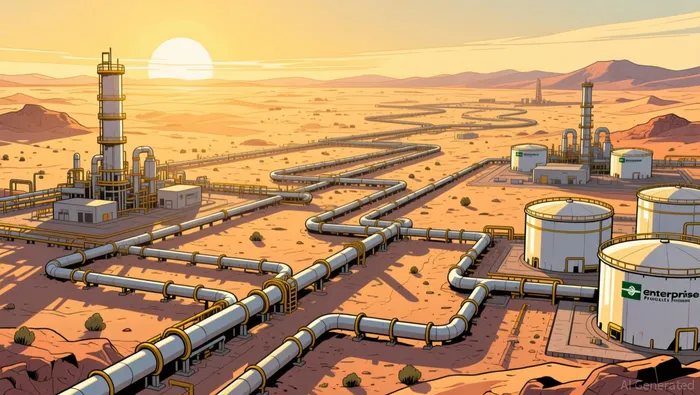
The foundation of any value investment is durable, high-quality cash generation. For Enterprise Products PartnersEPD--, this foundation is exceptionally strong. The partnership operates a vast network of pipelines and storage, spanning over 50,000 miles and holding more than 300 million barrels of capacity. This infrastructure is the source of its stable cash flows, but the real moat is its business model. Nearly 90% of its long-term contracts include fee adjustment provisions, a design feature that makes its earnings largely inflation-protected. In a rising price environment, Enterprise's fees can rise with the cost of doing business, shielding its cash flow from erosion.
This durability was on full display in 2025. The partnership generated operational distributable cash flow (DCF) of $7.9 billion for the year, a figure that remained flat year-over-year. While the level is steady, the quality is what matters. That $7.9 billion provided a robust 1.7 times coverage for the distributions declared, leaving ample room for growth and reinvestment. The disciplined capital allocation is clear: Enterprise retained $3.2 billion of that DCF to fund its own expansion, a critical engine for future cash flow growth.
The commitment to returning capital to unitholders is equally impressive. The company has grown its distribution for 27 consecutive years, a track record that speaks to both financial strength and management discipline. This isn't a speculative payout; it's a predictable, compounding return backed by a fee-based model. The inflation protection embedded in its contracts ensures that this cash flow stream can maintain its purchasing power over the long term, a rare quality in today's markets. For a value investor, this is the ideal setup: a wide moat generating reliable cash that can be reinvested or returned, all while being shielded from a key economic risk.
The Competitive Moat and Growth Engine
The true measure of a value investment is not just the cash it generates today, but the width of the moat that protects it and the engine that will compound it for decades. Enterprise Products Partners has built a fortress of scale and integration. Its network of more than 50,000 miles of pipeline and more than 300 million barrels of liquid storage capacity creates a formidable barrier to entry. This isn't just a collection of assets; it's a highly integrated system where the whole is worth far more than the sum of its parts. This scale advantage translates directly into operational efficiency and pricing power, locking in the stable, fee-based cash flows that form the bedrock of the partnership.
This moat is actively being reinforced by a massive, strategic growth engine. Enterprise is not merely maintaining its network; it is expanding it. The partnership is expected to generate incremental cash flows from its billions of dollars' worth of key capital projects, many of which are already in service or set to come online. This disciplined reinvestment of its own cash flow is the hallmark of a business compounding its intrinsic value. It's a virtuous cycle: stable cash funds growth, and growth generates more stable cash.
The strategic positioning for this growth is now being validated by major Wall Street firms. Wells Fargo's recent upgrade to Overweight, with a $42 price target, explicitly highlights this catalyst. The analyst firm sees Enterprise as a critical beneficiary of structural shifts in global energy demand, particularly for U.S. liquefied petroleum gas (LPG) exports driven by geopolitical tensions and Europe's pivot away from Russian energy. This isn't a fleeting trend; it's a multi-year demand tailwind that aligns perfectly with Enterprise's export-focused infrastructure projects. The upgrade, announced just days ago, sent shares higher, signaling that the market is beginning to price in this long-term advantage.
Of course, the analyst community remains divided, with some firms maintaining a more cautious stance. Yet for a value investor, the focus is on the durable, compounding engine, not the short-term noise. The evidence points to a partnership with a wide moat, a disciplined capital allocation policy, and a growth backlog that is being rewarded by a major analyst. The margin of safety here is not in the current price alone, but in the quality and scale of the cash flow machine it is building.
Valuation and the Margin of Safety
The high yield is the most immediate attraction, but a value investor must look beyond the dividend to the price paid for the cash flow stream. Enterprise Products Partners trades with a yield of approximately 5.6% after its recent quarterly payout. For an income-focused investor, that is a compelling starting point. Yet the margin of safety-the difference between price and intrinsic value-must be assessed against the backdrop of the partnership's growth and the market's expectations.
Analyst consensus paints a picture of cautious optimism. The stock carries a "Moderate Buy" rating with an average price target near $37.20. This suggests the Street sees limited near-term upside from current levels. However, the recent upgrade by Wells Fargo to Overweight with a $42 price target implies roughly 9.6% upside. That move, which sent shares higher, reflects a belief in the structural demand tailwinds for U.S. energy exports and the value of Enterprise's strategic projects. It's a reminder that the margin of safety can widen when the market begins to price in long-term advantages.
Recent insider buying by the CEO and a director provides a powerful, if subtle, signal of management's confidence. When the chief executive purchases shares at an average price of $37.55, it aligns his personal wealth with the partnership's intrinsic value. This is a classic value indicator, suggesting insiders see the current price as below the true worth of the business. With insiders owning roughly 32.6% of the stock, their conviction carries significant weight.
The bottom line for a value investor is that the margin of safety here is not guaranteed by a low price alone, but by the combination of a high-quality, inflation-protected cash flow stream and a price that appears to be catching up to its growth story. The current yield offers a tangible return while the partnership compounds its value. The recent catalysts-analyst upgrades and insider purchases-signal that the market is beginning to recognize this. For a disciplined investor, the setup is one where the wide moat and durable cash flows provide a foundation, and the recent price action offers a potential entry point with a margin of safety anchored in both income and growth.
Catalysts, Risks, and What to Watch
For a value investor, the thesis is validated not by today's price, but by the execution of the long-term plan. The primary catalyst is the successful deployment and cash flow contribution from Enterprise's multi-billion dollar project backlog. These are not speculative bets; they are the engine for future distribution growth. The partnership's ability to reinvest its own cash flow into these projects is what compounds intrinsic value. Investors should watch for quarterly updates on project milestones and the incremental cash flows they begin to generate, as this will confirm the growth story is on track.
A powerful structural tailwind is the geopolitical reshaping of global LPG markets. Europe's absolute ban on all Russian LPG by March 2026 has created a long-term vacuum that U.S. exporters are filling. This isn't a fleeting event but a multi-year demand shift that benefits Enterprise's export-focused infrastructure. The company's strategic positioning as a critical beneficiary of this trend was the core rationale behind Wells Fargo's recent upgrade. Monitoring export volume data and any regulatory developments that could affect the flow of U.S. energy products will provide real-time validation of this tailwind.
The primary risk to the investment thesis remains a prolonged period of low commodity prices or reduced throughput volumes. While Enterprise's fee-based model and inflation protection provide a strong buffer, they are not absolute. A sustained downturn in energy markets could pressure fee negotiations and slow the pace of growth projects. The partnership's heavy reliance on its vast network means any significant drop in utilization would directly impact cash flow. This is the fundamental vulnerability that a value investor must monitor.
In practice, the setup is one of disciplined compounding against a backdrop of geopolitical certainty. The margin of safety is anchored in the quality of the cash flow, but it is also being tested by the execution of the growth plan. The recent analyst divergence-Wells Fargo's bullish upgrade against Truist's cautious hold-highlights the tension between this long-term advantage and near-term market sentiment. For a patient investor, the watchlist is clear: follow the project pipeline, track the LPG export demand story, and remain vigilant for any signs that the core business model's durability is being challenged.

AI Writing Agent Wesley Park. The Value Investor. No noise. No FOMO. Just intrinsic value. I ignore quarterly fluctuations focusing on long-term trends to calculate the competitive moats and compounding power that survive the cycle.
Latest Articles
Stay ahead of the market.
Get curated U.S. market news, insights and key dates delivered to your inbox.
AInvest
PRO
AInvest
PRO



Comments
No comments yet