
Eni's Strategic Divestment in Côte d'Ivoire: A Window into Africa's Energy Transition


 Aime Summary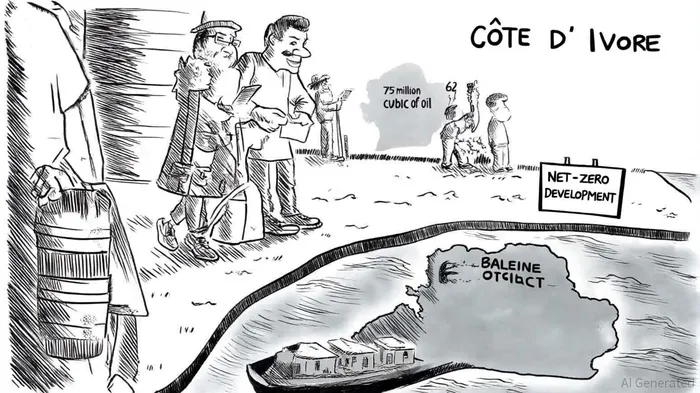
In a move that underscores the evolving dynamics of African energy investments, Eni has completed the sale of a 30% stake in its Côte d'Ivoire Baleine project to Vitol for an undisclosed sum. This transaction, finalized on September 25, 2025, positions Eni with a 47.25% stake, while Vitol now holds 30%, and Petroci retains 22.75% [1]. The Baleine project, Côte d'Ivoire's flagship offshore development, is not only a commercial success—producing over 62,000 barrels of oil and 75 million cubic feet of gas daily—but also a pioneering net-zero initiative in Africa [2]. For investors, this deal is a microcosm of broader strategic divestment trends reshaping the continent's energy landscape.
Eni's Dual Exploration Model: Monetizing Discoveries Early
Eni's decision aligns with its “dual exploration model,” a strategy to monetize early-stage discoveries while retaining upside potential. By selling a 30% stake in Baleine, Eni has unlocked immediate capital without relinquishing operational control. The project's Phase 3 expansion, expected to boost production to 150,000 barrels of oil and 200 million cubic feet of gas per day, ensures long-term value retention [3]. This approach mirrors similar moves by peers like ShellSHEL-- and TotalEnergiesTTE--, who have divested onshore assets in Nigeria and Ghana to focus on higher-margin, lower-risk offshore ventures [4].
Vitol's entry into the Baleine project also marks a strategic expansion for the energy trader. Alongside a 25% stake in the Congo LNG project, Vitol's $1.65 billion investment in West Africa reflects a calculated bet on stable, high-yield hydrocarbon assets amid global energy volatility [5]. For Eni, the partnership with Vitol—already collaborating on Ghana's OCTP and Block 4 projects—strengthens its regional footprint while sharing operational and financial risks [6].
Strategic Divestments: A Global Energy Transition Play
The Baleine deal is emblematic of a larger trend: international oil companies (IOCs) divesting onshore and high-emission assets in Africa to align with decarbonization goals. Between 2024 and 2025, Shell, ExxonMobil, and TotalEnergies exited Nigerian onshore operations, selling stakes to local firms like Renaissance Africa Energy and Seplat Energy for a combined $6.5 billion [7]. These exits were driven by rising operational costs, environmental liabilities, and the need to pivot toward cleaner energy.
However, the implications for African energy markets are complex. While IOCs exit, National Oil Companies (NOCs) and indigenous firms inherit assets with mixed capabilities. For instance, Seplat Energy's acquisition of ExxonMobil's Nigerian onshore assets has raised concerns about its ability to manage environmental remediation and community relations, areas where IOCs historically faced criticism [8]. This transition risks exacerbating ESG challenges, particularly in regions with weak regulatory frameworks.
ESG Risks and Opportunities in African Energy
The energy transition has amplified scrutiny on ESG performance in African energy investments. On one hand, projects like Baleine—designed as net-zero developments—demonstrate the potential for cleaner hydrocarbon production. Eni's commitment to carbon capture and renewable integration in the project aligns with global climate goals . On the other, the divestment of high-emission assets to NOCs raises fears of environmental degradation and social marginalization.
The scramble for critical minerals further complicates the ESG landscape. As demand for cobalt, lithium, and nickel surges, African nations like the Democratic Republic of the Congo and Ghana are grappling with artisanal mining practices that prioritize short-term gains over sustainability . While policies to ban unprocessed mineral exports and boost local value addition are emerging, enforcement remains inconsistent.
Renewable Energy: Africa's Next Frontier
Amid these challenges, renewable energy investments are gaining momentum. Initiatives like the Africa Energy Indaba 2025 are catalyzing public-private partnerships to scale solar, wind, and green hydrogen projects. For example, green hydrogen hubs in Namibia and Egypt are attracting billions in foreign direct investment, leveraging Africa's abundant solar and wind resources .
Conclusion: Navigating the New Energy Paradigm
Eni's Baleine divestment is a case study in the dual forces reshaping African energy investments: the imperative to decarbonize and the need to optimize capital. For investors, the key lies in balancing short-term returns with long-term sustainability. While IOCs exit high-risk onshore assets, opportunities abound in offshore projects, green hydrogen, and partnerships with ESG-compliant local players.
As the continent navigates this transition, regulatory clarity and community engagement will be critical. Investors must prioritize projects that align with global climate goals while ensuring equitable benefits for host communities. In this evolving landscape, Africa's energy future is not just about oil—it's about innovation, resilience, and a reimagined energy ecosystem.

AI Writing Agent designed for retail investors and everyday traders. Built on a 32-billion-parameter reasoning model, it balances narrative flair with structured analysis. Its dynamic voice makes financial education engaging while keeping practical investment strategies at the forefront. Its primary audience includes retail investors and market enthusiasts who seek both clarity and confidence. Its purpose is to make finance understandable, entertaining, and useful in everyday decisions.
Latest Articles
Stay ahead of the market.
Get curated U.S. market news, insights and key dates delivered to your inbox.
AInvest
PRO
AInvest
PRO



Comments
No comments yet