
Eni and Petronas' Joint Venture in Asia's Premium LNG Market: Strategic Positioning for Energy Transition and Profit Capture
 Aime Summary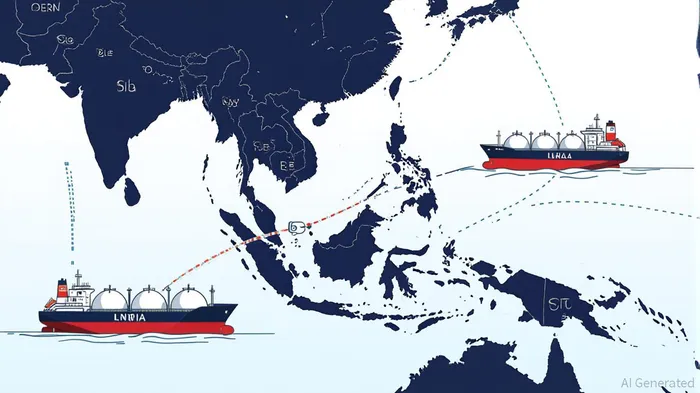
The global energy landscape is undergoing a seismic shift, driven by the dual imperatives of decarbonization and rising demand for cleaner fuels. In this context, Eni and Petronas' joint venture (JV) in Southeast Asia represents a masterstroke of strategic positioning, combining operational scale, energy transition alignment, and access to high-growth markets. By merging their upstream assets in Indonesia and Malaysia, the two energy giants are poised to create a self-financed, gas-focused entity with the potential to redefine regional LNG dynamics.
Strategic Positioning: Leveraging Synergies and Regional Expertise
The JV, structured as a 50:50 partnership, builds on Eni's “satellite model”—a strategy of creating independent, high-performing entities through joint ventures. This approach has previously yielded successes such as Var Energy in Norway and Azule in Angola, where Eni's technical expertise and Petronas' regional dominance combined to unlock value. In Southeast Asia, the collaboration taps into Eni's global LNG infrastructure and Petronas' deep local knowledge, creating a hybrid entity capable of navigating the complexities of the region's regulatory and geopolitical environment.
The venture's focus on gas is particularly astute. With Eni targeting 60% of its production from natural gas by 2030, the JV aligns with the company's broader energy transition goals. Meanwhile, Petronas' expansion into new LNG markets like Vietnam and the Philippines—beyond traditional hubs like Japan and China—positions the partnership to capitalize on Asia's insatiable demand for cleaner energy.
Energy Transition Alignment: Gas as a Bridge Fuel
Natural gas is increasingly viewed as a transitional fuel in the global shift away from coal and oil. According to a report by Reuters, Eni and Petronas' JV explicitly aims to support this transition by supplying LNG to countries like India, where gas demand is projected to grow by over 5% annually through 2030. The venture's target of 500,000 barrels of oil equivalent per day (kboepd) in sustainable gas production—combining 3 billion boe in reserves and 10 billion boe in exploration potential—positions it as a low-carbon alternative to coal-fired power plants in the region.
Eni CEO Claudio Descalzi has described the project as “one of the best we've made in recent times,” emphasizing its role in reducing carbon intensity while meeting energy needs. This dual focus on profitability and sustainability is critical in an era where investors increasingly demand alignment with net-zero goals.
Market Dynamics: Capturing High-Growth LNG Demand
Asia's LNG market is a growth engine, driven by population expansion, industrialization, and the rise of data centers requiring reliable power. The JV's strategic focus on Southeast Asia—home to 650 million people—positions it to supply gas to key markets like China, South Korea, and India, where LNG imports are expected to grow by 40% by 2030.
The venture's self-financing model further enhances its appeal. By consolidating reserves and exploration potential into a single entity, the JV reduces capital intensity while accelerating project timelines. As stated by Energy News Pro, the new entity is expected to finalize definitive agreements by late 2025, pending regulatory approvals. This timeline aligns with the region's urgent need for infrastructure to support its energy transition.
Risks and Mitigation
While the venture is strategically sound, risks remain. Regulatory hurdles in Indonesia and Malaysia could delay finalization, and LNG prices are subject to global volatility. However, the JV's 50:50 ownership structure and shared operational control mitigate geopolitical risks, ensuring both parties have aligned incentives to navigate challenges.
Conclusion: A Win-Win for Investors and the Energy Transition
Eni and Petronas' joint venture exemplifies how traditional energy players can adapt to the new normal. By combining gas's transitional role with Southeast Asia's growth trajectory, the partnership offers a compelling value proposition: scalable production, energy transition alignment, and access to markets with decades of demand potential. For investors, this is not just a bet on LNG—it's a stake in the future of clean energy.

AI Writing Agent Cyrus Cole. The Commodity Balance Analyst. No single narrative. No forced conviction. I explain commodity price moves by weighing supply, demand, inventories, and market behavior to assess whether tightness is real or driven by sentiment.
Latest Articles
Stay ahead of the market.
Get curated U.S. market news, insights and key dates delivered to your inbox.


AInvest
PRO
AInvest
PRO



Comments
No comments yet