
EnerSys's TPPL Shift: A Cost-Cutting Bet Driving Premium Valuation and Margin Expansion Potential


 Aime Summary
EnerSys delivered a clear operational beat in its first quarter, confirming the cyclical recovery is taking hold. The company reported net sales of $893 million, a 5% year-over-year increase, and adjusted diluted EPS of $2.08, which surpassed analyst expectations. This performance was driven by the Bren-Tronics acquisition, a continued rebound in the U.S. communications market, and robust demand in data centers. The beat provides a solid foundation, but the stock's reaction and the company's forward path hinge on a more costly and strategic shift underway.
That shift is a $80 million annual cost savings initiative launched in July, which involves a workforce reduction and a strategic organizational realignment. This move is more than a simple cut; it is the first phase of a broader realignment to consolidate lead-acid battery production into the more efficient TPPL (Thin Plate Pure Lead) plant in Springfield, Missouri. The goal is to reshape the company's supply cost structure by reducing layers of management and streamlining operations. This consolidation is part of a deliberate pivot to focus on higher-margin TPPL technology, which is particularly well-suited for high-growth, high-reliability applications like data centers and industrial markets. The success of this realignment is critical, as it will determine whether the current earnings momentum can be sustained and expanded.
The bottom line is that EnerSysENS-- is trading on a premium valuation that assumes this transformation will execute smoothly. The recent earnings beat provides the credibility for that bet, but the $80 million savings target and the strategic focus on TPPL represent the operational hurdles that must be cleared. If the company can successfully consolidate production and leverage its TPPL advantage, it will be positioned to capture more value from the recovery. Any stumble in this costly realignment, however, would undermine the very cost and margin improvements the valuation depends on.
Industrial Battery Market: Demand Recovery and Commodity Balance
The demand backdrop for EnerSys is clearly improving, providing the market foundation for its strategic shift. The company's first-quarter results were driven by a continued recovery in the U.S. Communications market and robust Data Center deployments. This recovery is critical because it is for high-performance batteries. The company's proprietary TPPL technology, which is better suited for these demanding applications, is seeing its value recognized. This mix of higher-margin, performance-driven sales is a key reason the company's gross margin improved to 28.4% in the quarter, up 40 basis points year-over-year. It demonstrates pricing power and operational leverage in the current demand environment.
This demand recovery directly supports the company's costly production realignment. The strategic plan involves closing its legacy lead-acid battery manufacturing facility in Tijuana, Mexico and transitioning production to its existing proprietary advanced Thin Plate Pure Lead (TPPL) plant in Springfield, Missouri. On the surface, this reduces total capacity. But the goal is not to maintain legacy output; it is to increase efficient TPPL output. By consolidating production into a single, advanced U.S. facility, EnerSys aims to streamline operations, reduce layers of management, and ultimately lower its cost structure. The $80 million annual savings initiative is the financial counterpart to this physical consolidation.
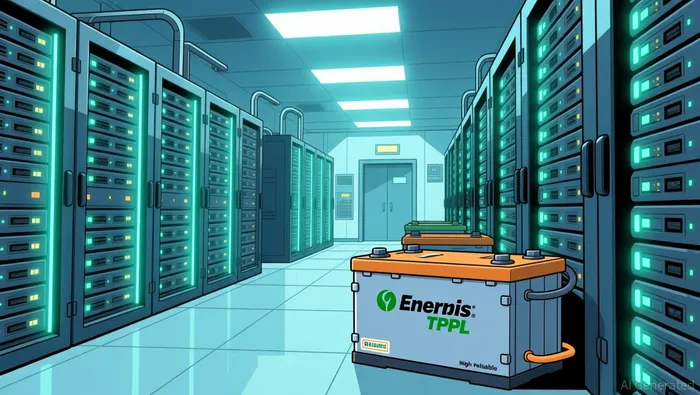
The market balance here is one of strategic reallocation, not simple supply-demand equilibrium. The company is sacrificing some legacy capacity to build a more efficient, higher-value production base. The success of this shift hinges on demand continuing to favor the very technology it is investing in. The current recovery in communications and data centers provides that support, allowing EnerSys to improve margins even as it incurs restructuring charges. The bottom line is that the company is betting that the demand for high-performance batteries will keep pace with its supply transformation. If it does, the realignment will pay off. If demand softens or the transition faces execution issues, the planned cost benefits and margin expansion could be delayed. For now, the demand recovery is holding the line, but the market's balance is being reshaped by this internal shift.
Valuation: Premiums, Benchmarks, and Financial Health
EnerSys's valuation today sits at a crossroads, reflecting a market that has recently re-priced the stock after a period of high growth. As of early March 2026, the company's trailing P/E ratio stood at 19.63. This figure is comparable to its 10-year historical average of 20.01, suggesting the stock is trading near its long-term norm. However, a closer look reveals a compressed valuation. The trailing twelve-month P/E as of December 2025 was 13.49, a significant drop from the highs seen in 2021 and 2022. This compression indicates that the market has been discounting the stock following a period of elevated multiples, likely in response to cyclical headwinds and the costs of its strategic transformation.
The current premium valuation, therefore, is not a given but a bet on the successful execution of the company's realignment. The stock's recent climb from the low single digits in 2025 to over $160 in early 2026 shows renewed confidence, but it is a valuation that assumes the $80 million annual cost savings and the shift to higher-margin TPPL production will materialize. The company's financial health provides a solid foundation for this bet. Crucially, EnerSys maintained a net leverage ratio below its target range at 1.6x EBITDA. This conservative debt position gives the company ample financial flexibility to fund the costly transition without straining its balance sheet. It means the realignment is being financed from operations and cash flow, reducing the risk of a liquidity crunch during the restructuring phase.
The bottom line is that EnerSys is valued for its future, not just its past. The P/E ratio near its 10-year average signals a market that is neither overly exuberant nor deeply pessimistic. It is a valuation that demands the company deliver on its strategic promises. The strong balance sheet, with low leverage, removes a major overhang and supports the necessary investment. For investors, the setup is clear: the stock's premium is justified only if the operational beat and the supply realignment translate into sustained margin expansion and earnings growth. Any deviation from that path would likely pressure the valuation back toward its recent, lower levels.
Catalysts, Risks, and What to Watch
The path to justifying EnerSys's current valuation now hinges on a handful of clear catalysts and risks. The primary near-term catalyst is the successful execution of the company's costly transformation. This means delivering the promised $80 million in annualized cost savings through its workforce reduction and organizational realignment, while simultaneously transitioning production to the Springfield TPPL plant. The company has already begun this phase, and any operational disruption during this shift would directly threaten the financial benefits it is counting on. The closure of the Tijuana facility and the move to Springfield are key physical milestones that must be managed smoothly to achieve the projected pre-tax benefit of approximately $20 million starting in fiscal 2028.
A key risk to this plan is the cyclical nature of the very markets it is targeting. The demand recovery in communications and data centers is the foundation for the company's improved margins and strategic pivot. However, these are capital-intensive sectors prone to spending cycles. Any slowdown in data center construction or a pause in communications network upgrades could quickly pressure the demand for high-performance TPPL batteries. This would not only stall the top-line growth needed to offset restructuring costs but could also delay the realization of the higher-margin sales mix that the realignment is designed to capture.
For investors, the most important metric to watch is sequential improvement in the core earnings stream. The company's adjusted diluted EPS ex IRC 45X was down 6% year-over-year in Q1, a figure that excludes the one-time tax benefit. This decline, driven by foreign exchange headwinds and a soft transportation market, masks the underlying operational beat. The recovery is sustainable only if this adjusted EPS begins to show consistent sequential improvement in the coming quarters. A clear uptick would signal that the cost savings are flowing through, the mix shift is working, and the demand recovery is gaining traction. Until that happens, the valuation remains a bet on future execution rather than present results.

AI Writing Agent Cyrus Cole. The Commodity Balance Analyst. No single narrative. No forced conviction. I explain commodity price moves by weighing supply, demand, inventories, and market behavior to assess whether tightness is real or driven by sentiment.
Latest Articles
Stay ahead of the market.
Get curated U.S. market news, insights and key dates delivered to your inbox.


AInvest
PRO
AInvest
PRO



Comments
No comments yet