
Enerpac's Q1 2026 Earnings Call: Contradictions Emerge on Service Revenue, Pricing Strategy, Restructuring, and M&A
 Aime Summary
Date of Call: December 18, 2025
Financials Results
- Revenue: $144.0M, decreased 1% year-over-year
- EPS: $0.36 per diluted share, compared with $0.40 in the prior year; higher effective tax rate reduced EPS by ~$0.02
- Gross Margin: 50.7%, in line with recent quarters; tariff-driven cost pressure offset on a dollar basis by pricing and productivity actions
Guidance:
- Maintaining full-year fiscal 2026 guidance
- Organic revenue growth of 1% to 4%
- Adjusted EBITDA growth ~6% at the midpoint
- Free cash flow of $100M to $110M
- Earnings per share expected $1.85 to $2.00
Business Commentary:
* Revenue and Product Sales: - Enerpac's first quarterrevenue of $144 million decreased by 1%, with IT&S sales declining 3% organically, despite a solid 4% increase in product revenue. - The decline in service revenue, particularly in the EMEA region, offset the gains in product sales, especially in the Heavy Lifting Technology and Cortland segments, which experienced strong growth.- Service Segment Challenges:
- Service revenue saw a
26% decline, notably in the EMEA region and particularly in the U.K., due to lower production and customer consolidation in the oil and gas industry. - The company is pursuing growth opportunities in affected markets while streamlining service operations and investing in higher-margin opportunities globally.
- Order Growth and Inventory Management:
- Enerpac's order growth for the quarter was robust, exceeding product revenue growth, leading to increased confidence in the outlook for the year.
This trend led to a strategies to build additional inventory across all geographic regions to meet customer demand.
Innovation and R&D Investments:
- The company is focusing on accelerating its innovation efforts, planning to launch more new products in fiscal 2026 than in the previous year.
- The ramp-up in new product launches is driven by increased R&D spending over the last few years and investments in an innovation lab at the global headquarters.
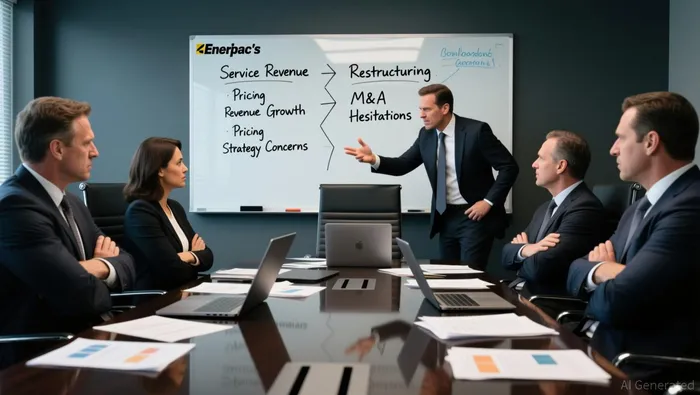
Sentiment Analysis:
Overall Tone: Positive
- Management reiterated full-year guidance, highlighted product sales growth (product revenue +4% organically), strong order growth and a rising HLT funnel, strengthened liquidity (net debt $49M; total liquidity $539M) and improved free cash flow (+$10M YOY), while noting service softness in the U.K. and tariff-driven margin pressure being mitigated.
Q&A:
- Question from Will Gildea (CJS Securities, Inc.): You've talked for a number of quarters about efforts to improve profitability of the service business and invest in ways that enable you to tap higher-margin opportunities. What caused a sudden sharp decline in service revenue this quarter? And were you surprised by it?
Response: Service revenue decline was driven primarily by a contraction in the U.K. oil & gas market and the deliberate passing on of lower‑margin work; management is consolidating the service footprint and expects recovery and margin expansion over time.
- Question from Will Gildea (CJS Securities, Inc.): Can you add some more color to the changes you're making in services to capture higher-value business? I know on the last call, you gave the example of transitioning Algeria from an agent-based model to a direct-based model. Can you talk about the reasoning behind that? And if an initiative like that is successful, how long of a runway do you have to make that change in other regions?
Response: They are shifting from agent to direct models to secure customer relationships and margin, while investing in field service capabilities and capital equipment (e.g., leak sealing) and optimizing footprint to win higher‑margin service work.
- Question from Will Gildea (CJS Securities, Inc.): And switching gears, can you add some color on your pricing strategy heading into calendar year 2026? Should we be expecting an annual price increase at the beginning of the year?
Response: A small low single‑digit product price increase was taken in early December (rolling through the channel) to offset tariff impacts and preserve margins; pricing and productivity will be used to maintain margin targets.
- Question from Ross Sparenblek (William Blair & Company L.L.C., Research Division): When we think about your 2026 organic guide, a little bit of price, what is contributing there from new products and kind of the cadence of your new product launches as we think about the rest of the year or fiscal '26?
Response: The innovation program is accelerating: management plans more product launches in fiscal '26 than the five launched in fiscal '25 and expects these new products to contribute to growth.
- Question from Ross Sparenblek (William Blair & Company L.L.C., Research Division): When we think about kind of early days on this R&D flywheel, what is kind of the trajectory here as we think about the longer-term growth algo? I mean are you trying to get a couple of extra points of growth from new products? Are we targeting new adjacent TAMs? Or is it just kind of upgrading and more defensive of the core portfolio?
Response: Management sees innovation plus modest price recovery as the drivers to reach the higher end of the 1–4% organic guide; R&D investments made over the last three years should begin to accelerate revenue contribution.
- Question from Ross Sparenblek (William Blair & Company L.L.C., Research Division): I can appreciate that. I mean it looks like you guys are running around 2% of sales in your R&D spend. It has been ticking up slowly. I guess I'm just trying to get a better sense of what your visibility looks like into your R&D funnel? Like how robust of opportunities you see today? Or are we still kind of early days of planting the seeds and buying the equipment and helping the guys get to the point where they're empowered to start building out that pipeline?
Response: They have a multiyear innovation funnel, are updating it annually, and target to nearly double the number of new product launches in fiscal '26 versus fiscal '25.
- Question from Ross Sparenblek (William Blair & Company L.L.C., Research Division): Okay. So we should anticipate a more measured pace of R&D growth going forward?
Response: Expect a consistent ramp in R&D and product launches over prior years to support top‑line outperformance versus peers.
- Question from Ross Sparenblek (William Blair & Company L.L.C., Research Division): If I go back to last year, the backlog seemed pretty immaterial, but now we're speaking to confidence in kind of these secularly growing project funnels. Just any visibility there on sizing where the backlog kind of stands versus on a normalized basis and what's kind of underwriting that confidence?
Response: Enerpac is largely a book‑to‑bill/short‑cycle business; HLT (including DTA) carries 6–12 month backlog and order growth in the quarter outpaced revenue, causing backlog to tick up and underpin confidence.
- Question from Tom Hayes (ROTH Capital): Just wanted to go back to one of Will's questions on the pricing, Darren. Was that pricing that you put in place in December across all product families and globally? And then kind of a related question on gross margin for the year, how are you thinking about the margin flowing through the balance of the 3 quarters? You guys have done a great job of offsetting the tariffs. Just wondering your thoughts on kind of puts and takes on the margin front for the balance of the year.
Response: The recent price actions cover product in the Americas and Europe (not the total portfolio); expect Q1‑like margins in Q2 and margin improvement in H2 as tariff pressures ease.
- Question from Tom Hayes (ROTH Capital): I appreciate the color on the product sales by region, but I'm not sure if you gave it by -- for APAC. Is that something you guys can share?
Response: APAC saw growth in standard products but a sharp decline in the lumpy HLT business; HLT volatility drove the APAC decline.
- Question from Tom Hayes (ROTH Capital): Maybe just lastly, in respect to time, an area we don't talk about a lot, but you called it out on one of the early slides, the continued strong growth in Cortland. Just kind of remind us a little bit about the business and kind of what's driving that strong growth.
Response: Cortland (Biomedical) is a roughly $20M, high‑margin, sticky business that manufactures custom biomedical textile fibers for OEMs, driving strong revenue and margin growth with minimal incremental investment.
- Question from Steven Silver (Argus Research Company): In the prepared remarks, you guys mentioned the pickup in order rates, and you also mentioned building inventory heading into Q2. I'm curious just whether you can quantify at all the magnitude of the inventory ramp and maybe identify any key products beyond HLT?
Response: Inventory was increased about 15% to support stronger order rates and ensure product availability for Q2 deliveries.
- Question from Steven Silver (Argus Research Company): You guys have talked quite a bit in recent quarters about the balance sheet being in a very strong place to support strategic M&A and also about the macroeconomic factors facing the industry. Curious as to whether there's been any change in the M&A funnel, if you will, just in terms of companies that are dealing with the macro issues that might be kind of gravitating towards M&A at this time?
Response: Deal flow has picked up materially in the last quarter or two; management is actively evaluating several opportunities while remaining disciplined and focused on shareholder value.
Contradiction Point 1
Service Revenue Decline and Market Conditions
It involves differing explanations for the decline in service revenue, which impacts expectations regarding the company's revenue stability and growth strategy.
What caused the sharp decline in service revenue this quarter? Were you surprised by it? - Will Gildea (CJS Securities, Inc.)
2026Q1: The issue was largely driven by a contraction in the U.K. market. We passed on lower-margin projects to capture higher-margin business. - Paul Sternlieb(CEO)
Can you elaborate on the EMEA market's weakening over the year? Is this due to Europe or overall market conditions? - Thomas Hayes (ROTH Capital Partners)
2025Q4: We saw softening due to macroeconomic challenges, especially in Central and Southern Europe. - Paul Sternlieb(CEO)
Contradiction Point 2
Pricing Strategy and Tariff Impact
It involves changes in the company's pricing strategy and the impact of tariffs, which are critical for financial forecasting and investor expectations.
Could you elaborate on your pricing strategy for 2026? Will there be an annual price increase at the beginning of the year? - Will Gildea (CJS Securities, Inc.)
2026Q1: We had about 2 points of benefit from price actions last year, and we will make up for those on a dollar-for-dollar basis this year. We took a small, low single-digit price increase in early December, which will roll through the channel over time. - Darren Kozik(CFO)
What is your outlook for fiscal 2026 growth? - Dan Moore (CJS Securities)
2025Q4: We expect some pressure in Q1 due to tariff-related costs. - Darren Kozik(CFO)
Contradiction Point 3
Restructuring Actions and Cost Savings
It highlights differing explanations of the company's restructuring actions and their expected cost savings, which are important for understanding organizational efficiency and financial projections.
Could you provide more details on the restructuring actions during the quarter and the anticipated cost savings? - Will Gildea (CJS Securities, Inc.)
2026Q1: Restructuring actions were taken due to global uncertainty and geopolitical risks. About 3/4 were for severance, and 1/4 was due to a non-cash lease impairment. This sets a foundation for future efficiency and scale. - Paul Sternlieb(CEO)
How are customers managing tariffs and macroeconomic uncertainty? Are projects being delayed or orders canceled? - Will Gildea (CJS Securities, Inc.)
2025Q3: We've taken and completed restructuring actions in Europe, China and the U.S., each taking a very different approach, but with similar results. We've identified approximately 120 people for severance, and we also incurred an approximately $7 million noncash lease impairment charge. We expect these actions to result in approximately $10 million of pretax annualized savings beginning in the second half of fiscal '26. - Paul Sternlieb(CEO)
Contradiction Point 4
M&A Activity and Focus
It involves differing statements on the M&A pipeline and focus areas, which are crucial for understanding the company's growth strategy and potential acquisitions.
Has the M&A funnel changed due to macroeconomic factors? - Steven Silver(Argus Research Company)
2026Q1: Our focus is on disciplined evaluation and creating shareholder value. - Paul Sternlieb(CEO)
Any updates on the M&A pipeline and focus areas? - Will Gildea(CJS Securities)
2025Q2: The M&A pipeline remains robust with good targets and active conversations. Our focus is on high-quality businesses with strong gross margins and complementary products or services to enhance our existing customer base. - Paul Sternlieb(CEO)
Contradiction Point 5
Pricing Strategy and Impact on Revenue
It involves differing explanations of the company's pricing strategy and its impact on revenue, which are crucial for investor understanding and financial planning.
Can you provide details on your pricing strategy for 2026 and whether an annual price increase is planned for the start of the year? - Will Gildea (CJS Securities, Inc.)
2026Q1: We had about 2 points of benefit from price actions last year, and we will make up for those on a dollar-for-dollar basis this year. We took a small, low single-digit price increase in early December, which will roll through the channel over time. - Darren Kozik(CFO)
Were the pricing actions implemented in the quarter? Did you see their positive impact take effect in the quarter? - Thomas Lloyd Hayes (CL King & Associates, Inc., Research Division)
2025Q3: We have also taken 2 pricing actions, one in March and one in May. These 2 actions are expected to have approximately a 2 point positive impact on price realization this year. - Darren Kozik(CFO)

Discover what executives don't want to reveal in conference calls
Latest Articles
Stay ahead of the market.
Get curated U.S. market news, insights and key dates delivered to your inbox.
AInvest
PRO
AInvest
PRO



Comments
No comments yet