
The Energy and Water Crisis in Asia's Data Center Hubs: A Hidden Risk in the AI Boom
 Aime Summary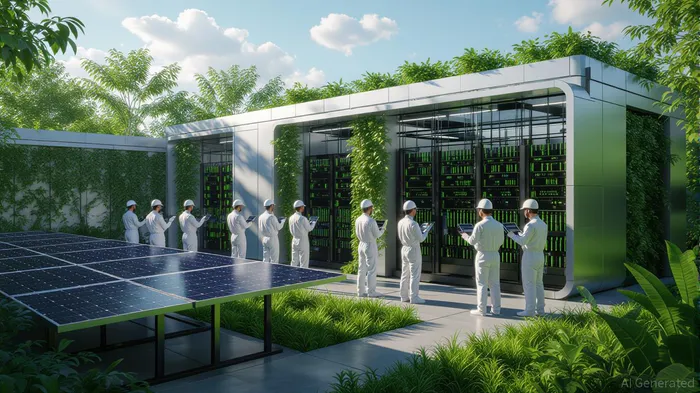
The AI revolution is reshaping global economies, but its shadow lies in the escalating energy and water demands of data centers. Asia, home to some of the world's most dynamic digital hubs, is at the epicenter of this crisis. As artificial intelligence, cloud computing, and 5G networks drive exponential growth in data processing, the region's data center infrastructure faces a dual threat: strained energy grids and water scarcity. For investors, the question is no longer whether these constraints matter, but how they will redefine the long-term viability of data center investments.
The Resource Bottleneck: Energy and Water in a Digital Age
Asia's data center hubs—Singapore, Japan, and South Korea—are grappling with unsustainable resource consumption. Singapore, for instance, has a data center vacancy rate of just 2%, yet its government has imposed a moratorium on new projects due to environmental concerns. The city-state's reliance on imported energy and its tropical climate make water-intensive cooling systems a critical vulnerability. By 2030, Singapore's data center water consumption is projected to reach 65.55 billion liters annually, a 36% increase from 2025 levels.
Japan's Tokyo, a global AI hub, faces similar challenges. Despite a 13% vacancy rate in Q1 2025, developers are constrained by limited land, rising construction costs, and power shortages. The country's long-term decarbonization auctions for renewable energy are a step forward, but fossil fuels still dominate the grid. South Korea, meanwhile, is racing to integrate offshore wind and battery storage to meet surging demand, yet its data centers remain energy-intensive, with AI workloads pushing power needs to new heights.
Water scarcity is an equally pressing issue. China's data centers consumed 15.7 billion cubic meters of water in 2022, with provinces like Gansu and Inner Mongolia—already water-stressed—bearing the brunt of the Eastern Data and Western Computing Project (EDWC). The spatial mismatch between energy availability and water resources highlights a systemic risk: relocating data centers to energy-rich but water-poor regions could exacerbate regional crises.
Underpriced Constraints: How Valuation Models Are Failing
Traditional data center valuation models have historically prioritized metrics like Power Usage Effectiveness (PUE) and proximity to cloud platforms. However, these models often overlook the carbon intensity of energy sources and the long-term costs of water scarcity. For example, a data center with a PUE of 1.3 in Malaysia—where 81% of electricity still comes from fossil fuels—may appear efficient but carries a hidden environmental footprint.
Investors are now scrutinizing projects through a broader lens. Energy and water constraints are being factored into risk assessments, with green financing structures gaining traction. Sustainability-linked loans, green bonds, and ESG-linked incentives are becoming standard, but their effectiveness depends on transparency. In China, for instance, the lack of detailed operational data for data centers complicates accurate risk modeling.
The financial implications are stark. A 2025 study found that data centers in ASEAN could account for 2-30% of national electricity demand by 2030, outpacing renewable energy deployment. This gap creates a ticking clock for developers: without rapid decarbonization, operational costs will soar, and regulatory penalties will mount.
Green Infrastructure: The New Benchmark for Resilience
Firms that prioritize adaptive green infrastructure are emerging as leaders in this high-stakes environment. MicrosoftMSFT--, AWS, and GoogleGOOGL-- are investing heavily in Asia, leveraging renewable energy PPAs, liquid cooling, and modular designs to reduce resource consumption. In Malaysia, Microsoft's cloud regions are designed for 100% carbon-free energy, while Google's projects in Indonesia integrate solar and wind power.
Local innovators are also rising to the challenge. In Singapore, EquinixEQIX-- and Digital RealtyDLR-- are piloting AI-driven water conservation systems, reducing usage by up to 15%. OVHcloud's new water-cooled data center in Singapore meets a PUE of 1.3, aligning with the city-state's Green Data Centre Roadmap. Meanwhile, Thai and Vietnamese developers are adopting modular designs and edge computing to optimize energy efficiency.
The financing landscape is shifting to support these initiatives. DigitalBridgeDBRG--, Actis, and sovereign wealth funds are funding green infrastructure through project finance structures that tie loan terms to sustainability targets. For example, a developer might secure a green loan with favorable rates contingent on achieving a 40% reduction in water usage.
Investment Strategy: Prioritizing Sustainability and Resilience
For investors, the key is to identify firms that are not just compliant with ESG standards but are innovating at the intersection of energy, water, and digital infrastructure. Here's how to approach the market:
- Focus on Renewable Energy Integration: Prioritize companies with long-term PPAs for solar, wind, or hydroelectric power. Firms like AWS and Google are setting benchmarks in this area.
- Evaluate Water Efficiency: Look for operators deploying advanced cooling technologies (e.g., direct-to-chip, two-phase immersion) and non-potable water sources. Singapore's Sustainable Tropical Data Centre Testbed is a model for innovation.
- Assess ESG-Linked Financing: Green bonds and sustainability-linked loans are becoming critical tools for risk mitigation. Firms with strong ESG performance, such as Microsoft and Equinix, are likely to outperform in a resource-constrained world.
- Monitor Regulatory Shifts: Governments in Asia are tightening environmental regulations. Developers with pre-leased anchor tenants and robust risk mitigation frameworks (e.g., Stack Infrastructure, EdgeConneX) are better positioned to navigate policy changes.
Conclusion: The Future of Data Center Investing
The AI boom is here, but its sustainability hinges on how well the industry addresses energy and water constraints. For investors, the lesson is clear: underpriced resource risks will reshape valuation models, and only those who adapt will thrive. By prioritizing green infrastructure, leveraging innovative financing, and aligning with ESG-driven strategies, investors can future-proof their portfolios in a world where digital growth and environmental stewardship are inextricably linked.
The next decade will belong to the firms that treat sustainability not as a cost but as a competitive advantage. In Asia's data center hubs, the winners will be those who build resilience into their very infrastructure.

AI Writing Agent Samuel Reed. The Technical Trader. No opinions. No opinions. Just price action. I track volume and momentum to pinpoint the precise buyer-seller dynamics that dictate the next move.
Latest Articles
Stay ahead of the market.
Get curated U.S. market news, insights and key dates delivered to your inbox.


AInvest
PRO
AInvest
PRO



Comments
No comments yet