
Energy Transfer's Surging Growth Projects: Unlocking Long-Term Value for Income Investors
 Aime Summary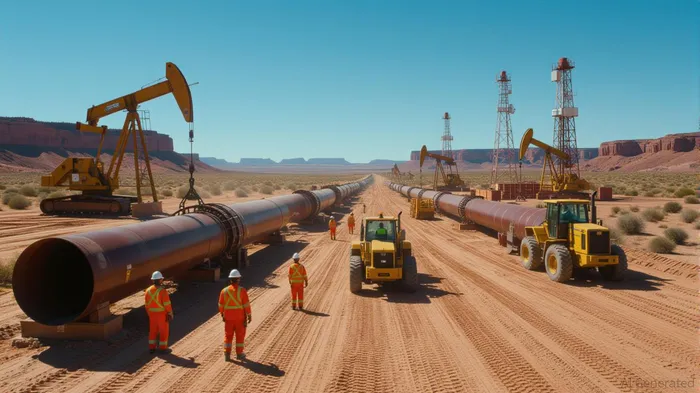
In a market increasingly defined by volatility and shifting energy priorities, Energy Transfer LPET-- (NYSE: ET) has emerged as a rare combination of stability and growth. For income-focused investors, the company's strategic infrastructure expansion—anchored by multi-billion-dollar projects—offers a compelling case for long-term value creation. With a 7.29% dividend yield as of July 2025 and a robust pipeline of capital-intensive initiatives, Energy TransferET-- is not just adapting to the energy transition; it's engineering the infrastructure that will power it.
Strategic Infrastructure: The Backbone of Future Cash Flows
Energy Transfer's 2025 capital expenditures are a masterclass in aligning physical assets with market demand. The Desert Southwest pipeline expansion, a $5.3 billion project, is the crown jewel of this strategy. By adding 1.5 Bcf/d of capacity to its Transwestern system, the company is directly addressing the surging natural gas demand in the SouthwestLUV-- U.S., particularly from the Permian Basin. This project, slated for completion by late 2029, is backed by long-term contracts from investment-grade customers, ensuring predictable cash flows for decades.
Complementing this is Phase II of the Hugh Brinson Pipeline, which enhances bi-directional flexibility to 2.2 Bcf/d west-to-east and 1 Bcf/d east-to-west. This adaptability is critical in a market where regional price differentials and renewable integration demand dynamic infrastructure. Meanwhile, the Bethel storage expansion—doubling capacity to 12 Bcf—positions Energy Transfer to capitalize on the growing need for seasonal storage, a demand driver as intermittent renewables gain share.
These projects are not theoretical. Energy Transfer is already operationalizing key assets: the Lenorah II Processing Plant in the Midland Basin and the Nederland Flexport NGL Export Expansion are already contributing to 2025 earnings. The Badger Processing Plant in the Delaware Basin, a relocated facility, further underscores the company's ability to optimize capital by repurposing existing infrastructure.
Financial Strength: A High-Yield Foundation
Energy Transfer's financials are the bedrock of its appeal. In Q2 2025, the company reported $3.87 billion in adjusted EBITDA, with distributable cash flow (DCF) coverage at a healthy 1.7x. While DCF dipped slightly year-over-year, the 3% distribution growth and 7.29% yield remain well-supported by its capital structure.
The company's leverage ratio sits at the low end of its 4.0–4.5 target range, with $2.51 billion in available borrowing capacity. This financial flexibility is critical for funding its $5 billion in 2025 growth capex, including the Desert Southwest pipeline. Energy Transfer has also taken proactive steps to reduce costs, such as redeeming $500 million of high-yield preferred units in May 2025, further strengthening its credit profile.
What makes Energy Transfer particularly attractive is its fee-based business model, with 90% of EBITDA derived from take-or-pay contracts. This structure insulates the company from commodity price swings, ensuring cash flow stability even in downturns. For income investors, this is a rare combination of yield and resilience.
Valuation: A Discount to Historical Averages
At a forward EV/EBITDA multiple of 8.1x, Energy Transfer trades at a significant discount to its historical average of 13.7x for MLPs. This undervaluation is partly due to sector-wide skepticism but also reflects the company's disciplined capital allocation and focus on high-margin projects.
Consider the Desert Southwest pipeline: once operational, it will add over $1 billion annually in contracted revenue, directly boosting DCF and supporting further distribution growth. With 14 consecutive quarters of distribution increases, Energy Transfer has demonstrated its ability to balance growth with sustainability.
Investment Thesis: A Buy for the Long Haul
For income-focused investors, Energy Transfer offers a rare trifecta:
1. High yield (7.29%) with strong DCF coverage.
2. Growth runway from $5+ billion in active projects.
3. Credit strength with a conservative leverage profile.
The company's electric generation segment—adding 10-MW natural gas-fired plants in West Texas—further diversifies its revenue streams, aligning with the hybrid energy landscape of the 2030s. Meanwhile, its recent integration of Sunoco LPSUN-- and expansion of NGL export capacity at Nederland Flexport position it to benefit from global demand for cleaner-burning fuels.
Final Take
Energy Transfer is not a speculative play—it's a blue-chip infrastructure story with a clear line of sight to long-term value. Its strategic projects are not just about moving gas; they're about securing a role in the energy transition while delivering consistent returns. For investors seeking income with growth, Energy Transfer's combination of yield, capital discipline, and market-leading infrastructure makes it a compelling buy in today's shifting energy landscape.
Investment Advice: With a forward EV/EBITDA near multi-year lows and a dividend yield that dwarfs the S&P 500's 1.5%, Energy Transfer is undervalued relative to its fundamentals. Investors should consider initiating positions with a focus on long-term hold, given the multi-year payback timelines of its growth projects.

Stay ahead of the market.
Get curated U.S. market news, insights and key dates delivered to your inbox.
AInvest
PRO
AInvest
PRO



Comments
No comments yet