
Energy Transfer's Strategic Acquisitions Fuel Growth, But Debt Remains a Hurdle
Energy Transfer (NYSE: ET), one of the largest energy infrastructure companies in North America, has spent the past two years executing a bold acquisition strategy to expand its midstream footprint and diversify its revenue streams. While these moves have bolstered distributable cash flow (DCF) and supported rising shareholder distributions, they've also amplified the company's debt load. Investors must weigh the long-term growth potential of these acquisitions against the risks posed by elevated leverage. Here's how to assess Energy Transfer's valuation and growth trajectory.
The Acquisition Playbook: Expanding Scale and Scope
Energy Transfer's acquisitions since late 2023—Crestwood Equity Partners (Nov 2023), WTG Midstream (Jul 2024), and its joint venture with Sunoco LPSUN-- in the Permian Basin—have been central to its growth strategy. These deals have expanded its pipeline and processing capacity in key basins like the Permian and Eagle Ford, while also strengthening its position in natural gas liquids (NGL) and LNG export infrastructure.
For instance, the $4.5 billion acquisition of Crestwood added 6,000 miles of pipelines and 1.5 billion cubic feet per day of processing capacity, directly boosting volumes in the Permian. Similarly, the $3.2 billion WTG Midstream deal expanded its crude oil gathering and water disposal systems in the same region. These moves have positioned Energy TransferET-- to capitalize on the Permian's surging production, which is expected to grow by 500,000 barrels per day by 2027.
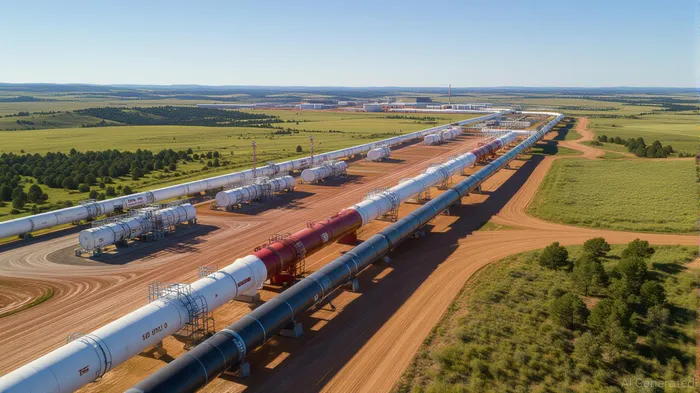
Distributable Cash Flow: Growth Amid Rising Costs
The acquisitions have translated into stronger DCF. In 2024, DCF attributable to partners rose 10% to $8.36 billion, while adjusted EBITDA hit $14.9 billion, driven by higher volumes and rate escalations in its fee-based contracts. Key contributors included:
- Permian volumes: Crude oil gathering volumes jumped 12% year-over-year in 2024.
- NGL infrastructure: The Sabina 2 pipeline conversion added 40,000 barrels per day of NGL capacity, boosting margins.
- LNG agreements: A 20-year supply deal with ChevronCVX-- for 2.0 million tonnes annually of LNG from its Lake Charles terminal secured long-term cash flows.
However, rising operational costs—such as environmental reserves, ad valorem taxes, and maintenance capital spending—have pressured margins. Maintenance CapEx rose to $1.16 billion in 2024, up 35% from 2023, and is projected to hit $1.1 billion in 2025. This underscores the trade-off between growth investments and near-term cash flow.
Debt Dynamics: A Double-Edged Sword
Energy Transfer's debt has surged to $59.75 billion as of late 2024, up from $51.4 billion in 2023, primarily due to acquisition financing. This has pushed its debt-to-EBITDA ratio to 3.7x, near the upper end of its target range of 3.5–4.0xZRX--. While the company maintains a solid interest coverage ratio of 2.9x, a prolonged period of low commodity prices or operational disruptions could strain liquidity.
The good news is that Energy Transfer has refinanced some high-interest debt and retains $2.2 billion in undrawn credit capacity. Its focus on “accretive” acquisitions—those that boost DCF per unit—has also helped. The 2025 outlook calls for adjusted EBITDA of $16.1–16.5 billion, which would further reduce leverage if realized.
Valuation: A Mixed Picture
At current prices (~$13/share as of July 2025), Energy Transfer's stock trades at a 12% discount to its five-year average EV/EBITDA multiple of 10.5x. The dividend yield of 9.8% (based on the $1.31 annualized distribution) is compelling, but it's supported by a DCF coverage ratio of ~1.2x—comfortable but not overly conservative.
Investors should also consider the company's growth projects:
- Hugh Brinson Pipeline: A $2.7 billion project set to begin service in late 2026, enhancing Permian takeaway capacity.
- Mustang Draw Processing Plant: A 275 MMcf/d facility in the Midland Basin, expected online by mid-2026, which could add ~$150 million annually to EBITDA.
The Investment Thesis
Energy Transfer's acquisitions have undeniably expanded its scale and cash flow generation capacity. However, its debt levels and capital intensity create risks. Here's how to position:
- Buy: If you believe Permian production growth will continue and Energy Transfer can deleverage over the next two years. The dividend yield is attractive, and the stock's valuation leaves room for multiple expansion.
- Hold: For income investors willing to accept moderate risk. The distribution is secure but unlikely to grow aggressively until leverage improves.
- Avoid: If you prioritize balance sheet strength over yield. The debt load and high maintenance CapEx could limit flexibility in a downturn.
Final Take
Energy Transfer is a classic “high-risk, high-reward” play in the midstream sector. Its acquisitions have positioned it to capitalize on U.S. energy production growth, but its debt profile demands disciplined management. Investors should monitor its EBITDA growth trajectory and debt reduction progress closely. For now, the stock's dividend yield offers a compelling entry point for those comfortable with the risks.

Delivering real-time insights and analysis on emerging financial trends and market movements.
Latest Articles
Stay ahead of the market.
Get curated U.S. market news, insights and key dates delivered to your inbox.
AInvest
PRO
AInvest
PRO



Comments
No comments yet