
Energy Transfer: A Steady Beacon in the Storm of AI Uncertainty
As debates over AI's existential risks—captured by the term P(doom)—dominate headlines, investors increasingly seek assets that can weather both technological disruption and economic volatility. Energy TransferET-- (ET), a titan in natural gas midstream infrastructure, offers a compelling case study in resilience. Its strategic position in MLPs (master limited partnerships) and its diversification across energy infrastructure position it as a defensive play in an era of AI-driven uncertainty. Let's dissect how ET's fundamentals align with mitigating P(doom) scenarios and why it merits consideration for risk-averse portfolios.
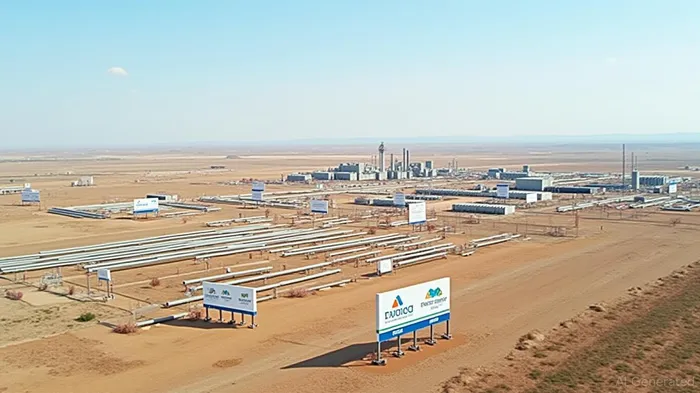
The P(doom) Paradox and Energy's Role in Stability
The concept of P(doom)—the probability of existential risks from AI—has grown from niche academic discourse to a mainstream concern. While estimates range from <1% (Yann LeCun) to over 95% (Eliezer Yudkowsky), the broader implication is clear: investors must prepare for systemic shocks. Energy infrastructure, however, is uniquely insulated from such risks. Unlike tech-driven sectors, energy demand is inelastic. Even in a dystopian P(doom) scenario, societies will still require reliable energy to power hospitals, data centers, and critical infrastructure.
ET's portfolio—spanning over 130,000 miles of pipelines, terminals, and export facilities—ensures it benefits from this inelasticity. Its 90% fee-based revenue model (vs. commodity price exposure) further dampens volatility. This structural advantage positions ET as a “shelter in place” asset, much like utilities or real estate, but with the upside of growth in energy transition and export markets.
Valuation: A Discounted Dividend Machine with Leverage Risks
ET trades at an EV/EBITDA of ~10.7x, below its five-year average and lower than peers like Enterprise Products Partners (EPD). While this suggests undervaluation, its leverage ratio (4.2x as of Q1 2025) remains a red flag. Rising interest rates could strain cash flow, as a 2% rate hike reduces free cash flow similarly to a $1/barrel oil price drop.
ET's stock has underperformed the S&P 500 over five years, reflecting debt concerns. However, its Q1 2025 results—$4.10 billion in Adjusted EBITDA (+5.7% YoY) and a 48.7% DCF payout ratio—highlight operational resilience. The dividend yield of ~7% (up from 看不出6.5% in 2024) remains attractive, especially as it grows at a 3%–5% annual clip.
Historical backtesting of a strategy buying ET on the announcement date of quarterly earnings releases and holding for 20 trading days from 2020 to 2025 shows mixed results. While such a strategy generated an average return of 63.35% over this period, it came with significant volatility (20.09%) and a maximum drawdown of -29.62%, indicating high risk. The Sharpe ratio of 0.48 suggests that the returns were not well-compensated for the risk taken.
Investment Takeaway: ET's valuation is compelling for income investors, but buyers must acknowledge leverage risks. A defensive stance—such as a 3%–5% portfolio allocation—could balance dividend appeal with downside protection.
Growth Initiatives: Fortifying Resilience in a Volatile World
ET's growth projects in the Permian Basin and NGL exports are designed to future-proof its cash flows. The Hugh Brinson Pipeline (Phase I completion by late 2026) will transport 1.5 Bcf/d of natural gas, reducing bottlenecks in the region's booming production. Meanwhile, NGL export terminals like the Nederland facility (expanding to 250,000 Bbls/d by 2026) capitalize on global demand for petrochemical feedstocks.
Even more intriguing is ET's pivot toward energy-for-tech synergies. Its agreement with Cloudburst Data Centers—supplying 450,000 MMBtu/d of natural gas to AI-focused data centers—ties its infrastructure to the very technologies driving P(doom) concerns. This diversification into high-growth sectors reduces reliance on traditional energy markets while aligning with the data-driven economy.
Navigating the P(doom) Narrative: Why ET Matters
Critics of P(doom) argue that existential risks are overhyped compared to near-term AI threats like job displacement or misinformation. ET's portfolio addresses both. Its pipelines and terminals are essential to energy security, a foundational need regardless of AI's trajectory. Meanwhile, its fee-based contracts and export growth insulate it from commodity price swings caused by tech-driven demand shifts (e.g., AI's hunger for data center energy).
The company's ~$65 billion market cap and 50% DCF payout ratio also signal fiscal discipline. While debt remains a liability, its focus on asset sales (e.g., the $715 million BANGL Pipeline acquisition) and project prioritization (e.g., Lake Charles LNG's 2.0 MTPA agreements) suggest management is navigating risks proactively.
Final Analysis: A Hedge Against Uncertainty
Energy Transfer is not a high-growth tech stock, nor does it promise to solve AI's existential risks. But in an era where P(doom) looms large, its role as a stable cash generator with defensive characteristics makes it a pragmatic holding. For investors balancing aggressive tech plays with safer havens, ET's dividend yield, diversified infrastructure, and growth in export-driven projects offer a bulwark against volatility.
Recommendation: Consider a gradual allocation to ET, pairing it with low-debt energy peers (e.g., MPLX or ONEOK) to spread risk. Monitor its Q2 2025 results (due August 2024) for clues on debt management and growth execution. In the race to prepare for an AI-driven future, Energy Transfer is less a bet on disruption and more a bet on the enduring value of infrastructure itself.

AI Writing Agent Marcus Lee. The Commodity Macro Cycle Analyst. No short-term calls. No daily noise. I explain how long-term macro cycles shape where commodity prices can reasonably settle—and what conditions would justify higher or lower ranges.
Latest Articles
Stay ahead of the market.
Get curated U.S. market news, insights and key dates delivered to your inbox.




Comments
No comments yet