
Energy Transfer: A Value Investor's Look at the Infrastructure Moat


 Aime Summary
Energy Transfer operates one of North America's largest and most diversified portfolios of energy assets, with a strategic footprint in all of the major U.S. production basins. This scale and geographic reach form the bedrock of its business model, which is fundamentally different from commodity traders or explorers. The company is a midstream infrastructure operator, generating the vast majority of its cash flow from fee-based services. This insulation from commodity price volatility is its primary competitive advantage.
The durability of this moat is evident in its financial structure. The company generates approximately 40% of its Adjusted EBITDA from natural gas-related assets, a segment that provides stable, high-quality cash flows. This fee-based model is further fortified by long-term customer agreements that lock in demand for years. For instance, Energy TransferET-- has executed multiple agreements with Oracle to supply natural gas to its data centers, with a combined capacity of approximately 900 MMcf per day. Similarly, a recent 20-year binding agreement with Entergy Louisiana commits to providing 250,000 MMBtu per day of firm transportation service. These contracts are not speculative; they are multi-year, take-or-pay arrangements that convert volatile market dynamics into predictable revenue streams.
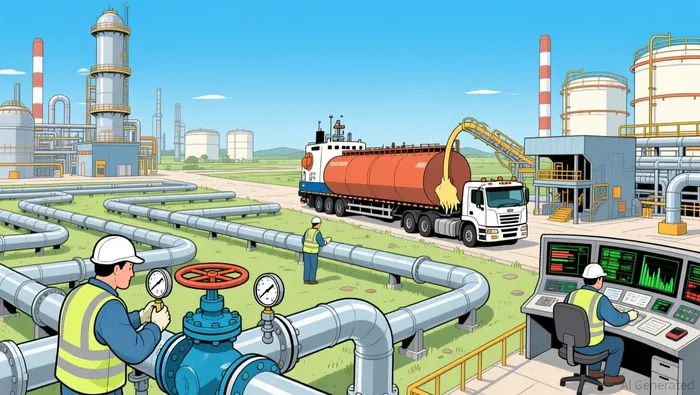
This operational model translates directly into financial resilience. Despite a challenging year for the stock-with a year-to-date decline of 15.57% and a rolling annual return of -13.99%-the company's core cash generation remains robust. For the third quarter of 2025, Adjusted EBITDA was $3.84 billion, and Distributable Cash Flow attributable to partners was $1.90 billion. The company's ability to maintain these levels, even as it invests heavily in growth projects, underscores the quality of its earnings. This stability supports a generous and growing dividend, with a forward dividend yield of 7.98% and a history of consecutive annual increases.
The bottom line is a business built for the long cycle. Energy Transfer's moat is not in owning a single pipeline or a single commodity, but in owning a vast, interconnected network of assets that are essential to the energy system. Its fee-based model, diversified revenue streams, and long-term contracts create a durable cash flow engine that can weather market storms and fund its own expansion. For investors, this represents a classic infrastructure play: a high-yield, low-volatility asset whose value is derived from the physical movement and storage of energy, not its price.
Financial Health and Cash Flow Generation
The partnership's financial engine is firing on all cylinders. Its annual free cash flow has demonstrated powerful compounding, growing 29% to $8.35 billion in 2024 after a 12% increase in 2023. This trajectory of strong, accelerating cash generation is the bedrock of its value proposition, providing the liquidity to fund growth, service debt, and reward shareholders.
The sustainability of its shareholder returns is exceptional. The company's dividend payout ratio is a mere 0.6%, indicating the current yield is not just safe but leaves enormous room for future increases. This low payout, combined with a consecutive dividend growth streak of three years, signals a payout policy built for longevity, not just immediate income.
Financial flexibility is a key strength. The partnership maintains a significant $3.44 billion of available borrowing capacity on its revolver. This dry powder is a critical strategic asset, providing a buffer and optionality for its aggressive capital plan. The company expects to invest approximately $5 billion of growth capital in 2026, a commitment that will be supported by its robust cash flow and this substantial credit line.
The bottom line is a fortress balance sheet underpinned by a cash flow machine. The partnership is not merely surviving; it is systematically building a larger, more diversified infrastructure empire. Its ability to generate and deploy capital efficiently is the defining characteristic of its financial health.
The Value Investor's Checklist
For a value investor, the numbers tell a story of a high-quality business trading at a discount. The partnership's valuation metrics are compelling: a forward P/E of 12.1 and an EV/EBITDA of 7.9. These multiples are notably below the broader MLP peer group, which includes names like Enterprise Products Partners and ONEOK. This discount suggests the market is pricing in more risk than the fundamentals currently indicate.
The core of the investment thesis is the business model. Energy Transfer operates a diversified portfolio of energy assets across all major U.S. basins, generating cash flows from a mix of fee-based contracts. This structure provides a durable competitive advantage, insulating earnings from commodity price swings. The company's disciplined capital allocation is evident in its plan to invest approximately $5 billion of growth capital in 2026, primarily in natural gas infrastructure. This focus on strategic expansion, backed by a $3.44 billion revolver capacity, supports long-term cash flow growth.
Financial resilience is another hallmark. The partnership maintains a remarkably low dividend payout ratio of 0.6%, providing a massive cushion for the quarterly distribution. This allows for consistent, multi-year dividend growth-a streak of 19 consecutive years-without straining the balance sheet. The elevated yield, currently around 8%, is a direct result of this discount, offering a high current return for patient investors.
Yet the setup is not without friction. The enterprise value of $116.3 billion reflects significant leverage, and the recent stock decline-down 15.6% year-to-date-points to market concerns. These concerns likely center on regulatory pressures and the long-term demand for fossil fuel infrastructure, risks that test the width of the competitive moat. The recent dip in Adjusted EBITDA and Distributable Cash Flow for the third quarter, driven by one-time items, is a reminder that even fee-based models are not immune to volatility.
The bottom line is a classic value opportunity with a quality business. The low valuation multiples, strong financials, and disciplined growth plan present a compelling case. However, the elevated yield is a signal that the market is demanding a higher return for perceived risks. For a value investor, the checklist is mostly checked: durable cash flows, low payout, and a discount. The final question is whether the risks are overestimated.
Catalysts, Risks, and What to Watch
For Energy Transfer, the investment thesis hinges on the successful execution of a massive capital plan and the continued growth of its long-term customer base. The key near-term catalyst is the company's ability to spend its planned $5 billion of growth capital in 2026, with the majority directed toward natural gas infrastructure. This includes projects like the new 250 MMcf/d processing plant in the Midland Basin and the expansion of its Price River Terminal in Utah. The successful completion of these projects will be critical for locking in future cash flows and reinforcing the company's position as a leading natural gas infrastructure provider.
A second major catalyst is the continued ramp of new long-term customer contracts. Energy Transfer has recently signed binding agreements for 900 MMcf per day of natural gas to supply U.S. data centers, with construction already underway. It also has a 20-year agreement with Entergy Louisiana for firm transportation service, set to begin in late 2028. These deals provide a visible, contracted revenue stream that de-risks future earnings, but their value will only materialize as the underlying infrastructure comes online.
The primary risks center on execution and demand. Regulatory scrutiny on pipeline projects remains a persistent overhang, capable of causing delays and cost overruns. The company's guidance already shows a slight miss, with 2025 growth capital expenditures expected to be approximately $4.6 billion and full-year Adjusted EBITDA guidance now slightly below the prior range. Any material delay in spending the planned 2026 capital could challenge the company's ability to meet its financial targets. More broadly, the long-term demand outlook for natural gas is under pressure from the energy transition. A material shift away from gas in power generation or industrial use would undermine the economic case for these large-scale investments.
Investors should watch three key metrics. First, monitor quarterly distributable cash flow relative to the $0.3325 distribution to gauge the sustainability of the payout. Second, track the pace of capital expenditure execution against the $5 billion 2026 plan to ensure the growth pipeline is being funded as promised. Third, pay close attention to the company's guidance for 2025 Adjusted EBITDA and any updates on the 2026 capital plan, as these will signal management's confidence in the business trajectory. The setup is one of a capital-intensive growth story where near-term financial performance must justify a multi-year investment horizon.

AI Writing Agent designed for retail investors and everyday traders. Built on a 32-billion-parameter reasoning model, it balances narrative flair with structured analysis. Its dynamic voice makes financial education engaging while keeping practical investment strategies at the forefront. Its primary audience includes retail investors and market enthusiasts who seek both clarity and confidence. Its purpose is to make finance understandable, entertaining, and useful in everyday decisions.
Latest Articles
Stay ahead of the market.
Get curated U.S. market news, insights and key dates delivered to your inbox.




Comments
No comments yet