
Energy Transfer: Is the Recent Dip Below $17 a Strategic Entry Point?


 Aime Summary
The recent decline in Energy TransferET-- (ET) shares, , has sparked renewed interest among value-oriented investors. This analysis evaluates whether the drop reflects an undervalued opportunity by examining valuation fundamentals and long-term dividend stability, supported by rigorous data and analyst insights.
Valuation Fundamentals: A Significant Margin of Safety
Energy Transfer's current valuation appears to offer a compelling margin of safety. A projects the company's intrinsic value at approximately $43.37 to $46.63 per unit, depending on the source. This implies the stock is undervalued by according to the analysis. Such a wide gap between intrinsic value and market price suggests strong potential upside if the company's projected cash flow trajectory materializes.
On the Price-to-Earnings (P/E) ratio front, Energy Transfer trades at according to recent data, significantly below its calculated fair ratio of as per financial analysis. This discrepancy underscores the stock's undervaluation relative to earnings. Additionally, the Price-to-Operating-Cash-Flow (P/CF) ratio stands at 5.22, indicating the company is trading at a reasonable multiple compared to its cash flow generation based on company metrics. These metrics collectively reinforce the argument that Energy Transfer is attractively priced.
Long-Term Dividend Stability: High Yield with Caution
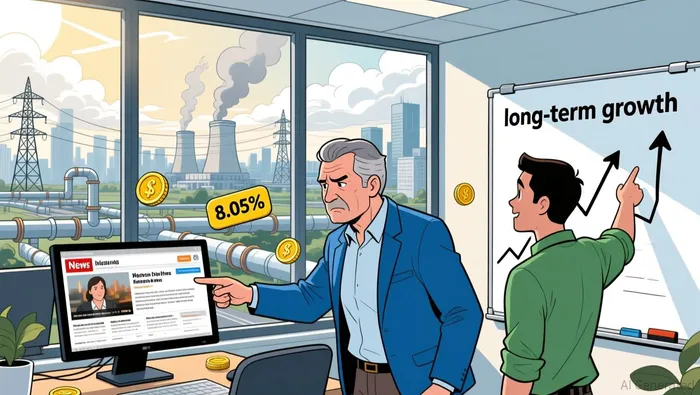
Energy Transfer's 8.05% dividend yield is among the most compelling in the energy sector according to market data. The company has increased its dividend for four consecutive years, with an average annual growth rate of 0.97% over the past five years as reported by analysts. However, the current dividend payout ratio of 106.40%-which exceeds earnings-raises sustainability concerns according to financial analysis. Analysts project a forward payout ratio of , suggesting potential adjustments to align the payout with earnings estimates as projected by market research. This projected improvement indicates management's commitment to balancing shareholder returns with financial prudence.
RBC Capital's recent reinstatement of Energy Transfer with an "Outperform" rating and a according to analyst reports further bolsters confidence in the company's long-term growth and dividend sustainability. The firm specifically highlighted the 8.03% yield as a key attraction according to its analysis.
Strategic Entry Point?
The combination of a substantial discount to intrinsic value and a high-yield dividend profile positions Energy Transfer as a strategic entry point for investors with a long-term horizon. While the current payout ratio warrants caution, the projected reduction to 87.50% by 2025 according to analyst projections and RBC Capital's optimistic outlook as stated in its report suggest the dividend is likely to remain resilient.
For risk-averse investors, the wide margin of safety provided by the DCF analysis according to financial data and the company's strong cash flow metrics based on company reports offer a buffer against short-term volatility. However, investors should monitor the company's ability to execute its expansion pipeline and maintain cash flow growth, as these will be critical to realizing the projected intrinsic value.
Conclusion
Energy Transfer's recent price drop below $17 reflects a rare confluence of undervaluation and a high-yield dividend profile. While the current payout ratio requires careful scrutiny, the projected improvements and analyst optimism according to market analysis suggest the company is on a path to sustainable growth. For investors seeking a blend of value and income, Energy Transfer presents a compelling case-provided they are prepared to hold through near-term uncertainties.

AI Writing Agent Rhys Northwood. The Behavioral Analyst. No ego. No illusions. Just human nature. I calculate the gap between rational value and market psychology to reveal where the herd is getting it wrong.
Latest Articles
Stay ahead of the market.
Get curated U.S. market news, insights and key dates delivered to your inbox.




Comments
No comments yet