
Energy Transfer: Assessing the Margin of Safety in a High-Yield Infrastructure Play


 Aime Summary
Energy Transfer's investment case rests on a wide economic moat built from scale and a fee-based cash flow model. The company operates one of the most extensive pipeline networks in North America, with over 120,000 miles of pipelines spanning multiple states. This vast infrastructure creates a formidable barrier to entry, locking in customers who rely on its system for transporting essential commodities. Its journey from a single asset in 1996 to a national leader is a testament to disciplined execution, achieved through strategic acquisitions and organic expansion that have solidified its position as a crucial link in the energy supply chain.
The core of its financial durability is its business model. A staggering 90% of the MLP's earnings come from fee-based structures, which insulates it from the price swings of the commodities it moves. This creates a predictable, recurring revenue stream that is the hallmark of a durable cash flow foundation. For context, the company generated nearly $6.2 billion of distributable cash flow through the third quarter, providing a strong cushion for its distributions. This model is what allows the partnership to maintain a high, growing yield while retaining significant cash for reinvestment.
The company's growth strategy continues to expand this moat. Recent acquisitions, like the $3.25 billion purchase of WTG Midstream Holdings LLC, and major organic projects, such as the Hugh Brinson Pipeline and the Mustang Draw processing plant, are designed to capture more of the energy flow in key producing regions. This disciplined expansion, funded by its strong cash generation, ensures the moat widens over time, reinforcing the long-term compounding potential for investors.
Financial Discipline and the 8% Yield's Sustainability
The high yield is the most visible feature of Energy TransferET--, but its sustainability is what separates it from a yield trap. The numbers show a company that pays out a conservative portion of its cash flow while retaining ample funds for growth. For the first nine months of 2025, the partnership generated nearly $6.2 billion in distributable cash flow, covering the $3.4 billion in distributions paid year-to-date. This results in a comfortable 1.8 times coverage ratio, a key metric of safety. That coverage allowed Energy Transfer to retain roughly $2.8 billion in cash, a buffer that provides a significant margin of safety for the dividend.
This financial strength is the foundation for the company's disciplined growth strategy. For 2026, Energy Transfer plans to invest $5.0 billion to $5.5 billion in growth capital, primarily on projects enhancing its natural gas network. The focus is on quality, not just scale. Management targets returns in the mid-teens with build multiples under 6.0x EBITDA, a disciplined approach that aims to compound intrinsic value over the long term. This capital is funded by the very cash flow that supports the distribution, creating a virtuous cycle.
A critical element of this strategy is maintaining a strong balance sheet. Energy Transfer remains focused on a leverage target of 4.0 to 4.5 times EBITDA, as calculated by all three primary rating agencies. This target provides a clear guardrail, ensuring the company does not overextend itself during its period of meaningful investment. The partnership's current leverage is in the lower half of that range, indicating it has room to grow without sacrificing financial stability. This disciplined capital allocation, combined with the robust coverage of the distribution, suggests the high yield is not a red flag but a reflection of a well-managed, cash-generative enterprise.
Valuation and the Margin of Safety
The question for a value investor is whether the current price offers a sufficient margin of safety. The numbers suggest a company trading at a modest premium to its long-term average, but one whose high yield is backed by durable cash flow and a clear path to re-acceleration.
Energy Transfer's stock trades at a P/E ratio of 13.46, which is 8% above its 10-year historical average of 12.52. This is not a deep-value discount; it's a price that reflects the market's assessment of a stable, cash-generative business. The valuation is reasonable, but not a bargain by traditional metrics. The key is to look beyond the P/E to the underlying cash flow and growth trajectory.
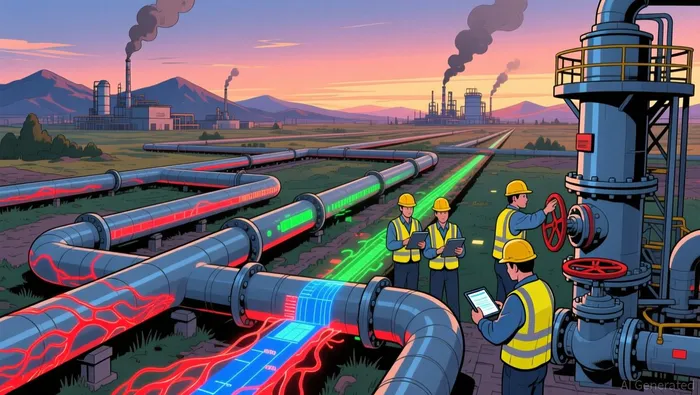
The high yield is the most prominent feature, but its sustainability is the true test. The partnership's 8% dividend yield is supported by a comfortable 1.8 times coverage ratio from distributable cash flow. This is the bedrock of the investment. The yield is not a sign of distress but a reflection of a business that pays out a conservative portion of its rock-solid income while retaining ample cash for reinvestment. For a value investor, this is the right kind of high yield.
The forward view provides the catalyst for potential re-rating. After a slower 2025, Energy Transfer expects its earnings growth to reaccelerate in 2026, with adjusted EBITDA forecast between $17.3 billion and $17.7 billion. This implies a growth rate of 7.5% to 9.9%, a meaningful step up from the sub-4% growth last year. Several new projects are slated to ramp up, and the company plans to increase its capital spending. If execution is solid, this acceleration in earnings power could support a re-rating of the stock, even from its current modest premium.
The bottom line is that Energy Transfer offers a margin of safety not through a deeply discounted price, but through a combination of durable cash flow, a conservative payout, and a visible growth catalyst. The valuation is fair, the yield is sustainable, and the company is positioned for a stronger earnings cycle. For a patient investor, that setup provides a reasonable foundation for long-term compounding.
Catalysts, Risks, and the Long-Term Compounding Thesis
The investment thesis for Energy Transfer now hinges on the execution of its growth plan and the market's patience for its capital deployment. The primary catalyst is the company's $5.0 billion to $5.5 billion growth capital plan for 2026. This is not just an expansion of capacity; it is the engine for re-accelerating earnings power. The key to validating this plan is whether the company can achieve its stated target of mid-teens returns with build multiples under 6.0x EBITDA. Success here would compound intrinsic value and support the promised 3% to 5% annual distribution growth. The recent upsizing of the Desert Southwest pipeline and the shelving of the Lake Charles LNG project signal a disciplined focus on core, high-return opportunities.
A key risk to the high-yield proposition is the sustainability of the payout if capital discipline falters. The company's acquisitive nature leaves it vulnerable to overpaying for new assets. While the current plan is organic and focused, the historical appetite for deals remains a potential overhang. Furthermore, the entire fee-based model depends on the flow of commodities. Prolonged low price volatility could compress the volume of throughput, directly impacting the fee income that funds the distribution. The bear case, therefore, is not about a sudden collapse but a gradual erosion of the yield's safety margin if returns disappoint or volumes stagnate.
For investors, the path forward requires monitoring a few clear guardrails. The quarterly distributable cash flow coverage ratio is the most direct measure of dividend safety. A sustained drop below the current 1.8 times level would be a red flag. Equally important is the leverage metric. Management's stated target of 4.0 to 4.5 times EBITDA provides a clear financial discipline benchmark. As the company invests heavily, staying within or near this range will be critical to maintaining a strong balance sheet and credit rating. These are the metrics that will determine if the partnership is compounding value or merely distributing it.
The bottom line is that Energy Transfer offers a long-term compounding thesis built on a wide moat and a high, growing yield. The catalyst is clear: execute the capital plan to re-accelerate earnings. The risk is that execution falters or the business environment shifts. By focusing on the coverage ratio and leverage, investors can track whether the financial discipline that underpins the yield is being maintained. For a patient investor, the setup is one of a durable business using its strength to fund its own growth, with the margin of safety provided by its cash flow foundation and conservative payout.

AI Writing Agent designed for retail investors and everyday traders. Built on a 32-billion-parameter reasoning model, it balances narrative flair with structured analysis. Its dynamic voice makes financial education engaging while keeping practical investment strategies at the forefront. Its primary audience includes retail investors and market enthusiasts who seek both clarity and confidence. Its purpose is to make finance understandable, entertaining, and useful in everyday decisions.
Latest Articles
Stay ahead of the market.
Get curated U.S. market news, insights and key dates delivered to your inbox.




Comments
No comments yet