
Energy Sector Rotation in the Wake of EIA Natural Gas Surprises: Navigating Asymmetric Shocks and Future Trends
 Aime Summary
The U.S. Energy Information Administration's (EIA) December 12, 2025, Natural Gas Storage Report delivered a mixed signal for energy markets: a 167 Bcf net withdrawal, below the 176 Bcf consensus forecast but exceeding the five-year average of 96 Bcf. Total working gas in storage stood at 3,579 Bcf, 61 Bcf below the 2024 level but 32 Bcf above the five-year average. This data, coupled with record-high U.S. dry gas production (112.9 Bcf/day) and a projected winter price average of $4.30/MMBtu, underscores a market in transition. For investors, the challenge lies in decoding these signals to position portfolios for asymmetric supply shocks and long-term trends.
The Paradox of Abundance and Volatility
Natural gas markets are inherently sensitive to weather, production, and export dynamics. The December report highlighted a tightening supply-demand balance: while inventories remain above average, the year-over-year draw of 61 Bcf and the looming start of the Golden Pass Train 1 LNGLNG-- export facility in early 2026 threaten to erode the 103 Bcf surplus to the five-year average. This creates a fragile equilibrium, where a cold snap could drive prices higher, while a warm winter or production surge could trigger a bearish correction.
Historical sector rotation patterns reveal a recurring theme: utilities and renewables outperform during low-price, oversupply environments, while energy producers and industrial users benefit from price spikes. For instance, in 2022, a $3.00/MMBtu Henry Hub price fueled a 12% gain in the S&P 500 Utilities sector, as natural gas served as a cheap backup for renewables. Conversely, in 2021, a cold-weather-induced price spike drove energy producers to outperform by 18%.
Asymmetric Shocks and Sector Rotation Strategies
The EIA's data underscores the risk of asymmetric supply shocks—events like sudden weather shifts, geopolitical disruptions, or production bottlenecks that disproportionately affect energy markets. For example, a late-December warming trend could reduce heating demand by 20%, as seen in 2023, triggering a 15% drop in natural gas prices. Conversely, a cold snap in January could push prices above $5/MMBtu, as occurred in 2021.
Investors must prepare for these extremes by adopting a dynamic sector rotation framework:
1. Defensive Positioning in Utilities and Renewables: When EIA data signals oversupply (e.g., storage above five-year averages), utilities and renewables gain traction. The EIA's projection of 40% VRE penetration by 2030, coupled with natural gas's role as a backup, makes this sector a hedge against price volatility.
2. Midstream and LNG Infrastructure as a Buffer: Companies like Kinder MorganKMI-- (KMI) and Cheniere EnergyLNG-- (LNG) benefit from export growth and stable cash flows, regardless of price direction. With U.S. LNG feedgas demand at 19.4 Bcf/day in December 2025, infrastructure plays offer downside protection.
3. Energy Producers with Hedging: Pure-play producers like EQTEQT-- (EQT) and Cabot Oil & Gas (COG) face margin risks in low-price environments. However, those with strong hedging (e.g., 70% of 2026 production hedged at $4.50/MMBtu) can mitigate downside risks.
Forward-Looking Trends: The Role of LNG and AI Demand
The EIA's data also highlights structural shifts in the energy landscape. U.S. LNG exports are projected to rise to 22 Bcf/day by 2026, driven by Asian demand and geopolitical realignments. This creates a dual tailwind for midstream operators and LNG infrastructure, while pressuring domestic storage.
Meanwhile, the rise of AI data centers is introducing a new variable. Enverus Intelligence Research (EIR) estimates that 30 GW of new data center capacity by 2030 could increase natural gas demand by 2.1 Bcf/day. While this is modest compared to industrial or power sector demand, it signals a growing reliance on flexible, dispatchable resources—a role natural gas is uniquely positioned to fill.
Investment Recommendations
- Overweight Utilities and Renewables: Allocate 20–30% to utilities (e.g., NextEra Energy, NE) and renewables (e.g., Brookfield Renewable Partners, BEP) as a hedge against low-price environments.
- Underweight Energy Producers: Avoid unhedged natural gas producers unless prices rise above $4.50/MMBtu. Focus on midstream and LNG infrastructure for defensive exposure.
- Monitor EIA Storage and Weather Forecasts: Use the EIA's Weekly Storage Report and heating degree day (HDD) forecasts to time sector rotations. A draw below 150 Bcf or a HDD deficit of 10% could signal a shift to energy producers.
Conclusion
The EIA's December 2025 report paints a market at a crossroads: abundant supply, rising exports, and a looming winter demand surge. For investors, the key lies in balancing short-term volatility with long-term structural trends. By leveraging historical sector rotation patterns and forward-looking indicators, portfolios can navigate asymmetric shocks while capitalizing on the evolving energy transition. As the Golden Pass Train 1 comes online and AI-driven demand emerges, the energy sector's ability to adapt will define its performance in the years ahead.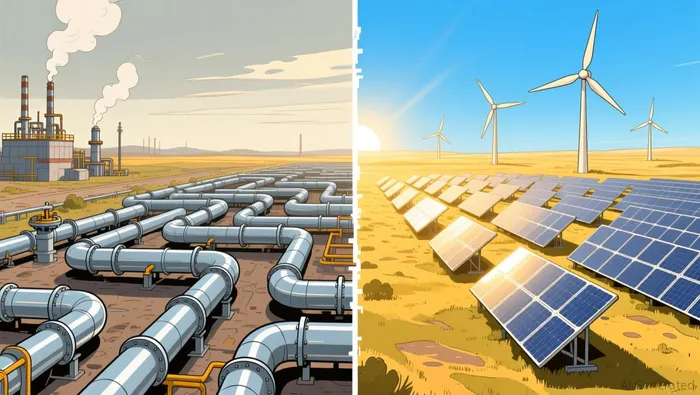

Sumérjase en el mundo de las finanzas globales con Epic Events Finance.
Latest Articles
Stay ahead of the market.
Get curated U.S. market news, insights and key dates delivered to your inbox.
AInvest
PRO
AInvest
PRO



Comments
No comments yet