
Energy Sector Rotation: Oil and Gas Efficiency vs. Construction's Energy Transition
 Aime Summary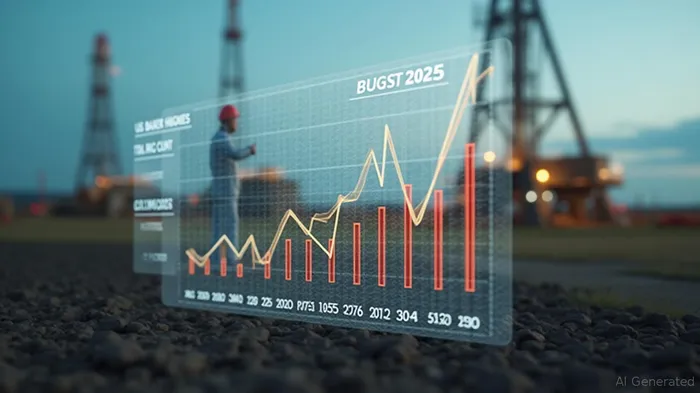
The U.S. energy landscape in 2025 is undergoing a quiet but profound transformation. The Baker HughesBKR-- Total Rig Count, a barometer of drilling activity since 1944, has stabilized at 539 rigs in August 2025—unchanged for weeks after a 14-week decline. This figure masks a deeper structural shift: operators are prioritizing efficiency over expansion, leveraging AI-powered automation and digital twin platforms to maximize output from existing wells. The rig count, once a direct proxy for production growth, now reflects a sector redefining itself through technological innovation rather than brute-force drilling.
Oil and Gas: Efficiency Over Expansion
The rig count breakdown reveals a subtle but telling trend: oil rigs rose by one to 412, while gas rigs fell by one to 122. This divergence underscores a strategic reallocation of capital. Oil operators are extending lateral drilling lengths and adopting AI-driven analytics to squeeze more output from fewer rigs. For example, SchlumbergerSLB-- (SLB) and Baker HughesBKR-- (BHI) are deploying digital twins to simulate reservoir performance in real time, reducing operational costs by up to 20%. These technologies rely heavily on semiconductors for data processing, creating a quiet tailwind for chipmakers like AMDAMD-- (AMD) and NVIDIANVDA-- (NVDA).
The rig count's stagnation also signals a shift in investor sentiment. Upstream oil projects, once the backbone of energy growth, are now underfunded. ESG pressures and shareholder demands for dividends have redirected capital toward midstream and downstream assets. This trend is evident in the performance of oilfield services (OFS) firms like Nine Energy ServiceNINE-- (NINE), which reported Q2 2025 revenue of $147 million, driven by high-margin technologies such as dissolvable frac plugs.
Construction: The Energy Transition's New Frontier
While oil and gas operators focus on efficiency, the construction sector is becoming the epicenter of energy investment. Federal policies like the Infrastructure Investment and Jobs Act (IIJA) and the Inflation Reduction Act (IRA) are fueling a $1.2 trillion global energy transition pipeline by 2030. Construction spending on energy projects is surging, with a 10% year-over-year increase in nominal value added in 2024.
The shift is most pronounced in gas infrastructure. With spot gas prices projected to rise 65%, construction firms are building LNG terminals, pipelines, and carbon capture facilities. Bechtel (BTE) and FluorFLR-- (FLR) are leading this charge, securing multi-year contracts for projects in the Permian Basin and Gulf Coast. Meanwhile, data center construction—driven by AI's insatiable energy demand—is creating 1,700 local jobs per facility, further boosting demand for electricians and HVAC technicians.
However, the sector faces headwinds. Material costs have spiked 50% due to tariffs on steel and aluminum, while a 3.5% unemployment rate masks a critical skills gap in MEP trades. To mitigate these challenges, firms are adopting BIM and prefabrication, reducing on-site labor by 30%. Investors should watch companies like TrimbleTRMB-- (TRMB) and AutodeskADSK-- (ADSK), whose software solutions are becoming indispensable for managing complex energy projects.
Sector Rotation: Where to Allocate Capital
The interplay between oil and gas efficiency and construction's energy transition creates clear sector rotation opportunities.
- Oil and Gas: Focus on Tech-Driven OFS Firms
- Baker Hughes (BHI) and Schlumberger (SLB) are outperforming peers by pivoting to AI and digital twins.
- Nine Energy Service (NINE) exemplifies the shift toward asset-light, high-margin technologies.
Construction: Prioritize Energy Transition and Infrastructure
- Bechtel (BTE) and Fluor (FLR) are benefiting from IIJA/IRA-driven projects.
- Trimble (TRMB) and Autodesk (ADSK) are gaining traction as construction-tech enablers.
Caterpillar (CAT) is seeing demand for machinery in LNG and hydrogen infrastructure.
Semiconductors: The Hidden Beneficiary
- AI and digital twin platforms require advanced semiconductors. NVIDIA (NVDA) and AMD (AMD) are positioned to capture this demand.
Conclusion: A New Energy Paradigm
The U.S. energy sector is no longer defined by rig counts or drilling booms. Instead, it's being reshaped by efficiency in oil and gas and innovation in construction. Investors who recognize this shift can capitalize on two complementary trends:
- Short-term gains in tech-driven OFS firms and semiconductors.
- Long-term growth in energy transition infrastructure and construction-tech.
As the rig count stabilizes and construction spending accelerates, the key to outperformance lies in aligning with the sector's evolving priorities. The future of energy isn't just about extracting hydrocarbons—it's about building a smarter, cleaner, and more efficient system.

Stay ahead of the market.
Get curated U.S. market news, insights and key dates delivered to your inbox.
AInvest
PRO
AInvest
PRO



Comments
No comments yet