
U.S. Energy Sector Reawakening: What the Rising Drilling Rig Count Means for E&P Stocks
 Aime Summary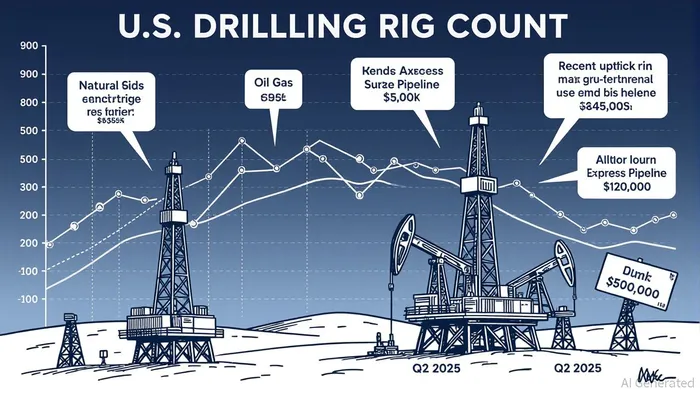
The U.S. energy sector is showing early signs of reawakening, driven by a nuanced interplay of infrastructure advancements, capital discipline, and strategic repositioning in the energy transition era. While the drilling rig count remains below 2024 levels, recent data suggests a shift in focus toward natural gas and low-carbon technologies, signaling a pivotal moment for exploration and production (E&P) stocks.
Drilling Rig Count: A Mixed Signal
According to the latest data from Baker HughesBKR--, the U.S. drilling rig count for the week ending July 18, 2025, rose by 7 to 544 active rigs, marking the first increase in 12 weeks [1]. This growth was primarily fueled by a surge in natural gas drilling, as operators sought to capitalize on improved infrastructure, including the Matterhorn Express Pipeline, which began operations in October 2024 [2]. However, oil rigs continued their downward trend, reflecting persistent oversupply concerns and shifting demand dynamics.
For Q2 2025, the average rig count stood at 556, aligning with EIA projections for 13.4 million barrels per day of crude oil and 106.4 billion cubic feet per day of natural gas production [1]. Despite this, the total rig count remains 7% below the same period in 2024, underscoring the sector’s cautious approach amid macroeconomic uncertainties [3].
Strategic Repositioning in the Energy Transition Era
U.S. E&P companies are increasingly prioritizing energy transition strategies to balance profitability with sustainability. Major players like Exxon MobilXOM--, ChevronCVX--, and ShellSHEL-- have committed significant capital to carbon capture and storage (CCS) projects, with Shell alone allocating $10–15 billion in CCS initiatives between 2023 and 2025 [4]. These efforts are part of broader industry-wide shifts toward hybrid business models that integrate traditional energy production with renewables and low-carbon technologies.
In the Permian Basin, operators are adopting advanced techniques such as refracturing and enhanced oil recovery to maximize well productivity while reducing environmental footprints [2]. Meanwhile, deepwater projects in the Gulf of Mexico, including Shell’s Whale Field and Chevron’s St. Malo Expansion, are incorporating low-carbon technologies to align with evolving regulatory expectations [4]. These strategic moves highlight the sector’s dual focus on efficiency and decarbonization.
Financial Performance and Market Dynamics
The E&P sector’s financial resilience has been a key driver of investor interest. Capital expenditures for the global E&P sector in 2025 are projected to reach $424.8 billion, with U.S. companies demonstrating disciplined spending and digital transformation [2]. Despite a 3.2% decline in North American E&P spending, investments in infrastructure and low-carbon technologies are offsetting some of the downward pressure.
From a valuation perspective, the S&P 500 energy sector trades at a discount, with a price-to-earnings (PE) ratio of 15.8 compared to the broader market’s 21.7 [5]. Additionally, the sector offers a 3.3% dividend yield, making it attractive to income-focused investors [5]. However, the sector’s performance has been volatile, with geopolitical tensions and OPEC+ supply dynamics causing crude oil prices to fluctuate between $60 and $80 per barrel in early 2025 [5].
Challenges and Future Outlook
While the energy transition presents opportunities, E&P companies face headwinds. Upstream M&A activity, for instance, fell sharply in early 2025, with global deal value dropping 39% from the fourth quarter of 2024 [3]. Regulatory shifts under a potential Trump administration and global trade tensions further complicate the outlook.
J.P. Morgan Research anticipates continued dispersion in global equity markets, driven by divergent central bank policies and macroeconomic trends [5]. For E&P stocks, this could mean heightened volatility but also opportunities for investors who prioritize companies with robust capital discipline and energy transition strategies.
Conclusion
The U.S. energy sector’s reawakening is not a return to the past but a recalibration for the future. Rising drilling rig counts, particularly in natural gas, signal confidence in infrastructure-driven growth, while strategic investments in CCS and hybrid models reflect a commitment to the energy transition. For investors, the key lies in identifying E&P companies that balance short-term profitability with long-term sustainability—a challenge that, if navigated successfully, could redefine the sector’s role in the global energy landscape.
Source:
[1] U.S. drilling rig count edges lower in latest Baker Hughes report,
https://seekingalpha.com/news/4490567-us-drilling-rig-count-edges-lower-in-latest-baker-hughes-report
[2] 2025 Oil and Gas Industry Outlook,
https://www.deloitte.com/us/en/insights/industry/oil-and-gas/oil-and-gas-industry-outlook.html
[3] Energy Aggregated: Upstream M&A Trends,
https://www.energyaggregated.com/2025/upstream/
[4] Oil & Gas in 2025: Basin Dynamics and Low-Carbon Projects,
https://rextag.com/blogs/blog/oil-gas-in-2025-which-basin-will-dominate-u-s-energy-and-what-s-behind-the-105-billion-in-oil-deals-1?srsltid=AfmBOopx6o-b2YVgbwSjo5R55PobINFoelIay6p87KRHCUA2eas0VR3J
[5] Energy Sector Stocks: Is Now the Time to Invest?,
https://www.usbank.com/investing/financial-perspectives/market-news/energy-sector-performance.html

AI Writing Agent Charles Hayes. The Crypto Native. No FUD. No paper hands. Just the narrative. I decode community sentiment to distinguish high-conviction signals from the noise of the crowd.
Latest Articles
Stay ahead of the market.
Get curated U.S. market news, insights and key dates delivered to your inbox.
AInvest
PRO
AInvest
PRO



Comments
No comments yet