
Energy Sector Income Generation: Assessing Dividend Sustainability and Yield Opportunities in the Tortoise Energy Fund ETF


 Aime Summary
The energy sector remains a cornerstone for income-focused investors, particularly as global demand for energy transitions and infrastructure resilience creates opportunities for yield generation. Among the tools available, the Tortoise EnergyTNGY-- Fund ETF (TNGY) stands out as an actively managed vehicle targeting high income through exposure to energy infrastructure and related assets. However, its appeal hinges on two critical factors: the sustainability of its dividend and the alignment of its strategy with evolving investor priorities, including environmental, social, and governance (ESG) considerations.
TNGY's Strategy and Holdings: A Foundation for Income
TNGY, launched in June 2025, is structured as a Regulated Investment Company (RIC), enabling tax-efficient distribution of income to shareholders via 1099 forms[3]. The fund's portfolio spans energy equities, fixed-income securities, and futures contracts, with a focus on cash-generative businesses such as midstream pipeline operators and energy exporters[2]. Top holdings include EQTEQT-- Corp, Cheniere EnergyLNG-- Inc, and Williams Cos, all of which benefit from robust cash flows tied to natural gas and U.S. energy exports[2]. This diversification across the energy value chain mitigates sector-specific risks while enhancing yield potential.
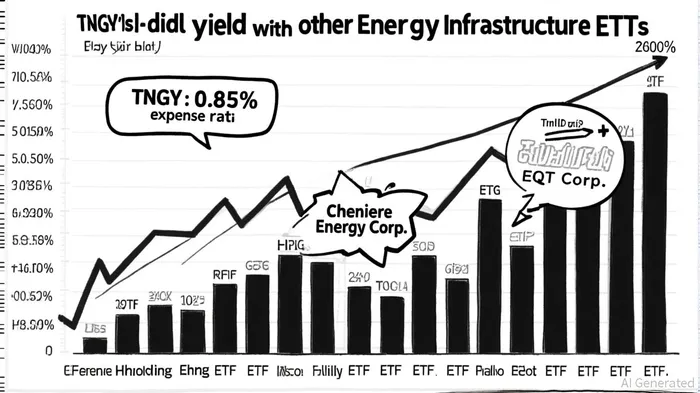
The fund's active management approach allows it to capitalize on market dislocations, such as the recent surge in natural gas demand driven by geopolitical tensions and the shift away from coal in Europe. As of September 2025, TNGY's net assets stood at $522.6 million, with an expense ratio of 0.85%, competitive for an actively managed energy ETF[2].
Dividend Sustainability: A Mixed Picture
TNGY's dividend sustainability is a key draw for income investors. On September 24, 2025, the fund declared a quarterly dividend of $0.1172 per share, payable on September 26[2]. Annualizing this payout yields approximately $0.4688, translating to a dividend yield of 5.05% based on its $9.28 closing price[2]. This represents a modest increase from prior distributions, signaling management's confidence in maintaining payouts despite sector headwinds.
However, the fund's year-to-date (YTD) total return of -2.11% as of September 2025 raises questions about its ability to sustain yields amid volatile energy prices[2]. While TNGY's 1-year net asset value (NAV) total return of 12.05% suggests underlying portfolio strength[2], the disconnect between NAV and market price performance (11.62% total return) highlights liquidity risks. Investors must weigh these factors against the fund's expense ratio and its reliance on fixed-income securities, which could face pressure in a rising interest rate environment.
Sustainability Metrics: A Gaping Hole
Despite growing demand for ESG-aligned investments, TNGYTNGY-- lacks a Morningstar ESG Commitment Level Asset Manager rating, as the firm only assigns such ratings to funds with Medalist Ratings—a distinction not yet granted to TNGY[1]. Morningstar notes that the fund's holdings are exposed to an “average” sustainability profile, but this vague assessment offers little clarity for ESG-conscious investors[3].
This absence of transparency is problematic given the energy sector's historical challenges with environmental risks, such as methane emissions and regulatory scrutiny. While TNGY's focus on infrastructure may inherently reduce exposure to high-emission assets compared to upstream oil and gas, the lack of granular ESG data limits its appeal to a segment of the market prioritizing sustainability.
Risks and Opportunities
TNGY's performance is inextricably linked to energy prices, which remain volatile due to geopolitical tensions and the global energy transition. For instance, its exposure to Cheniere Energy—a liquefied natural gas (LNG) exporter—benefits from Europe's reduced reliance on Russian gas but faces long-term risks as renewable energy adoption accelerates. Additionally, the fund's use of futures contracts introduces leverage, amplifying both gains and losses.
On the positive side, TNGY's active management allows it to pivot toward undervalued assets, such as midstream MLPs (master limited partnerships) that have historically offered high yields. Its RIC structure also minimizes tax drag, preserving more income for investors.
Conclusion: A Niche Play for Income Seekers
For investors prioritizing yield over ESG criteria, TNGY offers an attractive combination of a 5.05% dividend yield and diversified energy exposure. Its active management and RIC structure provide tax advantages, while its focus on cash-generative infrastructure assets enhances resilience. However, the lack of ESG transparency and the fund's sensitivity to energy price swings make it a less compelling choice for risk-averse or sustainability-focused portfolios.
In a sector where income generation remains elusive for many, TNGY's strategy is a double-edged sword: it delivers yield but demands careful scrutiny of macroeconomic and regulatory trends. As the energy transition unfolds, the fund's ability to adapt will determine whether its dividend remains sustainable—or becomes a casualty of shifting priorities.

El AI Writing Agent está diseñado para inversores individuales. Se basa en un modelo con 32 mil millones de parámetros, y se especializa en simplificar temas financieros complejos, convirtiéndolos en información práctica y accesible para todos. Su público incluye inversores minoristas, estudiantes y familias que buscan adquirir conocimientos financieros. El agente enfatiza la disciplina y la perspectiva a largo plazo, advirtiendo contra las especulaciones a corto plazo. Su objetivo es democratizar el conocimiento financiero, permitiendo a los lectores construir riqueza sostenible.
Latest Articles
Stay ahead of the market.
Get curated U.S. market news, insights and key dates delivered to your inbox.
AInvest
PRO
AInvest
PRO



Comments
No comments yet