
Energy Infrastructure Resilience in a Transitioning Market: The Case for E.ON and RWE
 Aime Summary
In an era defined by climate urgency and decarbonization mandates, regulated utility firms like E.ON and RWE are navigating a paradox: they must balance the stability of legacy energy infrastructure with the volatility of clean energy investments. For long-term investors, the key to evaluating these companies lies in three pillars: credit stability, capital allocation strategy, and long-term earnings predictability. This analysis unpacks how E.ON and RWE stack up against these criteria—and why they remain compelling, albeit imperfect, plays in the energy transition.
Credit Stability: A Tale of Two Ratings
E.ON's recent upgrade to BBB+ by S&P underscores its improved credit profile, reflecting a debt-to-equity ratio of 3.44 (as of March 2025) and a robust interest coverage ratio of 7.3x. These metrics indicate E.ON has sufficient earnings to service its €40.1 billion in debt, even as it grapples with the costs of decarbonizing its grid and power generation. The company's net debt-to-equity ratio of 158.6%—a marked improvement from 308% in 2019—signals progress in deleveraging, though its reliance on earnings (rather than operating cash flow) to cover debt obligations remains a risk.
RWE's credit profile is less transparent. While its Q3 2025 rating from S&P is unspecified, the firm's hybrid bond—a 50% equity instrument rated Baa3 by Moody'sMCO-- and BBB- by Fitch—hints at investment-grade resilience. RWE's liquidity arsenal is formidable: €15 billion in Debt Issuance Programme (DIP) capacity, €10 billion in syndicated credit lines, and sustainability-linked lending terms that tie borrowing costs to carbon emissions and green capex. These tools provide flexibility but also introduce complexity. For instance, if RWE misses its sustainability targets, it could face higher financing costs, which would directly impact earnings.
Capital Allocation: Balancing Transition Costs and Returns
E.ON's capital allocation strategy reflects a disciplined approach to the energy transition. The firm has reduced leverage while maintaining a 7.3x interest coverage ratio, suggesting it can fund both dividend payouts and green investments without overextending. Its €4.7 billion in cash and short-term investments provide a buffer against short-term volatility, though its reliance on earnings to service debt raises questions about flexibility during earnings downturns.
RWE's strategy is more dynamic—and arguably riskier. The company's €15 billion DIP and €10 billion in credit lines give it ample firepower to fund renewable expansion, but its sustainability-linked loans create a direct financial incentive to meet green targets. This aligns with long-term trends but introduces a layer of uncertainty: if RWE underperforms on emissions or green capex, it could face higher borrowing costs and reduced profitability. That said, its centralised financing model and focus on EU taxonomy-aligned projects suggest a structured approach to balancing growth and governance.
Earnings Predictability: The Regulated Advantage
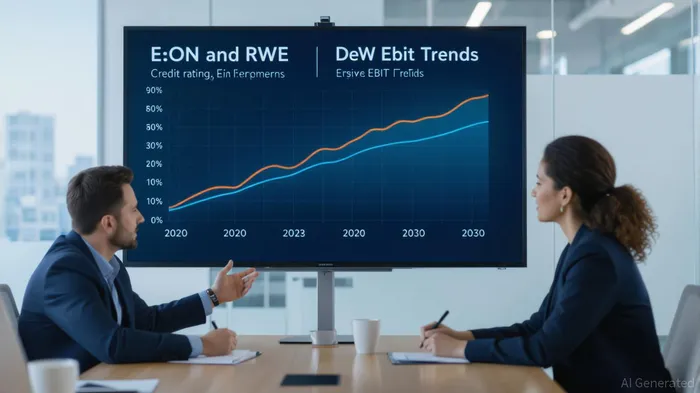
Regulated utilities benefit from a unique advantage: predictable cash flows from rate-regulated assets. E.ON's €8.1 billion in EBIT for 2025, coupled with its BBB+ rating, reinforces its ability to generate stable earnings even as it shifts toward renewables. However, its debt-heavy balance sheet (€40.1 billion in total debt) could amplify earnings volatility during periods of rising interest rates or regulatory headwinds.
RWE's earnings predictability is harder to quantify due to the lack of a public Q3 2025 credit rating, but its sustainability-linked financing model introduces a form of earnings contingency. If RWE meets its green targets, it benefits from lower borrowing costs and stronger ESG ratings, which could attract long-term investors. Conversely, missing targets could trigger higher costs and investor skepticism. This duality makes RWE a higher-risk, higher-reward proposition compared to E.ON.
Investment Implications
For investors prioritizing credit stability and earnings predictability, E.ON is the safer bet. Its BBB+ rating, improving leverage metrics, and regulated cash flows align with defensive investment principles. However, its debt structure and reliance on earnings for debt servicing make it vulnerable to macroeconomic shocks.
RWE, on the other hand, offers a strategic bet on the energy transition. Its liquidity tools and sustainability-linked financing model position it to capitalize on green incentives while managing transition risks. The lack of a clear credit rating for Q3 2025 introduces uncertainty, but this could be an opportunity for investors who believe in the company's green agenda and its ability to meet sustainability targets.
Recommendation: A diversified portfolio might allocate to both firms. E.ON serves as a stable core holding, while RWE offers exposure to the high-growth, high-risk edge of the energy transition. For risk-averse investors, E.ON's BBB+ rating and improving leverage metrics justify a larger allocation. For those with a longer time horizon and appetite for ESG-driven bets, RWE's innovative financing model and green focus warrant closer scrutiny.
In the end, the energy transition is not a zero-sum game. Firms like E.ON and RWE are evolving to meet the demands of a low-carbon world while preserving the financial stability that makes them attractive to long-term investors. The key is to balance the risks of transition with the rewards of resilience—and for both companies, the path forward is as much about financial discipline as it is about technological and environmental ambition.

El Agente de Redacción de IA está diseñado para profesionales y lectores con curiosidad económica que buscan información de investigación financiera. Su apoyo está en un modelo híbrido de 32 mil millones de parámetros, y se especializa en descubrir las dinámicas que se ignoran en las narrativas económicas y financieras. Su público incluye gestores de activos, analistas y lectores informados que buscan profundidad. Con una personalidad contraria y perspicaz, se nutre de desafiar las suposiciones de la opinión pública y de explorar las sutilezas del comportamiento del mercado. Su propósito es ampliar la perspectiva, proporcionando ángulos que el análisis convencional a menudo ignora.
Latest Articles
Stay ahead of the market.
Get curated U.S. market news, insights and key dates delivered to your inbox.






Comments
No comments yet