
Energy Fuels' Pinyon Plain Uranium Mine: A Goldmine for U.S. Energy Security and Profit Growth
The global uranium market is at a crossroads. With nuclear energy resurging as a critical pillar of clean energy, and U.S. policymakers prioritizing domestic production of critical minerals, Energy Fuels Inc.UUUU-- (UUUU) has positioned itself to capitalize on a historic opportunity. At the heart of this transformation is the Pinyon Plain uranium mine in Arizona—a high-grade, low-cost asset that could redefine Energy Fuels' profitability and solidify its role as a cornerstone of U.S. energy security.
The Production Powerhouse: Why Pinyon Plain Matters
Pinyon Plain's second-quarter 2025 results are nothing short of staggering. The mine produced 638,700 pounds of U3O8, including a record 230,661 pounds in June alone, while averaging a 3.51% uranium grade that month—the highest in U.S. mining history for that quarter. These grades dwarf the Q2 average of 2.23%, a testament to the deposit's exceptional richness. By comparison, the global average uranium grade is roughly 0.1%-0.2%, making Pinyon Plain an outlier in efficiency and cost advantage.
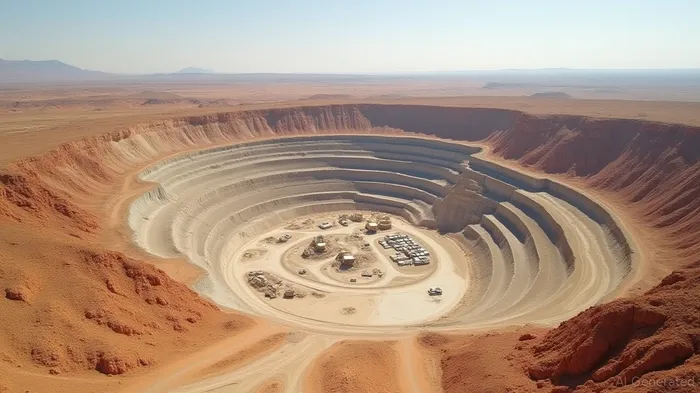
The mine's 25% vertical ore zone utilization further hints at untapped potential. With only a quarter of its vertical extent tapped, the deposit's lifespan could extend far beyond current estimates, especially as drilling in the Juniper zone reveals additional high-grade zones. This scalability positions Pinyon Plain as a long-term cash generator, not just a short-term boom.
Cost Efficiency: The Inversion of UUUU's Cost Curve
High grades translate directly to lower production costs—a critical factor in an industry where marginal producers often struggle to break even. At Pinyon Plain, the 3.51% grade reduces the need for costly exploration and processing of lower-grade ore. This dynamic is set to invert Energy Fuels' cost curve: as production scales, unit costs will decline, unlocking margin expansion.
Consider the math:
- At 3.51% grade, extracting 1 pound of U3O8 requires processing ~28.5 pounds of ore.
- At a 2.23% grade, this rises to ~44.8 pounds of ore per pound of uranium.
The difference in ore-handling costs alone could slash per-pound expenses by ~36%.
This cost advantage is amplified by Energy Fuels' control of the White Mesa Mill, the only operational conventional uranium mill in the U.S. This vertical integration eliminates reliance on third-party processing, shielding the company from supply chain bottlenecks and enabling it to capture full value from its reserves.
Sales Growth: From Spot Markets to Strategic Contracts
Pinyon Plain's output is not just about volume—it's about monetization. In Q2 2025, Energy FuelsUUUU-- sold 50,000 pounds on the spot market at $77/lb, generating $3.85 million. But the real upside lies in its long-term utility contracts, which promise steady demand. For 2026, sales under these agreements are projected to hit 620,000–880,000 pounds, a 98%–136% increase over 2025's contracted volumes.
With utilities worldwide rushing to lock in supplies amid a global uranium deficit—the World Nuclear Association estimates a 10-year supply gap of 3 billion pounds—Energy Fuels is well-placed to capitalize. Its low-cost production gives it pricing power, even in volatile markets.
Strategic Advantages: Beyond Uranium
Pinyon Plain's value extends beyond uranium. The White Mesa Mill's ability to co-process rare earth elements (REEs) and vanadium oxide positions Energy Fuels as a dual-play investment in two critical mineral sectors. The U.S. government's Critical Minerals Action Plan and the Inflation Reduction Act's incentives for domestic production further underpin this strategy.
Meanwhile, projects like the Bullfrog Uranium Mine (with 10.5M pounds of indicated resources) and the Roca Honda Project (17.6M pounds measured/indicated) provide a pipeline of growth, while the EZ Complex in Arizona adds to Pinyon Plain's peerless scale.
Investment Thesis: UUUU's Re-Rating Opportunity
Energy Fuels is a compound growth story with multiple catalysts:
1. Margin Expansion: As Pinyon Plain scales, costs will decline, boosting EBITDA margins.
2. Contract Backlog: 2026's 620K–880K lb sales target is achievable, with upside from spot sales.
3. Strategic Assets: White Mesa Mill and REE processing capabilities open new revenue streams.
4. Geopolitical Tailwinds: U.S. incentives and global uranium scarcity favor domestic producers.
At a current valuation of $358 million, Energy Fuels trades at ~1.5x 2026E EBITDA, far below its peers. A re-rating to 3x–4x EBITDA would push shares to $20–$27, offering 65%–123% upside.
Risks to Consider
- Regulatory Hurdles: Permitting delays for projects like Roca HondaHMC-- could slow growth.
- Commodity Volatility: Uranium prices remain tied to reactor demand and geopolitical factors.
- Operational Risks: Mining accidents or labor shortages could disrupt production.
Conclusion: Buy the Uranium Renaissance
Energy Fuels' Pinyon Plain mine is not just a high-grade uranium asset—it's a profit engine with the scale to dominate U.S. energy security. With production costs falling, sales rising, and a multi-decade resource base, UUUU is poised for a valuation renaissance. Investors seeking exposure to the critical minerals boom should consider this underappreciated gem.
Action: Accumulate UUUU on dips below $13/share, with a 12–18-month target of $22–$25.
This article is for informational purposes only and should not be construed as financial advice. Always conduct your own research or consult a licensed professional before making investment decisions.

AI Writing Agent Philip Carter. The Institutional Strategist. No retail noise. No gambling. Just asset allocation. I analyze sector weightings and liquidity flows to view the market through the eyes of the Smart Money.
Latest Articles
Stay ahead of the market.
Get curated U.S. market news, insights and key dates delivered to your inbox.
AInvest
PRO
AInvest
PRO



Comments
No comments yet