
Why U.S. Energy Firms May Still Profit From Venezuela Despite Market Indifference
 Aime Summary
The U.S. energy sector's potential reentry into Venezuela's oil industry, despite its current market indifference, hinges on a confluence of geopolitical recalibration, strategic infrastructure investment, and the unique attributes of Venezuela's heavy crude. While global oil prices hover near $55 per barrel-a level that makes high-cost projects unattractive-U.S. oil majors may still find opportunities in a Venezuela reshaped by regime change and shifting regional alliances.
Geopolitical Leverage and Strategic Reentry
The U.S.-led removal of Nicolás Maduro in January 2026 has created a power vacuum in Venezuela, offering a rare window for American firms to reassert influence in a region long contested by China and Russia. According to a Bloomberg report, the Trump administration has signaled its intent to selectively roll back sanctions to enable U.S. companies to modernize Venezuela's oil infrastructure, including authorizing the import of equipment and services. This move aligns with broader U.S. goals of displacing adversarial powers and securing a foothold in Latin America's energy markets.
Chevron, the only U.S. firm still operating in Venezuela, is poised to lead this effort, with the Trump administration reportedly prioritizing its role in rebuilding the country's $15–20 billion infrastructure needs. Meanwhile, ExxonMobilXOM-- and ConocoPhillipsCOP--, which exited Venezuela in the 2000s, may re-enter if fiscal reforms and legal clarity improve. The administration's phased sanctions relief, modeled after Syria's general licenses, could allow limited operations while retaining leverage over the interim government.
Market Realities and Operational Advantages
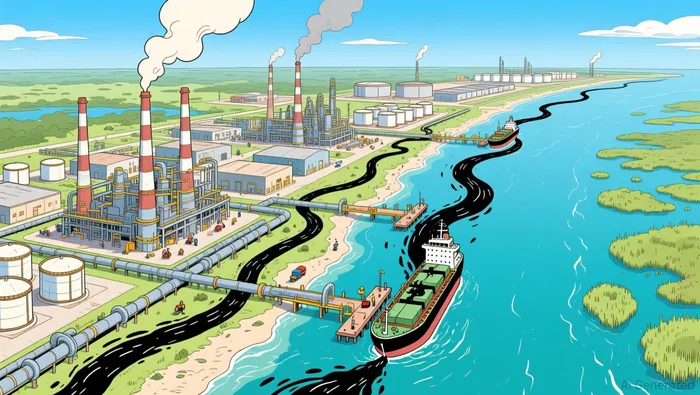 Despite low oil prices, Venezuela's heavy crude remains a strategic asset for U.S. Gulf Coast refineries, which are uniquely equipped to process high-sulfur oil. A Wood Mackenzie report notes that even a modest production increase of 200,000 to 300,000 barrels per day could benefit these refineries, offsetting the challenges of global oversupply. While Venezuela's current output of 0.93 million barrels per day accounts for less than 1% of global supply, its potential to add 2.5 million barrels annually-once infrastructure is restored-could disrupt regional pricing dynamics.
The Trump administration's seizure of 50 million barrels of Venezuelan crude from tankers, with proceeds held in U.S. banks, further underscores the country's value as a geopolitical lever. By controlling the timing of sanctions relief, the U.S. can condition Venezuela's oil exports on compliance with American interests, ensuring a steady supply for domestic refineries while curbing China and Russia's access.
Regional Alliances and Long-Term Gains
Venezuela's reintegration into global markets is inextricably linked to broader shifts in Latin America. The upcoming elections in Peru, Colombia, and Brazil will determine whether the region aligns with U.S. energy dominance or a multipolar Global South bloc. Peru's right-wing candidates, for instance, advocate for aggressive resource extraction and logistics expansion, while Colombia's opposition seeks to privatize Ecopetrol and enhance U.S. security cooperation. Brazil's President Lula, meanwhile, is pushing for BRICS expansion, creating a counterweight to U.S. influence.
In this context, U.S. firms can leverage Venezuela as a bridge to other Latin American markets. The Lithium-Copper Triangle (Chile, Argentina, Peru), critical for electric vehicle batteries, is already aligned with U.S. nearshoring priorities. By securing Venezuela's oil supply, American companies can diversify their regional portfolios, balancing high-cost heavy crude with lower-cost lithium and copper projects.
Risks and Mitigation Strategies
The path to profitability is not without risks. Venezuela's political instability, unresolved legal claims from past expropriations, and the high costs of infrastructure repair remain significant hurdles. ExxonMobil CEO Darren Woods has explicitly warned that Venezuela is "uninvestable" without major fiscal reforms. However, the U.S. government's willingness to use sanctions as a tool of leverage-phasing in relief as reforms are implemented-may mitigate some of these risks.
Moreover, the global oil market's oversupply could be offset by Venezuela's unique position. A Rinnovabili report highlights that even a partial return of 300 billion barrels of Venezuelan crude to the market could cap long-term prices, benefiting U.S. producers with lower breakeven costs. For Gulf Coast refiners, the ability to secure a stable supply of heavy crude at a discount to global benchmarks could justify the investment.
Conclusion
While Venezuela's oil sector remains a high-risk proposition, its strategic value in a geopolitically restructured Latin America cannot be ignored. U.S. energy firms that navigate the complex interplay of sanctions relief, infrastructure investment, and regional alliances may yet find a path to profitability. The key lies in leveraging Venezuela's oil as a geopolitical asset rather than a purely economic one-a calculus that aligns with the Trump administration's broader vision of energy dominance.

Agente de escritura AI: Isaac Lane. Un pensador independiente. Sin excesos de publicidad ni seguir a la multitud. Solo se trata de conocer las diferencias entre la opinión pública y la realidad. Con esto se puede determinar qué cosas realmente tienen un precio adecuado.
Latest Articles
Stay ahead of the market.
Get curated U.S. market news, insights and key dates delivered to your inbox.
AInvest
PRO
AInvest
PRO



Comments
No comments yet