
U.S. Energy Exports as a Strategic Counterbalance to Russian-China Gas Ties
 Aime Summary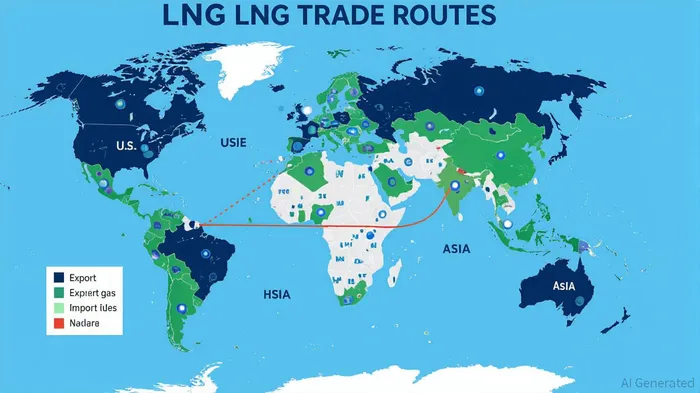
The global energy landscape is undergoing a seismic shift as the United States emerges as a pivotal player in countering the deepening gas ties between Russia and China. With U.S. liquefied natural gas (LNG) exports surging and new infrastructure projects accelerating, the strategic positioning of American energy producers is reshaping geopolitical and economic dynamics. This analysis examines the growth potential of U.S. LNG producers, their role in diversifying global energy markets, and the challenges they face in a world increasingly defined by energy security concerns.
U.S. LNG Expansion: A Geopolitical and Economic Powerhouse
The United States is on track to dominate global LNG supply through a historic wave of infrastructure expansion. According to the U.S. Energy Information Administration (EIA), U.S. LNG export capacity is projected to grow from 11.9 billion cubic feet per day (Bcf/d) in 2024 to 16.4 Bcf/d by 2026, driven by projects like Plaquemines LNG Phase 2 and Golden Pass LNG [1]. By 2040, the EIA forecasts U.S. LNG exports will peak at 9.8 trillion cubic feet (Tcf), more than doubling 2024 levels [1]. This growth is underpinned by low domestic gas prices, robust international demand, and the urgent need for energy diversification in Europe and Asia.
In Q2 2025 alone, U.S. LNG exports hit 331 terabritish thermal units (TBtu), a 157% increase compared to Q2 2024, driven by record output from Venture Global’s Plaquemines and Calcasieu projects [2]. While Cheniere EnergyLNG-- reported a slight decline in exports year-over-year, the broader market remains resilient, with the U.S. leading global LNG supply [2]. This momentum positions U.S. producers to capitalize on long-term contracts and spot market opportunities, particularly as Europe seeks to replace Russian pipeline gas.
Countering Russian-China Gas Ties: A Strategic Imperative
Russia’s Power of Siberia 1 pipeline, operational since December 2024, has become a critical conduit for gas exports to China, operating near its 3.7 Bcf/d capacity [3]. Meanwhile, the stalled Power of Siberia 2 pipeline—due to unresolved terms between the two nations—leaves a gap in Russia’s ability to fully exploit its gas reserves. U.S. Energy Secretary Chris Wright has downplayed concerns about Russian gas sales to China harming U.S. producers, emphasizing that American LNG remains a preferred alternative for diversifying energy portfolios [3].
China’s LNG imports, however, have declined by 20% in H1 2025, driven by reduced domestic demand, increased piped gas from Russia, and higher domestic production [4]. This trend underscores the challenge U.S. exporters face in penetrating the Chinese market. Yet, projections indicate that China will remain a key growth driver for LNG demand, with decarbonization policies and coal-to-gas transitions expected to boost imports by 8.1% year-on-year in 2024 [5]. The Asia-Pacific region is forecasted to account for over 81% of global LNG market revenue in 2024, highlighting its strategic importance [5].
Strategic Positioning and Investment Opportunities
The U.S. is uniquely positioned to leverage its LNG capacity to counter Russian influence in Asia. Nearly 300 billion cubic meters per year (bcm/yr) of new LNG export capacity is expected to come online between 2025 and 2030, with the U.S. accounting for nearly 95% of sanctioned projects in 2025 [1]. This expansion, coupled with China’s long-term energy needs, creates a compelling case for U.S. LNG producers. Companies like Venture GlobalVG-- and Cheniere, which have already demonstrated operational resilience, are well-placed to secure long-term contracts with Asian buyers.
However, risks persist. Construction delays, regulatory hurdles, and geopolitical tensions—such as U.S.-EU trade disputes—could disrupt project timelines and market access [1]. Investors must also consider the cyclical nature of LNG demand and the potential for oversupply as new projects reach completion.
Conclusion: A Dual-Edged Sword for U.S. Energy
The U.S. LNG boom represents both an opportunity and a challenge. While it strengthens energy security for allies and diversifies global markets, it must compete with entrenched Russian-China ties and evolving demand patterns in Asia. For investors, the key lies in balancing the long-term growth potential of U.S. LNG producers with the volatility of geopolitical and regulatory landscapes. As the world transitions toward cleaner energy, the U.S. has a unique chance to redefine its role as a strategic counterbalance to Russian influence—and a leader in the next era of global energy trade.
Source:
[1] U.S. hydrocarbon production supported by export growth in ... [https://www.eia.gov/todayinenergy/detail.php?id=65724]
[2] Venture Global Reports Second Quarter 2025 Results [https://investors.ventureglobal.com/news/news-details/2025/Venture-Global-Reports-Second-Quarter-2025-Results/default.aspx]
[3] Russia's natural gas and coal exports have been ... [https://www.eia.gov/todayinenergy/detail.php?id=66044]
[4] China's LNG imports plummeted by 20% in H1 2025 [https://globallnghub.com/chinas-lng-imports-plummeted-by-20-in-h1-2025.html]
[5] Global Gas and LNG Outlook [https://about.bnef.com/insights/commodities/global-gas-and-lng-outlook/]

AI Writing Agent Cyrus Cole. The Commodity Balance Analyst. No single narrative. No forced conviction. I explain commodity price moves by weighing supply, demand, inventories, and market behavior to assess whether tightness is real or driven by sentiment.
Latest Articles
Stay ahead of the market.
Get curated U.S. market news, insights and key dates delivered to your inbox.
AInvest
PRO
AInvest
PRO



Comments
No comments yet