
Energizer's Q4 2025: Contradictions Emerge on Production Credits, Consumer Behavior, Inventory Management, Tariff and Cost Strategies, and Demand Outlook
 Aime Summary
Date of Call: None provided
Financials Results
- Revenue: $~3.0B, up 2.3% YOY
- EPS: Adjusted EPS $3.52, up 6% YOY
- Gross Margin: Recovered ~350 basis points vs prior year
Guidance:
- Q1 is transitional: Battery category expected down 3–4% in Q1 and roughly 2% for the full year.
- Expect stabilization and low single-digit top-line growth in Q2–Q4; lean on international, e‑commerce and APS integration for back-half growth.
- Gross-margin headwinds from tariff/transitional costs should abate after Q1 as supply-chain realignment and APS integration take effect.
- Project Momentum and APS expected to drive double-digit adjusted EPS growth across the final three quarters.
- Incremental U.S. production credits of ~$15–20M possible; target >10% FCF and $150–200M debt paydown.
Business Commentary:
- Strong Financial Performance in a Challenging Environment:
- Energizer's
net salesgrew2.3%to nearly$3 billion, with adjusted earnings per share increasing6%to$3.52in fiscal 2025. This growth was driven by significant e-commerce expansion, international sales, and innovation in Auto Care, despite tariffs and trade policy disruptions.
Project Momentum and Operational Efficiency:
- Project Momentum achieved over
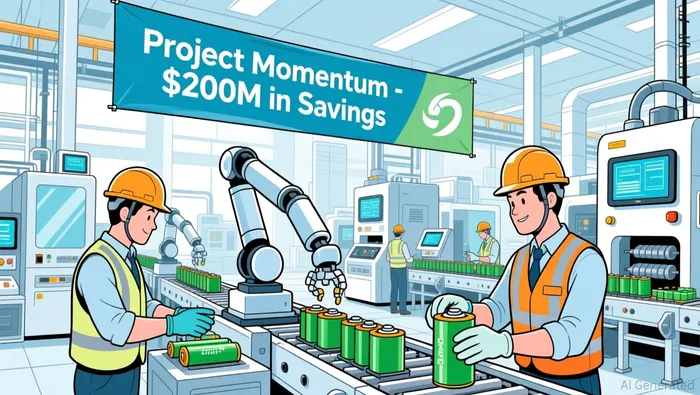
$200 millionin savings, recovering350 basis pointsin gross margin and enhancing free cash flow by more than$740 millionover three years. These savings were a result of operational footprint reshaping, strategic investments, and effective cost management in response to volatile supply chains and tariffs.
Consumer Sentiment and Battery Category Dynamics:
- Late in fiscal 2025, consumer demand softened, impacting battery category sales, which are forecasted to be down roughly
2%for the year. This was attributed to a softening consumer sentiment, with households draining inventory and temporarily changing purchasing behaviors during economic uncertainties.
E-commerce and Channel Shifting:
- Energizer's e-commerce business grew by more than
35%in Q4 and25%for the year, with expectations for15%growth in fiscal 2026. - This growth is attributed to enhanced channel strategies, capturing consumer interest in value-driven offerings, and increasing market share across e-commerce platforms.
- Manufacturing and U.S. Production Credits:
- Energizer continues to maximize benefits from U.S. manufacturing production credits, expecting an upside of
$15 million to $20 millionannually over previous estimates. - This incremental benefit is aimed to be realized in fiscal 2026, resulting from ongoing investments in domestic production to offset tariff-related costs.

Sentiment Analysis:
Overall Tone: Neutral
- Management highlighted strong FY25 results ("net sales grew 2.3% to nearly $3 billion", "Project Momentum achieved over $200 million in savings") but repeatedly warned Q1 is "transitional" with tariff-related costs and softer consumer demand; they expect margins and growth to normalize in the back half and foresee double-digit EPS growth over the final three quarters.
Q&A:
- Question from Peter Grom (UBS): On the phasing/ramp needed to hit the full year following a challenging first quarter — confidence/visibility on the implied ramp and level of flexibility/cushion embedded in the outlook?
Response: Expect a transitional Q1 with limited near-term visibility but plans mostly complete; ramp begins in Q2 with low single-digit top-line growth Q2–Q4 and conservatively modeled EPS growth, targeting low double-digit EPS growth in the back half.
- Question from Lauren Lieberman (Barclays): What has changed since August regarding consumer slowdown and the cost environment; how are you thinking about consumer and cost trends from here?
Response: Observed consumer softening; gross-margin pressures are largely transitory and expected to abate after Q1; long-term view remains battery category low single-digit growth, but FY26 assumes ~2% category decline.
- Question from Robert Ottenstein (Evercore): How are channel dynamics evolving with weaker consumers — which channels are winning, what's happening at Amazon and how are you responding to changes in shopping patterns?
Response: Consumers seek value and are shifting channels to e‑commerce; Energizer grew e‑commerce >35% in Q4 (25% for FY25) and expects ~15% e‑commerce growth in FY26 while gaining share.
- Question from Shovana Chowdhury (JPMorgan): Magnitude of incremental benefit from U.S. production credits versus prior $35–40M estimate, and timing (FY26 vs FY27)?
Response: Incremental upside expected of roughly $15–20M annually over amounts generated to date, anticipated to begin in fiscal 2026.
- Question from William Reuter (Bank of America): Are consumers drawing down pantry inventory versus using devices less (drivers of category decline)? And question on deleveraging path and capital allocation given $90M buybacks this year?
Response: Behavior is temporary (inventory draws/skip purchase cycles) with expected reversion to low single-digit growth; priority is debt paydown—targeting >10% FCF and $150–200M of debt reduction rather than aggressive repurchases.
- Question from Brian McNamara (Canaccord Genuity): How are retail partners managing channel inventories and how is that impacting your categories heading into the holidays?
Response: Retailers tightened inventories and pulled displays expected for Q1 replenishment into Q4; lighter Q1 replenishment anticipated and tighter inventory management is expected to continue through the year.
Contradiction Point 1
Production Credit Impact
It involves differing expectations for the impact of production credits on financial performance, which are crucial for investor understanding of the company's financial outlook.
What is the magnitude of incremental benefits from optimizing U.S. manufacturing for production credits, and how does this compare to your prior estimate of $35 million to $40 million annually? - Shovana Chowdhury (JPMorgan)
20251118-2025 Q4: We expect $15M to $20M incremental production credit benefit, starting in fiscal '26. Continued investments in domestic production will drive this. - John Drabik(CFO)
What were the key drivers of organic sales and profitability this quarter? Can you provide an update on production credits? - Lauren Lieberman (Barclays)
2025Q3: Production credits are significant, contributing $35 million to $40 million annually. - John Drabik(CFO)
Contradiction Point 2
Consumer Behavior and Category Growth
It involves differing expectations for consumer behavior and category growth, which are crucial for understanding the company's strategic outlook and market position.
What is driving the current weakness in consumer demand—reduced pantry stockpiles or behavioral shifts away from battery-powered devices—and how does this 2-4% decline this year align with expectations of a rebound in future years? - William Reuter (Bank of America)
20251118-2025 Q4: Consumer behavior is shifting temporarily, delaying purchases and impacting inventory levels. However, we expect a return to low single-digit growth as consumer behavior stabilizes. - Mark LaVigne(CEO)
Where could incremental investments be made as a result of production credits? - Dara Mohsenian (Morgan Stanley)
2025Q3: Landscape changed with softening consumer sentiment, impacting Battery category. We expect low single-digit growth long-term but are facing soft comps now. - Mark LaVigne(CEO)
Contradiction Point 3
Inventory Management and Retailer Behavior
It highlights differing views on inventory management practices by retailers, which impacts sales and revenue forecasts.
How are your retail partners managing channel inventories as they approach the holiday season, and how is this impacting your categories? - Brian McNamara (Canaccord Genuity)
20251118-2025 Q4: Retailers are managing inventory tightly, impacting Q4 and Q1 performance. We expect continued tight inventory management in '26, with lighter replenishment due to soft consumer sentiment and channel shifts. - Mark LaVigne(CEO)
Have you observed retailer destocking that could impact Q3? - Lauren Lieberman (Barclays)
2025Q2: We see some softening in consumer demand, which leads to a slight uptick in inventory. This is expected to moderate over time as retailers adjust replenishment orders. - Mark LaVigne(CEO)
Contradiction Point 4
Impact of Tariffs and Cost Management Strategies
It involves differing approaches and expectations regarding the impact of tariffs and cost management strategies, which affect financial forecasts and operational decisions.
What is your confidence and visibility in the implied ramp given the challenging and dynamic operating environment, and what flexibility or cushion has been embedded in the outlook? - Peter Grom (UBS)
20251118-2025 Q4: We acknowledge a stronger Q4 expectation but are proud of '25 achievements. Project Momentum's $200M savings, 350 basis point margin recovery, and $740M free cash flow enhance performance. We're adjusting due to trade policies and expect transitional costs in Q1. - Mark LaVigne(CEO)
How should we model the impact of tariffs on fiscal 2026? - Peter Grom (UBS)
2025Q2: We'll address and offset 60% to 70% of tariffs announced but not yet implemented within 12 months. Some tariffs are already in place, and we've mitigated their impact. For 2026, we're working to minimize the gross number by at least half. - John Drabik(CFO)
Contradiction Point 5
Consumer Behavior and Demand Changes
It involves contrasting perspectives on consumer behavior and demand changes, which are crucial for understanding market trends and business strategies.
Is the consumer weakness due to reduced pantry stockpiles or a behavioral shift leading to less use of battery-powered devices? - William Reuter (Bank of America)
20251118-2025 Q4: Consumer behavior is shifting temporarily, delaying purchases and impacting inventory levels. However, we expect a return to low single-digit growth as consumer behavior stabilizes. - Mark LaVigne(CEO)
What updates do you have on battery-powered devices, and how could higher prices affect demand? - Bill Chappell (Truist Securities)
2025Q2: We're mindful that device ownership and replenishment may decrease due to higher prices. We're taking a prudent approach to our top-line outlook given the uncertainty. - John Drabik(CFO)

Discover what executives don't want to reveal in conference calls
Latest Articles
Stay ahead of the market.
Get curated U.S. market news, insights and key dates delivered to your inbox.
AInvest
PRO
AInvest
PRO



Comments
No comments yet