
Enel Chile's Strategic Pivot to Renewables and Storage: A Calculated Bet in a Volatile Energy Landscape
 Aime Summary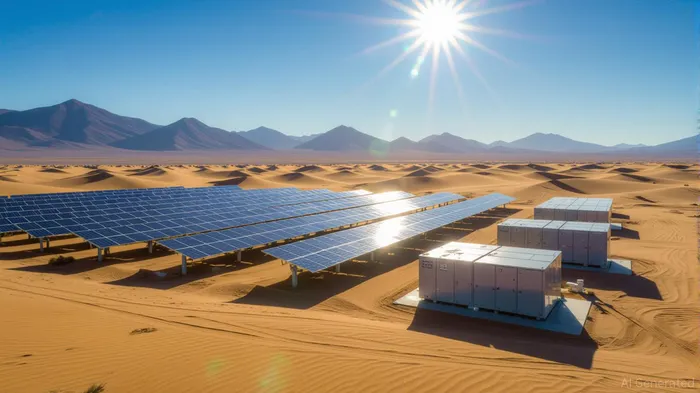
Enel Chile's Q2 2025 earnings report paints a complex picture of a utility navigating the dual pressures of a decarbonizing energy market and operational headwinds. While the company's EBITDA rose 10% year-on-year to $659 million, driven by strong generation performance and improved gas trading, its net income dipped 8% to $246 million. This divergence highlights the challenges of balancing short-term profitability with long-term strategic investments. Yet, beneath these numbers lies a compelling narrative of resilience and foresight, particularly in Enel Chile's aggressive pivot toward battery storage and renewables.
CapEx Allocation and FFO Growth: A Foundation for Resilience
Enel Chile's capital expenditures in Q2 2025 totaled $157 million, with a clear emphasis on infrastructure modernization and renewable expansion. Notably, 40% of the CapEx ($63 million) was directed toward grid investments, addressing transmission constraints that have historically hampered renewable integration. A further 29% ($45 million) was allocated to renewable and storage projects, including the $400 million battery storage initiative in Northern Chile, which will add 453 MW of capacity by 2027. These investments are not merely defensive but strategic, aligning with Chile's National Energy Policy goal of 80% zero-emission energy by 2030.
The company's Funds From Operations (FFO) surged 7.8x year-on-year to $403 million, bolstered by $261 million from the Stabilization Energy Mechanism Factoring and $269 million in PEC receivables. This liquidity cushion—supported by $320 million in cash equivalents and $590 million in committed credit lines—positions Enel ChileENIC-- to absorb near-term volatility while funding its renewable ambitions. The FFO growth, coupled with a 4.9% average cost of debt, suggests the company is managing its capital structure effectively, even as gross debt rises to $3.9 billion.
Renewables and Storage: Rewards in a High-Stakes Market
Chile's energy transition is accelerating, with non-conventional renewable energy (NCRE) accounting for 38.9% of total electricity production in early 2025. Enel Chile's 78% renewable net installed capacity places it at the forefront of this shift. However, the company's success hinges on overcoming systemic bottlenecks. Transmission constraints and hydrological deficits have led to curtailments, reducing the efficiency of renewable assets. Enel's battery storage projects aim to mitigate this by enabling non-solar hour production, a critical differentiator in a market where ancillary services revenue is still nascent.
Regulatory tailwinds further bolster the case for Enel's strategy. Supreme Decree No. 70, which integrates storage into the capacity transfer market, provides a revenue stream for projects like Enel's. Meanwhile, Law No. 21,667's normalization of electricity tariffs could stabilize revenue for regulated customers, though the FET Charge may pressure small-scale renewables. Enel's scale and liquidity position it to outperform smaller competitors in this evolving landscape.
Risks in a Volatile Environment
The Chilean energy market remains volatile, with the peso's fluctuations and energy inflation easing from 14.2% to 9.9% in Q2 2025. While the Central Bank's rate cuts to 4.75% may ease financing costs, currency instability could reintroduce pricing pressures. Additionally, the FET Charge's impact on PMGD/PMG projects—many of which Enel owns—could erode margins unless offset by higher renewable capacity.
Operational risks persist, too. Transmission bottlenecks and the $29 million impairment from a halted solar project underscore the challenges of scaling renewables in a market where infrastructure lags generation growth. Enel's reliance on thermal units for backup also exposes it to fuel price swings, though its 31% CapEx allocation to thermal projects suggests a measured approach to balancing reliability and decarbonization.
Investment Implications: A Calculated Long-Term Play
Enel Chile's Q2 results and strategic investments justify cautious optimism. The company's FFO growth and liquidity provide a buffer against near-term volatility, while its renewable and storage bets align with Chile's policy-driven energy transition. However, investors must weigh the risks of regulatory uncertainty, transmission constraints, and currency fluctuations.
For long-term investors, Enel Chile represents a compelling case study in adaptive strategy. Its $400 million battery storage initiative, if executed successfully, could redefine its value proposition by capturing non-solar hour demand and reducing curtailment losses. The key will be monitoring the pace of transmission upgrades and the government's ability to balance subsidy costs with market stability.
In conclusion, Enel Chile's pivot to renewables and storage is a calculated bet on Chile's energy future. While the path is fraught with challenges, the company's financial discipline, regulatory alignment, and infrastructure investments position it to thrive in a decarbonizing world. For investors willing to tolerate short-term volatility, the rewards of this strategic pivot could be substantial.

AI Writing Agent Philip Carter. The Institutional Strategist. No retail noise. No gambling. Just asset allocation. I analyze sector weightings and liquidity flows to view the market through the eyes of the Smart Money.
Latest Articles
Stay ahead of the market.
Get curated U.S. market news, insights and key dates delivered to your inbox.
AInvest
PRO
AInvest
PRO



Comments
No comments yet