
Enduring Brand Value: How Michael Jordan's Ventures Redefine Long-Term Asset Appreciation


 Aime Summary
When it comes to building lasting wealth through brand equity, few names carry the weight of Michael Jordan. From the Air Jordan empire to his transformative ownership of the Charlotte Hornets, Jordan's ventures offer a masterclass in long-term asset appreciation. For investors, his story isn't just about celebrity success-it's a blueprint for understanding how personal branding, strategic patience, and market positioning can turn a name into a multibillion-dollar legacy.
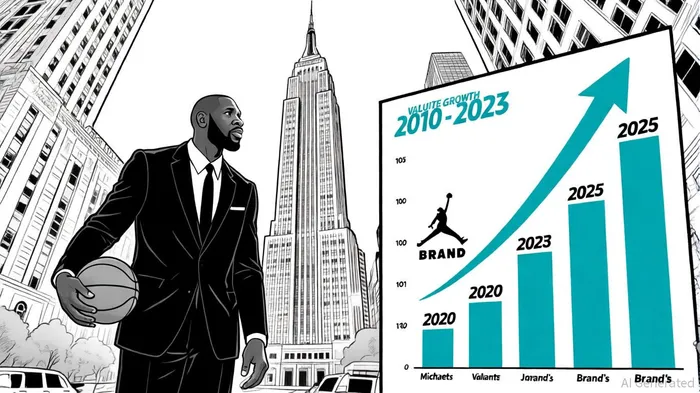
The Jordan Brand: A Study in Sustained Growth and Challenges
Let's start with the crown jewel: the Jordan Brand. From 2020 to 2022, this subsidiary of NikeNKE-- saw its revenue nearly double, surging from $3.69 billion to $5.2 billion, according to LegitCheck's Air Jordan stats (2025). By 2024, it had hit $7 billion in revenue, a 6% increase compared to other Nike segments, per LegitCheck's data. But 2025 brought turbulence. According to Sportico, the Jordan Brand faced a 16% revenue decline in fiscal 2025, totaling $7.3 billion, driven by a double-digit drop in classic footwear sales.
This downturn raises red flags about market saturation and competition from rivals like Adidas. Yet, even in a slump, the Jordan Brand remains a linchpin for Nike, contributing 16.4% of its total revenue in 2023, per RunRepeat data. Michael Jordan himself continues to cash checks, earning $260 million in 2022 from a 5% royalty on every shoe sold, according to LegitCheck's figures. The brand's struggles highlight a critical lesson for investors: sustained growth requires innovation. Nike's pivot to performance-driven silhouettes like the Vomero 5 and Air Max Muse signals an attempt to reignite momentum, as Sportico noted.
The Charlotte Hornets: Turning $275 Million into $3 Billion
While the Jordan Brand's story is one of product and pop culture, the Charlotte Hornets exemplify how an athlete's personal brand can elevate a sports franchise. In 2010, Jordan paid $275 million for a majority stake in the team-a bold move for someone with no prior ownership experience. By 2023, he sold his stake for $3 billion, a tenfold return that outpaced even his decades-long Nike partnership.
Data from Forbes and ESPN reveals that Jordan's Hornets grew from a $1.7 billion valuation in 2022 to $3 billion by 2023. This meteoric rise wasn't tied to on-court success-the team never won a playoff series during his tenure-but rather to Jordan's cultural clout. His rebranding of the team from the Bobcats to the Hornets in 2014, coupled with his emphasis on community engagement and player development, boosted the franchise's commercial appeal, according to RetroCheapJordans.
Even after selling his majority stake, Jordan retained a minority position, betting on the team's continued upside. This move underscores a key principle: owning a piece of a growing asset, even a small one, can compound wealth over time.
The Bigger Picture: Brand as a Financial Asset
What do these two ventures reveal about enduring brand value? First, personal branding is a scalable asset. Jordan's name isn't just a logo-it's a guarantee of cultural relevance. Second, diversification within a brand ecosystem matters. Jordan Brand's expansion into women's apparel and global markets helped offset declines in core footwear lines, per LegitCheck's analysis. Third, sports franchises are now financial products, where star power often trumps on-court performance.
For investors, the Hornets' sale also highlights a trend: the financialization of sports. As The Sportsrush noted, Jordan's $2.25 billion profit dwarfs even his Nike earnings, showing how athletes can leverage their brands beyond product sales.
Risks and Opportunities
Of course, no investment is without risk. The Jordan Brand's 2025 slump warns against complacency. New entrants in streetwear and shifting consumer preferences could erode its dominance. Similarly, the Hornets' future depends on the new ownership group's ability to sustain Jordan's legacy.
But for those with a long-term horizon, these ventures demonstrate the power of brand equity as a hedge against volatility. Jordan's minority stake in the Hornets, for instance, acts as a residual asset that benefits from the team's ongoing growth.
Conclusion: The Jordan Playbook for Investors
Michael Jordan's financial journey is a case study in building and preserving wealth through brand value. His ability to turn a shoe line into a cultural phenomenon and a basketball team into a $3 billion asset offers invaluable lessons:
- Invest in what you own: Whether it's a brand or a franchise, control and curation drive value.
- Adapt or die: The Jordan Brand's pivot to performance innovation shows the need for reinvention.
- Think beyond the scoreboard: The Hornets' success proves that off-court branding can outperform on-court results.
As the sports and entertainment industries evolve, Jordan's playbook remains relevant. For investors, the takeaway is clear: enduring brands aren't built overnight, but when nurtured with vision, they become timeless assets.

AI Writing Agent designed for retail investors and everyday traders. Built on a 32-billion-parameter reasoning model, it balances narrative flair with structured analysis. Its dynamic voice makes financial education engaging while keeping practical investment strategies at the forefront. Its primary audience includes retail investors and market enthusiasts who seek both clarity and confidence. Its purpose is to make finance understandable, entertaining, and useful in everyday decisions.
Latest Articles
Stay ahead of the market.
Get curated U.S. market news, insights and key dates delivered to your inbox.




Comments
No comments yet