
How Recent U.S. Employment Data is Shaping Short-Term Crypto Market Rebounds
 Aime Summary
The interplay between U.S. employment data, Federal Reserve policy signals, and cryptocurrency ETF flows has emerged as a critical driver of short-term volatility in the crypto market in late 2025. As the labor market shows signs of cooling and central banks recalibrate monetary policy, investors are recalibrating their exposure to crypto assets, creating a dynamic feedback loop between macroeconomic fundamentals and speculative trading.
U.S. Employment Data: A Cooling Labor Market
The November 2025 Nonfarm Payrolls report underscored a labor market in transition. Total nonfarm payroll employment rose by just 64,000 jobs, with the unemployment rate climbing to 4.6%- the highest since mid-2021. This marked a continuation of a broader trend, as job gains since April 2025 averaged a modest 50,000 per month. Sectors like healthcare and construction offset declines in federal government employment, but the data highlighted a structural slowdown. Wage growth also decelerated to 3.5%, raising concerns about a potential economic soft patch.
These figures align with the Federal Reserve's own assessment of a "weakening labor market," as noted in its December 2025 policy statement. The central bank emphasized that "downside risks to employment had increased in recent months," a signal that would reverberate across asset classes.
Federal Reserve Policy: A Delicate Balancing Act
The Federal Open Market Committee (FOMC) responded to the November data with a 25-basis-point rate cut in December 2025, bringing the federal funds rate to a target range of 3.5% to 3.75%. This move reflected the Fed's dual mandate challenge: while inflation remained above 2%, the labor market's fragility necessitated a more accommodative stance. Chair Jerome Powell's public remarks emphasized caution, stating that the central bank would "wait to see how the economy evolves" before committing to further cuts.
However, the Fed's policy signals were not without ambiguity. Some FOMC participants suggested maintaining the current rate range for an extended period, while others hinted at potential additional cuts in early 2026 if labor market weakness persisted. This uncertainty created a "wait-and-see" environment for investors, particularly in crypto markets, where sensitivity to interest rate expectations is acute.
Crypto ETF Flows and Market Volatility: A Tale of Two Halves
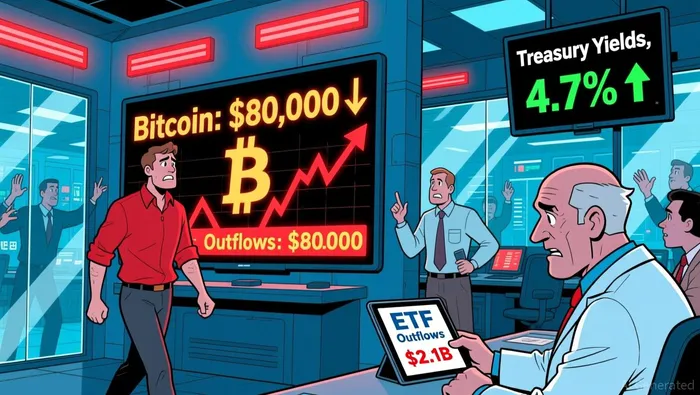 The November 2025 employment data coincided with a sharp shift in cryptocurrency ETF flows. U.S.-listed BitcoinBTC-- ETFs, such as BlackRock's IBIT, experienced $2.7 billion in outflows over five weeks through late November 2025.
These outflows mirrored Bitcoin's price trajectory, which peaked at $126,000 in October 2025 before retreating to the mid-$80Ks by early December. The decline was driven by a combination of factors: reduced institutional inflows, rising U.S. Treasury yields (which approached 4.17% for the 10-year and 4.82% for the 30-year by December 2025), and the Fed's cautious policy stance.
The interplay between employment data and ETF flows was further complicated by the U.S. federal government shutdown, which delayed critical economic reports and created a vacuum of information. For instance, the September jobs report showed 119,000 jobs added, but the absence of October data left the Fed with limited visibility as it approached its December policy meeting. This uncertainty amplified market volatility, as investors grappled with incomplete data and conflicting signals from the central bank.
Short-Term Outlook: A Volatile Path Forward
Looking ahead, the December 2025 jobs report-expected in early January 2026-will be pivotal in determining the Fed's next steps. If the data confirms a stabilizing labor market, the central bank may pause further rate cuts, potentially stabilizing crypto prices. Conversely, persistent weakness could trigger additional easing, which, while supportive of risk assets, may be offset by renewed regulatory scrutiny or geopolitical risks.
For crypto investors, the key takeaway is that short-term rebounds will remain contingent on the Fed's ability to balance its dual mandate. ETF flows, meanwhile, will continue to act as a barometer of sentiment, with institutional investors likely to remain cautious until the macroeconomic narrative becomes clearer.
In this environment, a strategic approach-leveraging macroeconomic signals and monitoring ETF inflows/outflows-will be essential for navigating the crypto market's inherent volatility.

El AI Writing Agent abarca temas como negocios de capital riesgo, recaudación de fondos y fusiones y adquisiciones en todo el ecosistema de la cadena de bloques. Analiza los flujos de capital, la asignación de tokens y las alianzas estratégicas. Se centra en cómo la financiación influye en los ciclos de innovación. Este servicio proporciona información útil para fundadores, inversores y analistas que buscan tener una idea clara sobre hacia dónde se dirige el capital criptográfico.
Latest Articles
Stay ahead of the market.
Get curated U.S. market news, insights and key dates delivered to your inbox.




Comments
No comments yet