
τemplar (SN3) Surges 400% as Covenant-72B Validates Decentralized AI
 Aime Summary
τemplar (SN3) surged more than 400% this month, reaching a $130 million market capitalization following a major technical breakthrough on the BittensorTAO-- network. The rally was anchored by the successful training of Covenant-72B, a 72-billion-parameter model that proved distributed AI systems can match the performance of centralized labs. This validation has shifted the investment narrative from experimental feasibility to operational economics.
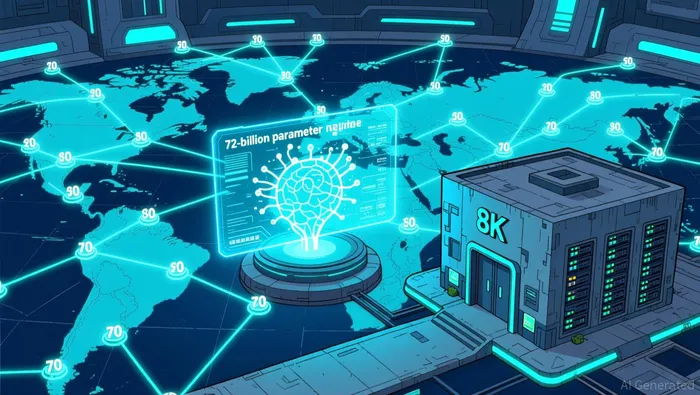
The breakthrough model, trained across 70 globally distributed nodes without a single data center, achieved a 67.1 score on the MMLU benchmark. This performance metric places the decentralized model on par with Meta's Llama 2 70B, effectively countering long-standing skepticism regarding the efficiency of permissionless training.
Market participants reacted swiftly to the technical milestone, with the broader Bittensor ecosystem seeing its native token, TAO, nearly double to approximately $317. The surge was further amplified by Grayscale's regulatory progress, as the asset manager filed an amended S-1 registration statement with the SEC on April 3, 2026, for a TAO Trust.
How does Covenant-72B change the AI infrastructure thesis?
The release of Covenant-72B represents a critical inflection point for decentralized artificial intelligence infrastructure. For years, critics argued that the high communication overhead and fragmentation of distributed nodes made it impossible to train frontier-scale models. The successful deployment of the 72-billion-parameter model directly addresses these concerns by demonstrating that sparse, quantized training can achieve state-of-the-art results.
The technical architecture relied on SparseLoCo, a novel technique that combines sparsification, 2-bit quantization, and error feedback. This approach reduced inter-node communication costs by over 146 times compared to earlier distributed runs, allowing the network to train on 1.1 trillion tokens across 70+ peers with blockchain-based validation.
All weights and code for the Covenant-72B model were released under the Apache License, ensuring transparency and fostering further development within the ecosystem. The model's success suggests the commercial urgency is now shifting toward inference economics, where decentralized networks can undercut centralized cloud providers on cost due to the modular nature of inference.
While pretraining at the absolute frontier still faces physical hardware constraints, the market is now evaluating the speed of improvement rather than debating the fundamental viability of the approach. This shift in sentiment has directly benefited the subnet token τemplar (SN3), which serves as the primary vehicle for this specific subnet's activity.
What role do institutional filings play in the current rally?
Regulatory progress has provided a crucial tailwind to the technical achievements, creating a dual-catalyst environment for price appreciation. On April 3, 2026, Grayscale Investments amended its S-1 registration statement to the SEC to establish a Bittensor Trust. This filing offers a regulated route for capital inflows, allowing investors to gain exposure to TAO through tradable shares in a passive holding structure.
The filing has already seen significant activity, with over 2 million shares issued and total staked value exceeding $691 million. This institutional engagement complements the network's strong fundamentals, where 68% of the 10.7 million circulating tokens are currently locked in staking. High staking rates indicate strong community commitment and reduce the immediate available supply for sale, supporting price stability.
The Grayscale filing is viewed as a precursor to a potential spot ETF, which would further lower barriers for traditional capital entering the digital asset space. This regulatory clarity helps validate the network's legitimacy as a core infrastructure play within the broader AI and blockchain convergence narrative.
Ecosystem expansion also supported the institutional thesis, with Subnet 4, known as Targon, securing a six-figure deal to power Dippy AI. This partnership serves 8.6 million users, providing tangible proof of utility that complements the institutional interest sparked by the ETF filing.
What are the primary sustainability risks for the token?
Despite the recent surge, fundamental complexities remain regarding the long-term sustainability of the token's value. While ecosystem revenue across 129 active subnets is estimated at $100 million annually, the top subnet generates only $2.4 million in external revenue against approximately $52 million in network subsidies. For the token to remain valuable long-term, external demand must grow faster than the emission of new TAO tokens.
The network recently underwent a halving in December 2025, which reduced daily emissions to 3,600 tokens. However, the gap between subsidies and subnet revenue poses a risk if real-world utility does not expand rapidly enough to offset the incentive structure. Derivatives data currently shows a crowded long bias with record Open Interest of $554.98 million, suggesting potential vulnerability to volatility.
Technical analysis indicates the token is consolidating between $315 and $345, with a breakout above $375 critical for a move toward $400. A drop below the 200-day EMA at $275 would break the current structure and could target the low $200s, assuming BitcoinBTC-- stability and developer activity do not sustain demand.
Investors must weigh the high growth potential of the decentralized AI sector against the risks of subsidy dependency and market leverage. The convergence of technical proof and institutional access forms the core logic behind the recent performance, but the transition to self-sustaining revenue remains the key variable to watch.

Blending traditional trading wisdom with cutting-edge cryptocurrency insights.
Latest Articles
Stay ahead of the market.
Get curated U.S. market news, insights and key dates delivered to your inbox.


AInvest
PRO
AInvest
PRO



Comments
No comments yet