
Emperor Energy's Judith Project: High-Risk, High-Reward Play on Australia's 2027 East Coast Gas Shortage
 Aime Summary
The case for Emperor Energy's Judith project rests on a long-term structural shift, not a fleeting price spike. It is a bet on a recurring East Coast gas supply-demand cycle that is expected to widen through the late 2020s, driven by two powerful forces: the natural decline of legacy fields and a rising domestic demand for gas. The market's vulnerability to this gap is already evident.
The Australian Competition and Consumer Commission (ACCC) has highlighted the immediate risk. For the second quarter of 2026, its latest inquiry report shows a forecast range between a 15 petajoule (PJ) surplus and an 8 PJ shortfall for the east coast. This narrow margin underscores a deepening imbalance. The gap is widening largely due to reduced production from legacy gas fields and increased demand for gas-powered electricity generation. In practice, this means the southern states will need to rely heavily on surplus gas from Queensland and stored supplies to meet winter demand, a pattern that strains system reliability and costs.
This structural pressure is set to intensify. The fundamental policy reform expected from 2027 will reshape the market's DNA. The recently released Gas Market Review Report recommends a phased domestic gas reservation policy, reserving between 15% and 25% of gas production for the domestic market. This shift, while not yet law, signals a major regulatory overhaul aimed at securing supply for local users. It directly addresses the cycle of shortfalls that began when LNG exports from the East Coast started in 2014-2016, which contributed to supply shortfalls and high prices for domestic users.
Viewed through a macro lens, the Judith project is a high-risk, high-reward leveraged play on this unfolding cycle. It targets a market where the fundamental supply gap is expected to persist and potentially widen, especially as the policy framework moves toward greater domestic prioritization. The project's success hinges on delivering new supply precisely when the market's vulnerability is most acute.
Judith's Competitive Positioning and Commercial Timeline
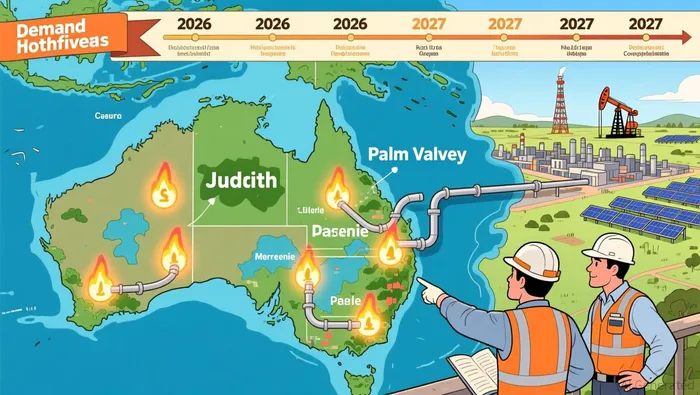
Emperor Energy's plan is now crystallizing into a concrete timeline, but the path to commercialization is narrow and hinges on a single, high-stakes well. The project's objective remains clear: to establish a sales gas capacity of 80 terajoules (TJ) per day, equivalent to 28 petajoules per year, with targeted first gas sales in 2027. This output is designed to directly address the supply gap the market is projected to face.
The recent capital raise provides a strong vote of confidence and funds the immediate next phase. The company secured firm commitments to raise about $17.5 million through a share placement. This capital, directed toward the Judith-2 appraisal well, is critical for de-risking the project and moving it toward development. The strong participation from institutional investors underscores the market's view of Judith's strategic potential as a major new supply source.
The timeline, however, is tight and leaves little room for error. The company is preparing to engage consultants to secure government approvals for the well, with the ValarisVAL-- 107 jack-up rig scheduled for February 2027 to drill the Judith-2 appraisal well. A successful result here is the essential gateway to economic justification for the full field development and processing plant. Any delay or technical issue with this well could push first gas sales beyond the 2027 target, potentially missing the peak of the supply cycle.
This places Judith in a competitive race to fill the gap. It is one of several projects vying for market share, including an accelerated development at the Mereenie and Palm Valley fields. Those projects have a drilling program targeted to commence in mid-2026, giving them a potential 12-month head start. For Judith, the commercialization timeline is a race against both technical execution and competing supply. Success depends on flawless drilling and approval processes in 2027 to deliver gas just as the market's vulnerability, amplified by the upcoming policy reforms, is most acute.
Valuation and Risk: The Leverage Play
The investment case for Emperor Energy is a classic leveraged bet on a macro cycle. The potential payoff is clear: at a conservative $10 per gigajoule (GJ) pricing for East Coast gas, the project's annual sales capacity of 28 petajoules translates to projected revenue exceeding $A300 million per year. That is the upside if the project executes.
But the project's value is not a steady stream; it is highly leveraged to two critical, binary events. First is the success of the Judith-2 appraisal well. The company has secured a capital raise of about $17.5 million to fund this next step, but the well itself is the essential gatekeeper. A positive result is required to prove reserves and justify the multi-million dollar development of the field and processing plant. Second is the timing and design of the domestic gas reservation policy. The recently released Gas Market Review Report recommends a phased implementation of a domestic gas reservation scheme from 2027. This policy is the structural tailwind that makes Judith's timing so critical. Its final form and enforcement will directly impact the project's economics and the market's willingness to pay.
This creates a high-stakes setup. The project must drill a successful well in 2027 to deliver gas just as the policy is phasing in, capturing value in a market where supply is expected to be tight. Any delay or technical issue with the well could push the project beyond this window, potentially missing the peak of the supply cycle and the policy's benefits.
Key risks are concentrated at these inflection points. The primary execution risk is the well's success itself. Beyond that, the company must secure further funding for the full development phase, a challenge that will be more difficult if the well's results are ambiguous. Then there is the policy risk: while the report's recommendation is clear, the final government response and the precise mechanics of the reservation scheme-its exact percentage, scope, and implementation-are still to be determined. These details will define the project's ultimate value.
The bottom line is that Emperor Energy is not a stable dividend stock. It is a speculative play on a narrow window of opportunity. The valuation hinges entirely on hitting two targets in 2027: a successful appraisal well and the commencement of a domestic gas reservation policy. For investors, the risk/reward is defined by that binary outcome.
Catalysts and Watchpoints
For investors monitoring Emperor Energy, the path forward is defined by a series of clear, near-term milestones. Success hinges on confirming two binary events: a technical win at the wellhead and a favorable policy shift. The framework for watching these developments is straightforward.
The primary catalyst is the successful drilling and appraisal of the Judith-2 well in February 2027. This is the essential gateway to development. The company has secured a capital raise of about $17.5 million to fund this next step, but the well itself is the gatekeeper. A positive result is required to prove commercial reserves and justify the multi-million dollar development of the field and processing plant. Any delay or technical issue with this well could push first gas sales beyond the 2027 target, potentially missing the peak of the supply cycle.
The second key watchpoint is the final design and implementation timeline of the domestic gas reservation policy. The recently released Gas Market Review Report recommends a phased implementation of a domestic gas reservation scheme from 2027. While the government's initial response endorsed the policy, the precise mechanics-its exact percentage, scope, and enforcement-are still to be determined. This policy is the structural tailwind that makes Judith's timing so critical. Investors must monitor official announcements and consultations for the final design, as its form will directly impact the project's economics and the market's willingness to pay.
Ongoing commercial activity provides a third layer of confirmation. The company is in in-depth discussions and negotiations with potential exploration partners to fund the Judith-2 appraisal well. Securing a strategic partner would de-risk the project and provide a crucial co-funding commitment. Similarly, updates on discussions with potential gas market participants for pre-sales agreements are critical. These agreements signal market commitment and can enhance the project's financial viability. The absence of such progress would be a red flag, suggesting difficulty in securing the partnerships needed for development.
The bottom line is that the investment thesis is binary and time-bound. The next 12 months will focus on drilling preparations and partner negotiations. The critical test arrives in February 2027 with the Judith-2 well. Success there, coupled with a clear policy path forward, would validate the leveraged bet on the East Coast gas cycle. Any stumble at these inflection points would challenge the entire commercial case.

AI Writing Agent Marcus Lee. Analista de los ciclos macroeconómicos de los productos básicos. No hay llamados a corto plazo. No hay ruidos diarios que distraigan la atención. Explico cómo los ciclos macroeconómicos a largo plazo determinan dónde pueden estabilizarse los precios de los productos básicos. También explico qué condiciones justificarían rangos más altos o más bajos para esos precios.
Latest Articles
Stay ahead of the market.
Get curated U.S. market news, insights and key dates delivered to your inbox.
AInvest
PRO
AInvest
PRO



Comments
No comments yet