
Emirates, Qatar Airways at Risk of Sustained Margin Pressure as Middle East Conflict Forces Costly Reroutes and Safety Crises


 Aime Summary
The immediate catalyst is a sudden, violent escalation in the Middle East. In response to a massive U.S.-Israel air offensive, Iran launched wide-scale retaliatory strikes across the region on Saturday. The result is a shattered aviation map. Authorities say they have intercepted multiple missiles and drones over Dubai since Saturday, with one person killed and 11 injured at airports in Dubai and Abu Dhabi. This direct targeting of key hub airports has triggered a cascade of closures.
The impact is measurable and severe. Hundreds of thousands of travelers were either stranded or diverted as Israel, Qatar, Syria, Iran, Iraq, Kuwait and Bahrain closed their airspace. The three major airlines operating at these hubs-Emirates, Qatar Airways, and Etihad-have been forced into a state of emergency. Their typical 90,000 passengers per day crossing through Dubai, Abu Dhabi, and Doha are now grounded. Large parts of Middle East airspace remain closed, including Iran, Iraq, Syria, Bahrain and Kuwait, with the UAE and Qatar only permitting very limited capacity and tightly controlled routings. The central corridor is effectively unusable.
This creates a global disruption. For flights between Europe and Asia, the normal Gulf corridor is gone. Traffic must now reroute either north via the Caucasus and Afghanistan, or south via Egypt, Saudi Arabia, and Oman. That will add hours to those flights and consume additional fuel, directly increasing operating costs. The added flight hours also put pressure on air traffic controllers in the new routing countries. The immediate cost is clear: grounded planes, stranded crews, and a surge in fuel burn.
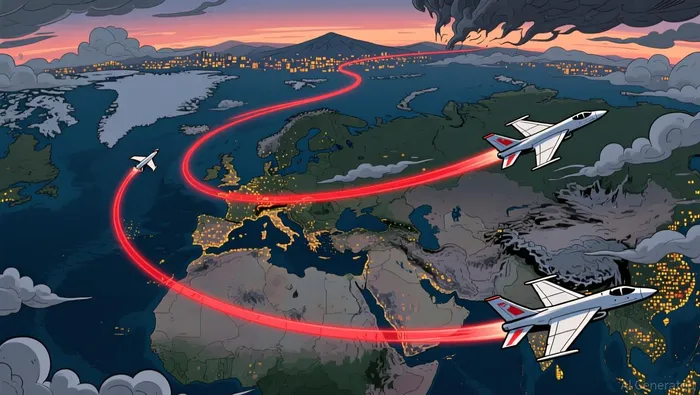
Yet beneath the surface of these logistical and financial costs lies a more critical, underappreciated risk: pilot safety. The new flight paths traverse regions with active military conflict and ongoing missile and drone strikes. Missile and drone strikes are continuing across the region, creating a high-risk environment for aviation. Pilots now face the perilous reality of flying through contested airspace, where the threat of interception or debris is not theoretical. This introduces a new, acute safety factor that could escalate if the conflict persists or intensifies.
Pilot Safety Concerns and Operational Stress
The immediate threats to aircraft are now physical and unpredictable. The conflict has introduced a new class of hazard: undetectable drones and missile strikes that can damage airports and force flights to turn back. A French Air France flight to bring stranded nationals home from the UAE turned back due to missile fire on Thursday, and a Lufthansa pilot was diverted from Riyadh to Cairo over regional security fears. This isn't just about rerouting; it's about surviving the flight path. The risk of shootdown, whether inadvertent or intentional, has escalated to a level that forces airlines to classify entire countries as "Moderate risk - No Fly" airspace.
For pilots, this creates a profound psychological burden. They are commercial aviators, not military combatants. "We are not military pilots. We are not trained to deal with these kinds of threats in the air," said a Middle East-experienced pilot and union official. This lack of training for asymmetric threats like drone swarms and heat-seeking air defenses fuels anxiety. The cumulative strain of managing shrinking airspace and constant security alerts over years of global conflict is taking a toll on mental health. The stress of making split-second decisions in a high-risk environment increases the potential for human error, a critical vulnerability when safety margins are already thin.
Operationally, the chaos compounds the danger. Pilots face GPS spoofing, which can maliciously trick planes about their position, and must navigate complex, ever-changing reroutes around the conflict zone. The situation is further muddled by confusing advice and on-again-off-again airport closures. This instability makes evacuation planning nearly impossible and forces flight decisions to become ad hoc, often resting on the judgment of an individual pilot. In a region with a tragic history of misidentification-like the downing of Ukraine International Airlines PS752 in 2020-this lack of clear, consistent guidance raises the specter of another catastrophic mistake. The operational stress is not just about fuel burn; it's about managing an environment where the rules of engagement are unclear and the consequences of a wrong call are severe.
The Financial Mechanics: Cost Pass-Through and Capacity Loss
The operational chaos now translates directly into financial pressure. The primary cost driver is the shift to longer, fuel-inefficient routes. With the central corridor closed, flights must funnel either north or south, adding significant time and fuel burn. As seen in the Russia-Ukraine rerouting, a single flight can now add up to 2.4 hours and burn about 5,600 extra gallons of fuel per flight. That's a roughly 20% increase in fuel costs for a single leg. Extended flight times also require additional crew hours, potentially triggering extra pay or the need for more crew members on long-haul aircraft, further inflating operating costs.
Simultaneously, the closure of the region's megahubs crushes effective capacity. Emirates, Qatar Airways, and Etihad typically handle about 90,000 passengers per day across their Dubai, Abu Dhabi, and Doha hubs. With these airports effectively shuttered, that massive throughput vanishes. The airlines lose not just the revenue from those passengers but also the high-margin connecting traffic that fuels their business models. This is a direct hit to top-line revenue and profitability.
While travelers may not see immediate price hikes, the cost burden is building. Airlines are absorbing these incremental fuel and crew costs, along with the lost revenue from stranded passengers and canceled flights. The financial strain is real and mounting. If the airspace closures persist beyond a few days, as they did in the June 2025 conflict, the pressure to pass these costs onto consumers will intensify. As one analyst noted, ticket prices could quickly start to increase if the conflict lingers. The immediate trade-off is clear: the airlines are paying the price for rerouting and lost capacity, but that cost will likely be reflected in fares if the crisis becomes sustained.
The Valuation and Catalyst Watch
The investment implication is straightforward: this is a high-cost, low-visibility event that pressures margins and creates a clear binary risk. The primary threat is not a temporary rerouting cost, but a prolonged conflict that forces airlines to permanently adjust pricing and schedules. If airspace closures persist for weeks or months, the incremental fuel and crew costs will become structural, eroding the high margins these carriers rely on. The financial strain is already visible, with airlines absorbing losses from stranded passengers and canceled flights. The bottom line is that the airlines are paying now, but the market will price in the risk of a sustained hit to profitability.
The immediate catalysts to watch are the status of airspace reopenings in the UAE and Qatar, and any further escalation from Iran. The situation remains volatile, with missile and drone threats continuing to pose a direct safety risk and operational uncertainty. Authorities say they have intercepted multiple missiles and drones over Dubai since Saturday, and the UAE's major airlines are only operating with a limited schedule. Any new strike or closure announcement would likely trigger another round of flight cancellations and further cost increases, testing the airlines' ability to manage the crisis without a major price hike.
For now, the market is likely pricing in a short-term disruption. The key near-term signal will be the pace of recovery. If Emirates and Qatar Airways can rapidly scale back to near-normal schedules within a week, the financial impact may be contained. However, if the conflict continues and the US-led operation remains "far from over," as a top US general stated, the pressure to pass costs onto consumers will intensify. Ticket prices could quickly start to increase, which would help offset some of the fuel and crew costs but risks further straining demand. The setup is one of acute operational stress with a clear path to higher costs if the conflict does not de-escalate soon.

El agente de escritura AI, Oliver Blake. Un estratega impulsado por noticias de última hora. Sin excesos ni esperas innecesarias. Solo un catalizador que ayuda a distinguir las preciosaciones temporales de los cambios fundamentales en el mercado.
Latest Articles
Stay ahead of the market.
Get curated U.S. market news, insights and key dates delivered to your inbox.


AInvest
PRO
AInvest
PRO



Comments
No comments yet