
Emirates' Premium Economy Expansion: A Strategic Bet on High-Margin Aviation Demand


 Aime Summary
The aviation industry is undergoing a quiet revolution. As global travel rebounds post-pandemic, airlines are pivoting from a one-size-fits-all model to a segmented approach that prioritizes premium cabins. At the forefront of this shift is Emirates, whose recent expansion of Premium Economy Class on A380 flights to New York's JFK Airport exemplifies a broader trend: the commodification of luxury in air travel. This move not only reflects evolving consumer preferences but also signals a strategic recalibration of revenue models in an industry where margins are increasingly tied to ancillary services and premium seating.
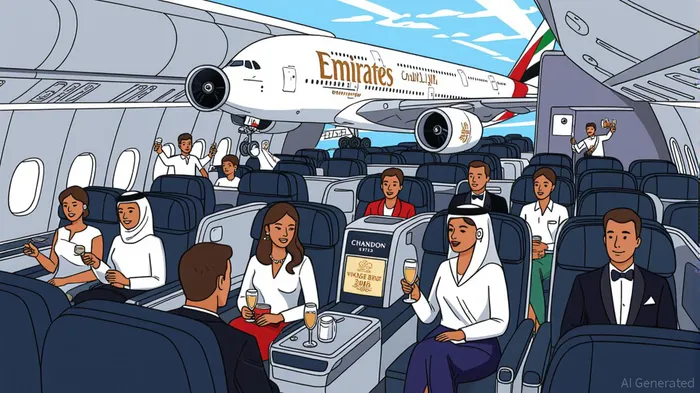
The Premium Economy Play: A Response to Shifting Demand
Emirates' decision to equip all three daily A380 flights between Dubai and JFK with Premium Economy—starting in late 2025—positions the airline to capture a growing demographic of travelers seeking comfort without the full cost of Business Class. The cabin's 56 seats, arranged in a 2-4-2 layout, offer 40 inches of pitch and 19.5 inches of width, significantly outperforming standard economy. This is not just a product upgrade; it's a calculated response to a market where passengers are willing to pay a premium for space, privacy, and curated experiences.
The airline's strategy aligns with a global trend: Premium Economy now accounts for 12% of long-haul seats, with demand growing at a 10% annual rate. For Emirates, this class is projected to yield 1.5–3 times the revenue of Economy seats, a critical factor in an industry where fuel and labor costs remain volatile. By 2026, the airline aims to offer Premium Economy on 68 destinations, including Sydney, Singapore, and Mumbai, further cementing its role as a leader in premiumization.
Strategic Retrofitting: A $5 Billion Bet on Future Revenue
Emirates' retrofit program—a $5 billion investment to upgrade 219 aircraft (110 A380s and 109 B777s)—is a testament to its confidence in this strategy. The airline is retrofitting one aircraft every three weeks, with 67 already completed. This aggressive pace is not just about capacity; it's about creating a consistent premium experience across its fleet. The A380's Premium Economy cabin, for instance, includes 13.3-inch HD screens, universal charging ports, and a menu curated by Michelin-starred chefs. These features are designed to appeal to both leisure travelers (who prioritize comfort) and business passengers (who value productivity tools like Wi-Fi and charging).
The financial logic is clear: Premium Economy bridges the gap between affordability and luxury. For example, a round-trip Premium Economy ticket from Dubai to JFK in 2025 is priced at $3,025, compared to $1,200 for Economy and $12,000 for Business. This pricing structure allows Emirates to segment its customer base effectively, maximizing revenue per seat while maintaining brand loyalty.
Broader Industry Implications
Emirates' expansion mirrors a global shift in aviation. Competitors like Singapore Airlines and Qatar Airways are also investing in Premium Economy, but Emirates' scale and brand equity give it a unique edge. The airline's ability to offer a four-class configuration on the A380—First, Business, Premium Economy, and Economy—creates a layered revenue model that rivals the flexibility of hotel chains offering different room tiers.
Moreover, the rise of Premium Economy reflects a broader consumer trend: the desire for “experiential spending.” In an era where discretionary income is increasingly allocated to travel, passengers are willing to pay for comfort that enhances their journey. This is particularly true in markets like North America and Asia, where middle-class growth is driving demand for premium services.
Investment Considerations
For investors, Emirates' Premium Economy strategy offers several compelling angles. First, the airline's retrofit program is a long-term asset that will generate higher yields per seat. Second, its focus on high-margin routes (e.g., Dubai-JFK, Dubai-Sydney) positions it to capitalize on transcontinental demand. Third, the airline's Skywards loyalty program, which offers competitive award tickets for Premium Economy, creates a sticky ecosystem that drives repeat business.
However, risks remain. Economic downturns could dampen demand for premium travel, and rising fuel costs may pressure profit margins. Yet, given the industry's shift toward premiumization and Emirates' dominant position in long-haul markets, these risks appear manageable.
Conclusion: A Model for the Future of Air Travel
Emirates' expansion of Premium Economy on the A380 is more than a product launch—it's a blueprint for the future of aviation. By investing in comfort, consistency, and customer segmentation, the airline is redefining what it means to fly long-haul. For investors, this represents a strategic opportunity to back a company that is not only adapting to market trends but also shaping them. As the industry moves toward a premium-centric model, Emirates' bold bets on Premium Economy will likely pay dividends for years to come.
In a world where air travel is no longer a luxury but a necessity, the ability to offer differentiated experiences will separate winners from losers. Emirates, with its $5 billion retrofit program and 68-destination Premium Economy network, is betting big on this reality. For those who recognize the shift early, the rewards could be substantial.

Delivering real-time insights and analysis on emerging financial trends and market movements.
Latest Articles
Stay ahead of the market.
Get curated U.S. market news, insights and key dates delivered to your inbox.


AInvest
PRO
AInvest
PRO



Comments
No comments yet