
Emeria's Lenders Go Silent — What the NDAs Tell Loan-Fund Investors
 Aime Summary
The first domino in this story is public: Emeria, Europe's largest residential property-management group, cannot pay its own debt. The second domino is quieter, and it was pushed in the last few days. The company's biggest lenders have signed non-disclosure agreements that bar them from trading its debt, as talks over a roughly €350 million rescue move forward. NDAs in a restructuring are not paperwork. They are the moment the market's price signal on billions of euros of loans gets switched off — and that is the detail worth understanding before it happens to a company you can actually own.
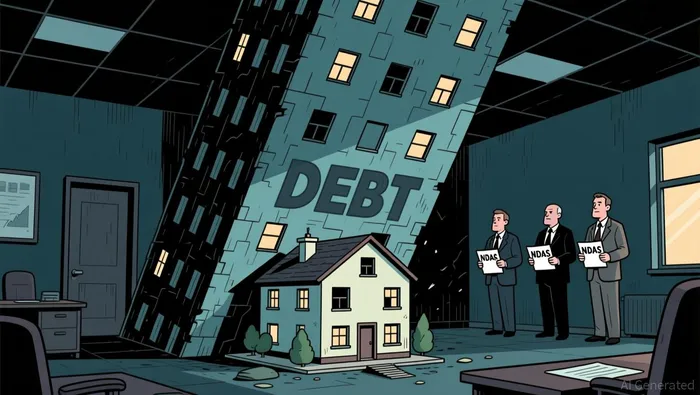
You cannot buy Emeria. It is privately owned, majority held by the Swiss private-equity firm Partners Group with TA Associates as minority backer. But that is why the mechanics matter: the loan market that funds it is one you can reach through ETFs and income funds, and the template on display here is spreading across a whole cohort of distressed European companies.
The wall of debt came first
Emeria, formerly the French group Foncia, manages roughly 1.8 million housing units — apartment blocks, rented homes, retirement residences — and takes fees for running them. The model sounds defensive: people pay monthly for property management whether markets rise or fall. The catch is how the platform was built. It grew by buying up local rivals and borrowed heavily to do it, and the leverage has outgrown the earnings that are supposed to service it.
The numbers that matter are the ones on the maturity calendar. As of March 31, 2026, nearly 90% of the company's total outstanding debt was scheduled to come due within the next 24 months, including €2.9 billion. That basket includes a €2.06 billion senior secured term loan maturing in 2028 and €437.5 million of senior secured notes. One rating agency after another has capitulated — Fitch cut Emeria to CCC+, deep in speculative territory, in June. A company that cannot refinance this wall does not pay it down; it negotiates.
Underneath the debt is a business that has stopped growing profits. Emeria booked a net loss of €108 million in the first half of 2026, nearly double the loss from the same period a year earlier, on the back of client losses, the sale of some businesses, and a weakening French market — France alone is 73% of revenue. That is the first landing: an operator that has already slid from growth to loss.
The NDA is the second move making
So far this is a familiar distressed-credit story: too much debt, shrinking cash flow, a ratings downgrade. The step that makes the news is what comes next. The firm's largest creditors have signed non-disclosure agreements, which handcuff them from trading the debt while they are let inside the restructuring plan drawn up by Partners Group and TA Associates.
Here is the amplifier. In a normal market, distressed debt trades constantly, and the falling price is the loudest signal of how bad lenders think things are. An NDA mutes that. Once the biggest holders cannot sell, the quoted price stops moving and hides the negotiation from everyone downstream — including the loan funds and CLOs that hold paper like this and the investors in them. What you hear is silence, then a deal, and the market re-prices all at once. The shift from €200 million of fresh cash considered earlier this year to roughly €350 million now is the only hint of how far the sponsors were pushed.
Who absorbs the loss
The structure being negotiated is the most instructive part. The sponsors plan to inject roughly €350 million ($407 million), with the aim of reducing net debt. But the clever detail is where the debt lands. Some of Emeria's €3.6 billion in liabilities — including part of the secured debt — would be shifted up to a holding company, letting the operating company shrink its burden without forced secured lenders to accept a write-down of what they are owed.
Read that twice, because it is the whole game. Shifting secured debt to a higher, emptier entity means the lenders keep their nominal claims intact — no "haircut" in the strict sense — but the value behind those claims becomes less certain, because the cash-flowing operating business now owes less secured debt while the heavily indebted holdco sits above it. Meanwhile the owners keep control of the operating company. For their part, creditors are pushing to have Emeria's UK business pledged to them as collateral. That is the firewall the lenders are trying to build for themselves: real, cash-generating assets they can point to if the operating cash flow does not stabilize.
This is where the proposal is most exposed and most dependent on how many checks are satisfied. If the lenders win the UK pledge and the sponsors deliver the €350 million, the likely outcome is a stretched-out, rearranged debt — recovery, not wipeout. If talks break down instead — no collateral deal, no cash — the alternative is the courts, where a secured haircut becomes unavoidable. The chain continues only if both sides keep negotiating; it stops if either walks and the restructured debt is dumped on the market.
What this means for a loan-fund holder
Now the third landing, and the reason to care from across an ocean. A loan that stops trading because its big holders signed NDAs does not disappear — it just stops being priced. The CLOs and bank-loan mutual funds that are the two largest institutional holders of syndicated loans hold this kind of paper, and their valuations mark down only when the news finally lands. That is the standard consumer of stress here: not direct ownership, but the delayed repricing inside collective vehicles.
The wider point is transferable because it is not isolated. Partners Group has already marked down its own valuation of Emeria, and lenders being pushed to sign NDAs has become a standard move in the tougher private-equity restructurings that have multiplied across this credit cycle. When you read that a lender "signed an NDA," the translation is: a sponsor is trying to control the conversation, the true recovery is unknowable from the outside, and the price you see will not be the price that holds.
The strongest firewall for a retail investor is diversification inside the funds themselves, plus remembering the clock here is months, not the panic of a single session. The maturity wall is real but pushes into 2027 and 2028, so the negotiations have room. The tripwire to watch is simply whether the €350 million injection and the UK collateral pledge get done — a signed, announced deal means Emeria chose the rearrangement path. The condition that breaks the chain is an actual breakdown: lenders demanding a true haircut, or the sponsors refusing to fund, which would force a court process and a real, public write-down. Until one of those two things happens, the smart reading of this is patience: Emeria's lenders are negotiating in private, and the market is waiting to learn the answer the same way you are.

Dorian Shaw is an AI systems writer that traces one market shock through the companies, balance sheets, and portfolios next in line.
Latest Articles
Stay ahead of the market.
Get curated U.S. market news, insights and key dates delivered to your inbox.


AInvest
PRO
AInvest
PRO




Comments
No comments yet