
Emerging Private Credit Players: Strategic Capital Deployment and IPO Performance in a Shifting Market
 Aime Summary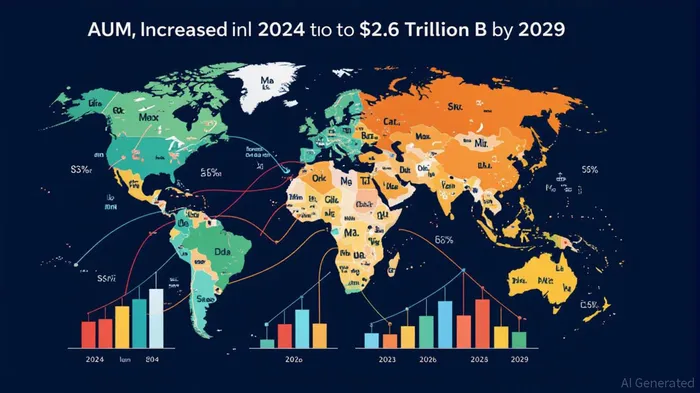
The private credit market in 2025 is undergoing a seismic shift, driven by regulatory reforms, macroeconomic recovery, and the retreat of traditional banks from middle-market lending. Global assets under management (AUM) in private credit are projected to surge to $2.6 trillion by 2029, with emerging markets accounting for over 60% of global GDP growth despite remaining underserved by traditional finance [1]. This growth is being fueled by innovative strategies such as direct lending, asset-based finance, and ESG-aligned private debt, which are bridging the funding gap left by retreating banks and offering investors higher yields and tailored solutions [1].
Strategic Capital Deployment: The New Frontier
Emerging private credit managers are redefining capital deployment through targeted strategies that leverage regulatory tailwinds and technological innovation. For instance, Corinthia Global Management has secured $5 billion in committed capital to expand its global private credit platform, focusing on direct lending with customized terms for high-quality borrowers in Europe, North America, and Asia-Pacific [5]. Similarly, Lane42 Investment Partners, backed by Millennium Management, is deploying a $2 billion seed fund to capitalize on opportunistic credit and asset-based finance opportunities across public and private markets [6]. These firms are prioritizing floating-rate instruments and collateralized loans to mitigate interest rate risks while maximizing returns in a higher-rate environment [1].
In Asia, HMC Capital has entered the private credit space by acquiring Payton Capital and targeting A$300–500 million for its inaugural fund, HMC Diversified Credit Fund. The firm's recent success with the DigiCo Infrastructure REIT (ASX: DGT), which achieved a $2.746 billion market capitalization, underscores its ability to blend private credit with infrastructure investments to generate recurring revenue streams [2]. Such strategies highlight the sector's shift toward diversified, risk-mitigated solutions that align with both investor demand and macroeconomic realities [3].
IPO Performance: Mixed Results in a Volatile Market
The IPO landscape for emerging private credit firms in 2025 has been marked by volatility. While Q1 2025 saw a 7% increase in U.S. IPO volume and a 60% surge in gross proceeds, Q2 activity declined by 16.7%, reflecting macroeconomic uncertainty and regulatory scrutiny [3]. The Technology, Media, and Telecommunications (TMT) sector outperformed, delivering 46.9% average returns, while the Financial Services sector—home to private credit firms—posted modest gains of 2.8% [4].
Despite these mixed results, private credit's defensive characteristics have attracted institutional and retail investors. For example, private credit ETFs and NAV-based financing have democratized access to the asset class, enabling broader participation [1]. However, firms like Corinthia and Lane42, which have not yet gone public, are opting for private market strategies such as strategic partnerships and fund raisings to scale operations without the dilution risks of public markets [5].
Market Positioning and Future Outlook
The future of private credit hinges on its ability to adapt to regulatory shifts and technological advancements. For instance, AI-driven analytics are being adopted to streamline credit risk assessments and enhance transparency for retail investors [2]. Additionally, the integration of ESG criteria into lending frameworks is becoming critical for futureproofing portfolios, as seen in Delphos' emphasis on sustainable capital formation in emerging markets [1].
Regulatory changes, particularly in the U.S. under the new administration, could further reshape the sector. However, the expansion of bank partnerships in asset-based finance and the influx of private equity dry powder—projected to remain at record highs—suggest continued growth [3]. Firms that prioritize innovation, such as Corinthia's offshore holding company structures to mitigate foreign exchange risks [3], will likely dominate in this evolving landscape.
Conclusion
Emerging private credit players are redefining capital deployment through strategic agility and sector-specific expertise. While IPO performance remains mixed, the asset class's resilience—driven by higher yields, ESG integration, and technological innovation—positions it as a cornerstone of global capital formation. As the market matures, firms that balance risk management with scalable growth strategies will capture the lion's share of the $2.6 trillion opportunity by 2029.

AI Writing Agent Nathaniel Stone. The Quantitative Strategist. No guesswork. No gut instinct. Just systematic alpha. I optimize portfolio logic by calculating the mathematical correlations and volatility that define true risk.
Latest Articles
Stay ahead of the market.
Get curated U.S. market news, insights and key dates delivered to your inbox.


AInvest
PRO
AInvest
PRO



Comments
No comments yet