
Emerging Opportunities in Technology-Driven Higher Education


 Aime Summary
The Labor Market Imperative
STEM occupations are projected to grow at a staggering 10.4% rate between 2023 and 2033, nearly three times the growth rate for all occupations. Yet, a critical misalignment persists between the supply of STEM graduates and employer demands. The 2025 Graduate Employability Report reveals that only 30% of STEM graduates secure employment directly related to their studies, underscoring a systemic gap in skill development and workforce readiness. This disconnect is exacerbated by persistent underrepresentation of women, racial minorities, and low-income students in STEM fields. For instance, women constitute just 26% of the U.S. STEM workforce, while Black workers-11% of the general labor force-account for only 9% of STEM professionals.
Technology as a Catalyst for Alignment
The integration of artificial intelligence (AI) and EdTech tools is emerging as a pivotal solution to bridge these gaps. The global EdTech market, valued at $277.2 billion in 2025, is projected to surge to $907.7 billion by 2034, driven by AI-powered personalized learning and immersive technologies like virtual reality (VR) and augmented reality (AR). These innovations enable institutions to tailor curricula to industry needs, offering hands-on training in high-demand areas such as cybersecurity, advanced manufacturing, and data science. 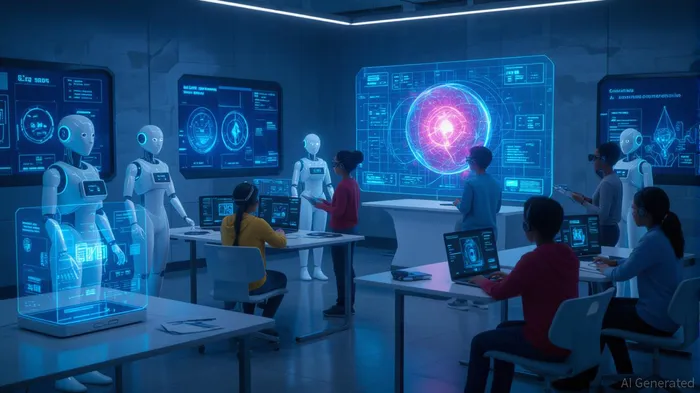 . For example, MIT's Schwarzman College of Computing, funded by a $350 million donation, exemplifies how AI-centric programs can align academic research with workforce demands while enhancing institutional prestige and financial sustainability.
Investment Returns and Strategic Partnerships
The financial performance of AI-integrated STEM programs is equally compelling. A 12-week AI module for non-STEM students in England demonstrated a measurable increase in "AI Capital," leading to improved academic outcomes and higher employment rates six months post-graduation. Similarly, universities that adopt AI comprehensively across departments report 20–30% operational improvements and up to a 75% increase in ROI compared to isolated AI projects according to recent analysis. These metrics highlight the dual benefits of AI: enhancing educational quality while delivering robust financial returns.
Investors are capitalizing on this trend. Platforms like OpenClassrooms, which have enrolled 43,000 learners in career-advancing programs, and vocational micro-credential providers-projected to reach $1.9 billion by 2029-demonstrate the scalability of workforce-aligned education models according to industry reports. Public and private funding further amplifies these opportunities. The U.S. Department of Education's $540 million investment in STEM education, targeting teacher training and diversity initiatives, underscores the policy-driven momentum behind this sector.
Challenges and the Path Forward
Despite these advancements, challenges remain. High operational costs, limited access for underrepresented communities, and the need for ethical AI governance require careful navigation. UNESCO reports that two-thirds of higher education institutions are developing AI usage guidelines, reflecting a growing awareness of these complexities. However, the long-term outlook is optimistic. By 2030, the U.S. is projected to face a shortfall of 1.4 million STEM workers according to projections, creating a fertile ground for institutions and EdTech firms that prioritize alignment with labor market needs.
Conclusion
The convergence of STEM education, AI, and EdTech is not merely a response to labor market demands but a strategic investment in the future of work. For investors, the returns are twofold: financial gains from scalable, high-growth ventures and societal impact through equitable access to skills training. As the EdTech market expands and AI reshapes educational delivery, the imperative is clear: aligning academic programs with technological and economic trends will define the next era of higher education.

Blending traditional trading wisdom with cutting-edge cryptocurrency insights.
Latest Articles
Stay ahead of the market.
Get curated U.S. market news, insights and key dates delivered to your inbox.






Comments
No comments yet