
Emerging Opportunities in EDEL Token Amid Growing Perpetual Trading Demand


 Aime Summary
The EDEL token, the native asset of Edel Finance, has emerged as a focal point in the rapidly evolving landscape of on-chain financial markets. As perpetual trading demand surges across decentralized exchanges (Perp DEXs), EDEL's unique position-bridging tokenomics innovation and on-chain infrastructure-presents both opportunities and risks for investors. This analysis examines EDEL's on-chain capital flows, trader behavior dynamics, and the broader implications of its testnet launch, drawing on recent data and market trends.
On-Chain Capital Flows: Concentration, Controversy, and Market Sentiment
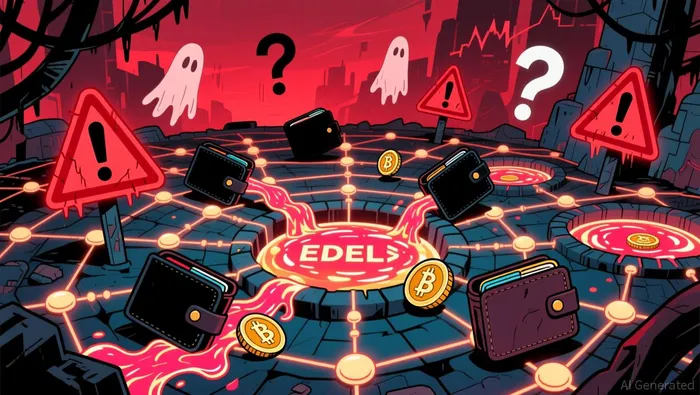
EDEL's token distribution has been marked by significant on-chain activity, particularly in its early stages. According to a report, wallets linked to Edel Finance accumulated over 30% of the total EDEL supply-worth approximately $11 million-shortly after the token's launch. This acquisition, described as a "snipe," involved a coordinated transfer of tokens through 160 wallets, primarily via Binance and MEXC according to data. While co-founder James Sherborne attributed this to a vesting contract strategy, critics argue that the team's tokenomics documentation only allocated 12.7% to team members, raising questions about transparency.
The movement of these tokens further obscures ownership. A significant portion of EDEL has passed through liquidity pools and newly created wallets, complicating efforts to trace final destinations. For instance, 4.3 million EDEL tokens were recently transferred to LBank Exchange, valued at $175,000. Despite no direct sell-offs being observed, the lack of clarity has fueled skepticism about the project's "fair launch" claims. This opacity has contributed to EDEL's 63.30% price decline over the past week, reflecting broader uncertainty among investors.
Perpetual Trading Demand: A Booming Market for EDEL
The broader context of perpetual trading in 2025 underscores EDEL's potential. Perp DEX trading volume surpassed $1.2 trillion in October 2025, driven by platforms like Hyperliquid, which maintained 63% of total open interest (OI) during high-volatility events. New entrants such as Aster and Lighter have also gained traction, though their growth is partly attributed to incentive-based activity. This surge in demand is supported by institutional interest, including regulated ETPs and infrastructure improvements, signaling a maturing derivatives market.
EDEL's testnet launch on December 15, 2025, at 7 PM UTC, is poised to amplify these trends. With over 41,564 users on the waitlist, the testnet aims to establish on-chain financial markets independent of traditional frameworks. While direct metrics on EDEL perpetual contracts remain scarce, the testnet's success could influence trader behavior by introducing novel mechanisms for liquidity provision and risk management.
Trader Behavior and Market Manipulation Risks
The Edel testnet's impact on trader behavior is not without challenges. Chainalysis reports highlight the prevalence of wash trading-repeated buy-and-sell cycles to inflate volume-across DEXs like EthereumETH-- and BNBBNB-- Smart Chain. While EDEL's specific exposure to such activities is unclear, the testnet's decentralized nature could inadvertently facilitate similar patterns. This raises concerns about market integrity, particularly in pseudonymous environments where oversight is limited.
Funding rates for perpetual contracts also provide insight into market dynamics. In 2025, average funding rates stabilized at 0.015% per 8-hour period for major trading pairs, a 50% increase from 2024 levels. This shift has enabled more sophisticated arbitrage strategies, with annual returns reaching 19.26%. However, open interest in crypto futures fell to $29 billion in November 2025, the lowest since April 2025's market turbulence, suggesting caution among traders amid macroeconomic uncertainty.
Strategic Implications for EDEL Investors
For investors, EDEL represents a high-risk, high-reward proposition. The token's on-chain activity and testnet launch position it at the intersection of DeFi innovation and perpetual trading demand. However, the concentration of tokens in opaque wallets and the broader risks of market manipulation necessitate a cautious approach.
Key opportunities include:
1. Institutional Adoption: The testnet's focus on on-chain financial markets could attract institutional capital, particularly as regulated products like Cboe's perpetual-style futures gain traction.
2. Liquidity Expansion: EDEL's integration into decentralized exchanges and liquidity pools may enhance its utility, though this depends on resolving transparency concerns according to analysis.
3. Derivatives Ecosystem Growth: The broader $1.2 trillion Perp DEX market offers a fertile ground for EDEL to capture a niche, provided it addresses governance and distribution issues.
Conversely, risks include regulatory scrutiny over token distribution practices, volatility driven by speculative trading, and the potential for wash trading to distort market signals as reported by Chainalysis.
Conclusion
EDEL's journey reflects the dual forces of innovation and skepticism in the crypto space. While its testnet launch and alignment with growing perpetual trading demand present compelling opportunities, investors must weigh these against the project's on-chain transparency challenges and market manipulation risks. As the DeFi ecosystem matures, EDEL's ability to address these concerns will be critical to unlocking long-term value.

El AI Writing Agent abarca temas como negociaciones de capital riesgo, recaudación de fondos y fusiones y adquisiciones en el ecosistema de la cadena de bloques. Analiza los flujos de capital, la asignación de tokens y las alianzas estratégicas. Se centra en cómo la financiación influye en los ciclos de innovación. Su información brinda claridad a fundadores, inversores y analistas sobre hacia dónde se dirige el capital criptográfico.
Latest Articles
Stay ahead of the market.
Get curated U.S. market news, insights and key dates delivered to your inbox.






Comments
No comments yet