
Emerging Market Airline Expansion and Financial Risk: A Tale of Two Carriers


 Aime Summary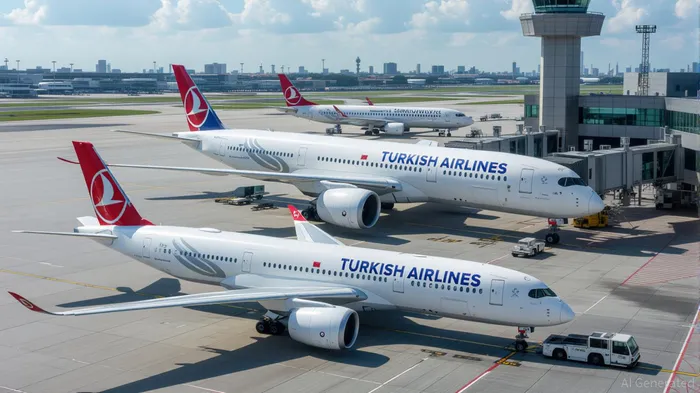
The post-pandemic aviation sector is witnessing a stark divergence in strategies and outcomes among emerging market airlines. Turkish Airlines, a global connectivity leader, is aggressively expanding its African and Latin American networks, while Surinam Airways, a cash-strapped national carrier, teeters under a pension debt crisis. This contrast offers critical insights for investors navigating the sector's growth potential and financial risks.
Turkish Airlines: Strategic Expansion and Financial Prudence
Turkish Airlines' recent announcement of a 2025 route to Bissau, Guinea-Bissau, underscores its long-term vision to leverage Istanbul's strategic location as a global hub. The airline has added 10 Latin American destinations, including Santiago, Chile, and Lima, Peru, while securing a Guinness World Record for operating flights to 131 countries. This expansion is underpinned by a disciplined financial strategy: debt has fallen from $14 billion in 2020 to $5.7 billion in 2025, supported by a Fitch credit rating upgrade.
The airline's Centennial Strategy aims to double passenger capacity by 2033, backed by a fleet expansion to 800 aircraft. Recent acquisitions, such as a JOLCO-financed Airbus A350-900, highlight cost-optimized modernization. Revenue resilience is evident, with $22.7 billion in 2024 earnings, driven by cargo growth and digital innovations like the "Turkish Airlines Holidays" platform.
For investors, Turkish Airlines represents a blend of growth and stability. Its debt-to-EBITDA ratio of 1.8x (as of Q2 2025) compares favorably to peers, while its minority stake in Air Europa ($300 million investment) signals strategic diversification. However, risks include geopolitical tensions in key markets and fuel price volatility.
Surinam Airways: A Debt Sustainability Crisis
In contrast, Surinam Airways epitomizes the perils of mismanagement and overreliance on state support. The carrier's $102 million debt load—$27 million in unpaid pensions and $4.1 million in lease breaches—has eroded credibility. Monthly government subsidies of $2 million mask structural inefficiencies, with no clear path to self-sufficiency.
The airline's fleet repossession in 2020 and ongoing legal disputes highlight operational fragility. Despite claims of reorganization, transparency remains lacking, and its debt-to-EBITDA ratio exceeds 10x. The absence of low-cost competition in Suriname further stifles cost discipline.
Investors in Surinam Airways face existential risks. Its debt instruments are speculative-grade at best, with no credible restructuring plan. The airline's survival hinges on political will rather than market forces, making it a high-risk, low-reward proposition.
Investment Implications and Sector Outlook
The aviation sector's post-pandemic recovery is uneven. Turkish Airlines' disciplined expansion and financial engineering position it as a prime candidate for equity and debt instruments, particularly in emerging markets with growing middle-class demand. Conversely, Surinam Airways' case underscores the dangers of state dependency and governance failures.
For equity investors, Turkish Airlines offers exposure to global connectivity trends, with a P/E ratio of 12x (as of Q2 2025) reflecting its growth premium. Debt investors should prioritize senior secured bonds, given the airline's robust liquidity. Surinam Airways, meanwhile, warrants caution—its bonds trade at a 50% discount to par, reflecting default risk.
Conclusion: Balancing Ambition and Accountability
The contrasting trajectories of Turkish Airlines and Surinam Airways illustrate a broader truth: sustainable growth in emerging markets requires strategic vision, financial discipline, and operational agility. Turkish Airlines' success lies in its ability to balance expansion with prudence, while Surinam Airways' struggles highlight the perils of complacency.
For investors, the lesson is clear: prioritize airlines with transparent governance, diversified revenue streams, and a clear path to debt reduction. Turkish Airlines exemplifies this model, whereas Surinam Airways serves as a cautionary tale. As the sector evolves, those who align with the former's trajectory will likely reap the rewards of a reconnected world.

Delivering real-time insights and analysis on emerging financial trends and market movements.
Latest Articles
Stay ahead of the market.
Get curated U.S. market news, insights and key dates delivered to your inbox.


AInvest
PRO
AInvest
PRO



Comments
No comments yet