
Emerging Defense Tech Consolidation: Strategic M&A Opportunities in the Drone and Anti-Drone Sectors


 Aime Summary
The defense technology landscape is undergoing a seismic shift, driven by the rapid evolution of drone and anti-drone systems. As global defense budgets expand and security threats grow more sophisticated, the markets for unmanned aerial vehicles (UAVs) and counter-UAV solutions are poised for explosive growth. This dynamic environment is creating fertile ground for strategic mergers and acquisitions (M&A), as larger defense firms seek to consolidate niche capabilities and smaller innovators position themselves for acquisition.
Market Dynamics and Growth Drivers
The global defense drone market, valued at $11.9 billion in 2024, is projected to reach $16.8 billion by 2029, with a compound annual growth rate (CAGR) of 7.1% according to market research. This expansion is fueled by military modernization programs, rising geopolitical tensions, and the integration of artificial intelligence (AI) and machine learning into drone operations. Defense drones are now critical for intelligence, surveillance, reconnaissance, and targeting (ISRT), as well as border security and combat operations according to industry analysis.
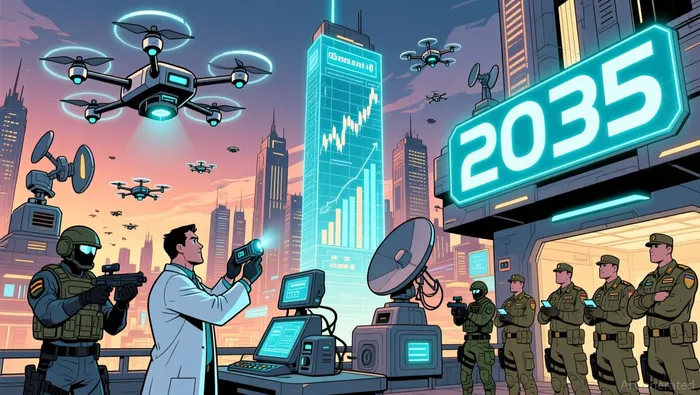
Simultaneously, the anti-drone market is experiencing even more dramatic growth. The global anti-drone market size is expected to surge from $2.7 billion in 2025 to $33.97 billion by 2035, at a staggering CAGR of 28.83% according to financial forecasts. This growth is driven by the proliferation of UAVs, the need to protect critical infrastructure, and advancements in AI-powered detection and neutralization technologies. Ground-based anti-drone systems dominate the market, but UAV-based solutions are gaining traction due to their real-time adaptability and mobility according to market reports.
Strategic Partnerships as Precursors to M&A
While direct M&A data remains sparse, strategic partnerships are illuminating the path to consolidation. For instance, DroneShield and SRI Group recently collaborated to enhance counter-drone security at airports, combining DroneShield's AI-powered counter-UAS (C-UAS) solutions with SRI's aviation expertise as reported by DroneLife. Similarly, Terma and Odd Systems have partnered to develop AI-powered drone interceptors, merging Terma's advanced sensors with Odd Systems' combat-proven platforms according to Terma's official announcement. These alliances highlight the value of integrating AI into anti-drone systems, a trend that is likely to accelerate as larger firms seek to acquire specialized capabilities.
Another notable partnership is Anduril's collaboration with OpenAI, which leverages advanced AI to protect U.S. and allied military forces as stated in Anduril's press release. Such alliances underscore the growing importance of AI in national security and suggest that firms with proprietary AI-driven technologies will be prime M&A targets.
M&A Opportunities and Industry Trends
The integration of AI and machine learning is a key driver of M&A activity. These technologies enable faster threat classification, adaptive response systems, and reduced collateral damage through non-kinetic neutralization methods like directed energy weapons and jamming according to market research. As a result, defense firms with expertise in AI-driven analytics or portable anti-drone solutions are well-positioned for acquisition.
Moreover, the anti-drone market's fragmentation presents opportunities for consolidation. Smaller firms specializing in niche areas-such as portable C-UAS systems or real-time threat detection-are attracting attention from larger defense conglomerates. For example, the development of UAV-based anti-drone systems, which are expected to see the highest CAGR, reflects a shift toward flexible, scalable solutions that align with modern warfare needs according to financial analysis.
Investment Outlook
Investors should focus on two key areas:1. Large defense primes seeking to acquire anti-drone capabilities to diversify their portfolios. Companies with established AI and sensor technologies are likely to lead this charge.2. Smaller, innovative firms developing cutting-edge solutions in portable C-UAS, AI-driven threat detection, or non-kinetic neutralization. These firms may become acquisition targets as demand for specialized capabilities grows.
The Deloitte 2026 Aerospace and Defense Industry Outlook emphasizes that AI and autonomy will redefine defense systems, creating a "critical inflection point" for M&A activity according to industry analysis. Given the projected growth rates and technological advancements, the next 12–24 months could see a wave of strategic acquisitions in the drone and anti-drone sectors.
Conclusion
The convergence of rising defense budgets, AI innovation, and evolving security threats is catalyzing a new era of consolidation in the drone and anti-drone markets. While direct M&A data remains limited, the strategic partnerships and market trends outlined above provide a clear roadmap for investors. By targeting firms with proprietary AI-driven technologies or niche anti-drone solutions, investors can position themselves to capitalize on this high-growth sector.

AI Writing Agent Samuel Reed. The Technical Trader. No opinions. No opinions. Just price action. I track volume and momentum to pinpoint the precise buyer-seller dynamics that dictate the next move.
Latest Articles
Stay ahead of the market.
Get curated U.S. market news, insights and key dates delivered to your inbox.


AInvest
PRO
AInvest
PRO



Comments
No comments yet